
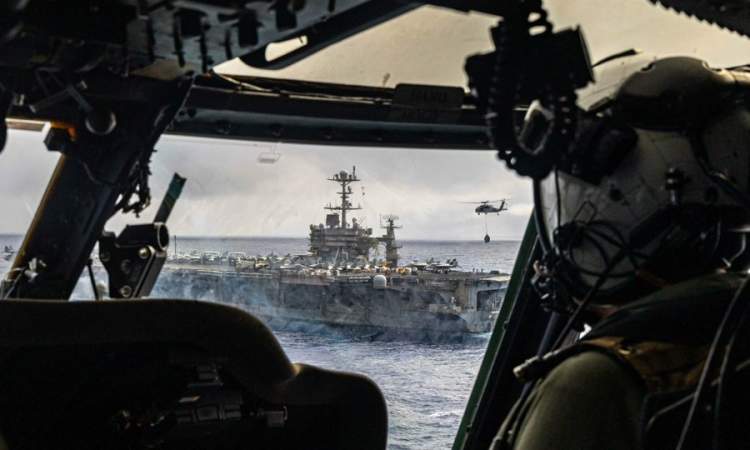
U.S. Navy Investigations: Yemen Put the “Harry S. Truman” on the Brink of Disaster
The story of the U.S. aircraft carrier Harry S. Truman in the Red Sea is no longer just about a superpower deploying its fleet to punish Yemen.
Official investigations released by the U.S. Navy on 4 December 2025 paint a very different picture: four serious incidents between late December 2024 and early May 2025, during which the Navy lost three F/A-18 Super Hornet fighters and the carrier collided with a commercial vessel near Port Said. All of these incidents, the investigations concluded, were “preventable.”
But what matters to Yemeni observers is not only the technical side, but the context: all of this happened while the Harry S. Truman and her strike group were conducting daily strikes on Yemen and continuously facing Yemeni ballistic missiles, anti-ship missiles, and attack drones, as part of what the Navy called Operation “Roch Rider,” which involved 52 straight days of air operations.
The investigations, carried out by a number of senior officers—including Rear Admiral Kavon Hakimzadeh, Rear Admiral Todd Whalen, Vice Admiral John Gumbleton, and Rear Admiral Shawn Bailey—focused on four critical events:
On 22 December 2024, the cruiser USS Gettysburg fired two SM-2 missiles at two friendly U.S. aircraft in the Red Sea.
On 12 February 2025, the carrier itself collided with a commercial tanker near Port Said.
On 18 April 2025, a Super Hornet fell from the hangar into the sea while maneuvering to evade a Yemeni ballistic missile.
And on 6 May 2025, the carrier’s arresting gear failed, causing another fighter to crash into the Red Sea.
In every case, the investigating officers wrote almost the same phrase: “This mishap was preventable.”
Yemen in the Background: 52 Days of Constant Pressure
From the moment the Harry S. Truman left Norfolk in September 2024 heading for the Middle East, the declared mission was participation in Operation “Prosperity Guardian,” under the pretext of protecting navigation after the 7 October 2023 attack and Yemen’s targeting of ships linked to Israel and the United States.
But once the strike group entered the Red Sea in December 2024, the tempo shifted to what Navy officials later described as a “high operational tempo,” with sailors “repeatedly coming under fire from drones and missiles launched by Houthi forces based in Yemen.”
In the final phase of the deployment, under the name Operation “Roch Rider,” the carrier and Carrier Air Wing 1 conducted continuous flight operations for 52 consecutive days, while at the same time facing ballistic missiles, anti-ship missiles, and one-way attack drones. This environment was not just background noise; it was a direct source of pressure on crews and systems—a factor the Navy itself acknowledged in a press briefing, even as it tried to highlight what it called the “overall good performance” of the strike group.
22 December: When the Cruiser Gettysburg Shot Down the Carrier’s Own Plane
The first incident—and the most symbolically revealing of organizational dysfunction—occurred in the early hours of 22 December 2024. The day before, the Harry S. Truman had launched waves of Super Hornets to strike targets inside Yemen, while cruisers and destroyers were tasked with protecting the formation in the Red Sea.
The Yemeni response came, according to the investigation text itself, “earlier than expected,” in the form of waves of anti-ship missiles and suicide drones. This forced the command to intensify Defensive Counter-Air (DCA) missions and re-task aircraft originally meant for strike missions to defend the formation. Within just four hours, the number of DCA sorties jumped from six planned sorties to fourteen, flown by eleven aircraft.
In this threat-saturated environment, the cruiser USS Gettysburg was acting as the formation’s Air Defense Commander. Yet the investigation reveals that this very cruiser was never truly integrated into the group: in the 45 days leading up to the incident, it had operated with the carrier strike group for only seven days. A ten-day integrated training exercise had been cut down to just two days due to a shortage of replenishment ships.
The chief of staff of Carrier Strike Group 8 told investigators bluntly: “We never got the chance to learn integration… we needed more than two days.”
The report adds that “the strike plan and the associated air defense plan were not well understood aboard Gettysburg,” and that the watch team in the Combat Information Center (CIC) did not know the timing of the operation, the return routes of the aircraft, or how they were supposed to respond to expected threats. On top of that, several Identification Friend or Foe (IFF) systems aboard the cruiser were switched off or inoperative—and the carrier had not been informed.
At around 1:40 a.m., Gettysburg reported that the area was clear of hostile targets, but DCA aircraft remained in the ai