
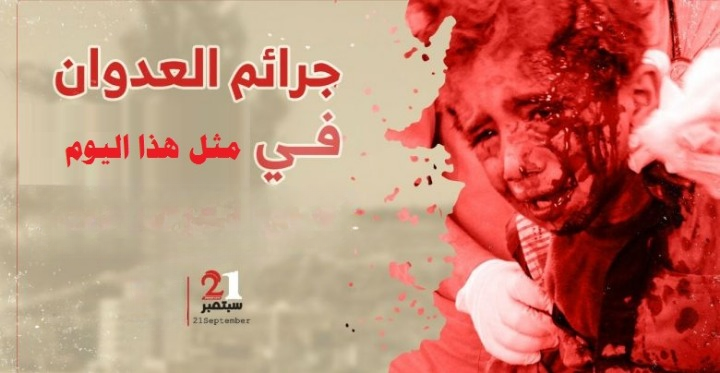
November 11: A Memory of Fire and Ash in the Record of the U.S.–Saudi–Emirati Aggression
On this day each year, the wounds of the Yemeni people reopen as memories of blood and devastation return — reminders that the U.S.–Saudi–Emirati aggression against Yemen was never merely a military war, but a comprehensive crime targeting people, land, and every aspect of life.
From 2015 to 2022, November 11 has witnessed a series of bloody massacres carried out by coalition warplanes and their mercenaries across multiple Yemeni provinces — events that stand as grim testimony to the unparalleled brutality of this war against a free nation.
2015: Blood in Shabwah, Ruins in Sana’a and Saada
On November 11, 2015, coalition airstrikes killed three civilians from one family, including two women, in the al-Sa’idat area of Bayhan District, Shabwah.
In Sana’a, airstrikes destroyed a mosque in Waalan, Bani Dhibyan District, and hit al-Mukair area six times, damaging homes and farmland.
In Saada, warplanes bombed Saada University buildings four times, pounded Nashour and al-Safra, and carried out more than 15 airstrikes on al-Raboua (Asir), along with heavy artillery shelling on Haradh (Hajjah) using over 45 Katyusha rockets.
2016: Escalation and Repeated Civilian Targets
In 2016, the aggression continued its campaign with airstrikes on Hayd bin Aqil and al-Safra in Asilan, Shabwah, and further raids on Shada, Kitaf, and al-Dhahir in Saada, as well as strikes on Qamar village in Jizan.
2017: Fishermen Martyred and Bombing of the Capital and Hodeidah
On November 11, 2017, coalition aircraft committed one of the most heinous massacres at sea — striking two fishing boats near al-Badi’ Island in the Red Sea, killing eight fishermen and wounding eight others.
In Sana’a, two airstrikes hit the al-Ardi neighborhood behind al-Shohada Mosque, destroying four homes and injuring eight civilians. The attacks also extended to Saada, Najran, Hajjah, and Nihm, showing a deliberate expansion of the killing zones across all fronts.
2018: Death at Hodeidah’s Doorstep
A citizen was killed and six others injured when coalition aircraft bombed a house in the al-Halqa area of Hodeidah’s al-Hali District. Mercenary shelling targeted al-Khamseen Street, while additional airstrikes struck Haraf Sufyan (Amran) and Razeh (Saada), destroying farms and property and devastating border villages.
2019: Mercenary Shelling on Hodeidah and Saada
On November 11, 2019, coalition mercenaries intensified shelling on al-Jah, al-Durayhimi, and Hays in Hodeidah with over 13 artillery shells, while Saudi artillery and rockets targeted populated villages in Razeh District, Saada.
2020: Heavy Air Raids on Marib, Jawf, and Hodeidah
In 2020, coalition warplanes launched more than 18 air raids on Majzar, Madghal, Rahba, and Khub wa al-Sha’af in Marib and Jawf, plus a strike on al-Buqa, near Najran.
Armed spy drones conducted three airstrikes on al-Tuhayta (Hodeidah), amid continuous rocket and artillery attacks across the province.
2021: Repeated Crimes in Saada, Sana’a, and Marib
On November 11, 2021, two civilians were killed and others wounded by Saudi artillery fire on Shada and Monabbih border districts. Coalition warplanes bombed Sahar, Majz, and Kitaf in Saada, as well as al-Thawra and al-Sabeen districts in Sana’a, Raymat Hamid (Sanan), and Haraf Sufyan (Amran).
In Marib, over 16 air raids struck al-Jubah and Sirwah, while mercenaries launched over 249 artillery shells on civilians in Hodeidah.
2022: Ongoing Aggression Despite a “Truce”
Despite the so-called truce, November 11, 2022, saw renewed attacks in Hodeidah, where mercenaries shelled al-Tuhayta, al-Jabaliyah, and Hays with artillery and gunfire — a clear violation of the ceasefire and proof that the aggression’s military and economic war against Yemen was far from over.
An Unforgettable Memory and an Unbroken People
The crimes committed on November 11 each year are but one fragment of the thousands of atrocities carried out by the U.S.–Saudi–Emirati war machine against the Yemeni people.
Despite the immense suffering and years of open wounds, Yemenis remain steadfast, holding to their promise of resistance. They understand that the blood of the martyrs is the seed of victory — and that from the fire and ashes, the path to liberation and justice continues.