
European Website: Yemen’s Low-Cost Strategies Prove More Effective Than Western Fleets
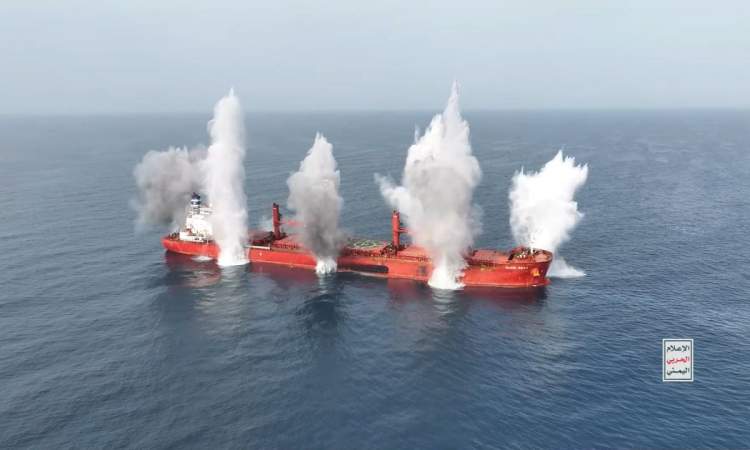
The European website Modern Policy stated that the Yemeni army’s attacks on vessels linked to the Israeli entity in the Red Sea revealed a major shift in the nature of modern conflicts, proving that low-cost, asymmetric combat strategies are more effective than the advanced Western naval fleets.
In a report published Sunday, the website said that the Yemeni army’s maritime operations in the Red Sea “have demonstrated that asymmetric strategies are often more effective than the traditional military power of states.” It added that “this phenomenon represents a major shift in the nature of modern conflicts,” noting that actors today are “capable of reshaping global strategic calculations at a far lower cost.”
According to the report, “the Yemeni army’s operations reflect the failure of the conventional security model and affirm the need to understand irregular threats as a decisive factor in contemporary geopolitical dynamics.”
It argued that “the Yemeni army’s success lies in using asymmetric strategies that combine low cost, high flexibility, and significant strategic impact. Unlike 20th-century insurgencies that relied on guerrilla warfare, the Yemeni army escalated its threat level by deploying suicide drones, ballistic missiles, and low-cost surveillance systems, directing these inexpensive weapons at commercial vessels worth billions of dollars.”
The report continued: “When a single drone damages or threatens a commercial vessel, dozens of global companies are forced to reroute, increasing logistical costs and creating widespread economic risks.”
According to the analysis, “asymmetric strategies operate by avoiding the opponent’s primary strengths and striking at vulnerabilities that render those strengths irrelevant. This is exactly what happened in the Red Sea: the superiority of modern warships becomes worthless when the threat comes from small drones that are hard to track and inexpensive to replace.”
The report explained that “the limited ability of major naval powers to respond to these attacks highlights flaws in traditional defense doctrine. The United States and the United Kingdom deployed advanced combat fleets, yet the Houthis’ attacks continued and struck strategic targets.”
It also considered that “the Houthis’ strategic power does not stem solely from their military capabilities, but also from their ability to exploit global economic interconnectivity through the Red Sea route.” The report noted that the attacks had a massive psychological impact: “When a strike occurs, dozens of major companies immediately review their maritime routes. This fear has an economic effect far greater than the physical damage inflicted on targeted vessels.”
It added: “Strategically, the Houthis realized that creating uncertainty is a cheap and highly effective strategic weapon.”
The report concluded that “the Red Sea crisis underscores the urgent need for a radical shift in global security strategy. States can no longer rely on international deterrence as a fundamental pillar.” It noted that “the Houthis’ attacks are not merely a disruption to international trade, but a harbinger of a profound realignment in the global security order.”
It ended by stating that “asymmetric strategies have undermined state dominance and exposed the unpreparedness of international security structures in confronting irregular threats.”