
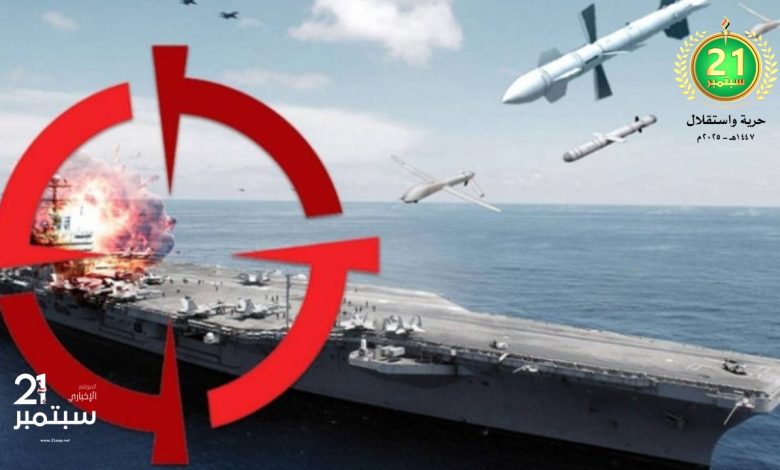
September 21… The Revolution that Shattered the American Myth and Turned Washington’s Technological Superiority into a Strategic Burden
Yemen has never been an easy arena for invaders. Yet what has unfolded since the dawn of the September 21 Revolution far surpassed all expectations, announcing the birth of a new political and military equation in the region: an equation of national sovereignty that liberated Yemen’s political decision from American and Gulf dominance, and enabled Yemen—relying on its own capabilities—to impose its own rules over one of the most important international waterways in the world.
The American myth collapsed—by land, sea, and air—at the hands of a people besieged for a decade. The Yemeni action was not a mere reaction, but a historic project that upended the balance of power and proved that free will is stronger than the vast American technological arsenal, which—because of Yemeni resilience—turned into a financial and strategic burden on Washington and its allies.
From Liberation to Breaking Tutelage… Yemen Steps Out of the American Shadow
Liberating Yemen’s sovereign decision was not just a political shift—it was the foundation that enabled the country to transform into a regional force that shapes its own equations.
Before September 21, the American ambassador was the de facto ruler in Sana’a, and the security and military apparatuses operated under Washington and Riyadh.
The revolution ended all of that and restored sovereignty to the Yemeni people.
This liberation was the spark that loosened Washington’s grip over the Red Sea and Bab al-Mandab and paved the way for the development of defensive and offensive capabilities that, years later, shook the strongest military on earth.
The Fall of the American Myth in the Sky… F-35 Under Yemeni Fire
When a U.S. Air Force squadron commander declares that “F-35 fighters came under direct fire over Yemen for the first time in 20 years,” this is not a casual statement. It is a strategic admission that the skies are no longer the exclusive domain of American stealth aircraft.
In military terms, it is equivalent to announcing the loss of one of Washington’s most important deterrence lines.
Yemeni action did not stop at downing MQ-9 drones, but extended to threatening the F-35—America’s most advanced military asset.
This shift would not have been possible without the September 21 Revolution that freed national will and enabled the construction of modern air-defense systems that surprised Pentagon experts themselves.
American Colonel Mark Junzinger admitted that Yemeni air defenses are “more advanced than expected,” and that American pilots are forced to maneuver and change tactics inside Yemeni airspace.
Thus, Yemen moved from threatening ships to threatening stealth aircraft, proving the battle is no longer superficial, but one of full air sovereignty.
From Truman to Eisenhower… Yemen Turns the Red Sea into a Graveyard for American Deterrence
The U.S. Navy has not witnessed a streak of setbacks like those shown in the Red Sea.
Its prestige crumbled one blow after another:
Five aircraft carrier strike groups forced to withdraw, including Eisenhower, Roosevelt, and Truman.
Three F/A-18 Super Hornets lost in successive incidents.
The carrier Truman colliding with a commercial vessel.
Friendly fire bringing down a U.S. aircraft within the naval formation.
Arresting cable failures resulting in an aircraft falling off the carrier deck.
These are not “technical anomalies,” but signs of a collapsing deterrence structure.
The French outlet Futura-Sciences described the events as “a crippling blow to the reputation of the world’s strongest navy.”
American military websites called them “the greatest operational failure of the U.S. Navy in the 21st century.”
The decisive element was Yemen’s success in maintaining naval pressure throughout the deployment of Truman—forcing the U.S. fleet to operate under constant fear, exposing its vulnerabilities, and accelerating technical and human breakdowns.
Hence the acknowledgment by TradeWinds:
“The Yemenis are the undisputed masters of Bab al-Mandab.”
When America’s Technological Superiority Becomes a Liability
Yemen reversed the entire equation:
America possesses weapons worth billions—
Yemen possesses willpower that costs nothing.
A War on the Rocks analysis captured the American shock:
Intercepting a Yemeni drone costing a few thousand dollars requires a U.S. missile costing over $4 million.
Operating a single aircraft carrier costs tens of millions per day.
Continuing operations has become financial hemorrhage that Washington cannot sustain.
Yemen turned American technology into a strategic burden and proved that traditional deterrence is ineffective against a rival operating under the equation:
Lower cost… greater impact.
The Red Sea… From an American Lake to a Theater of Yemeni Sovereignty
Before the revoluti