
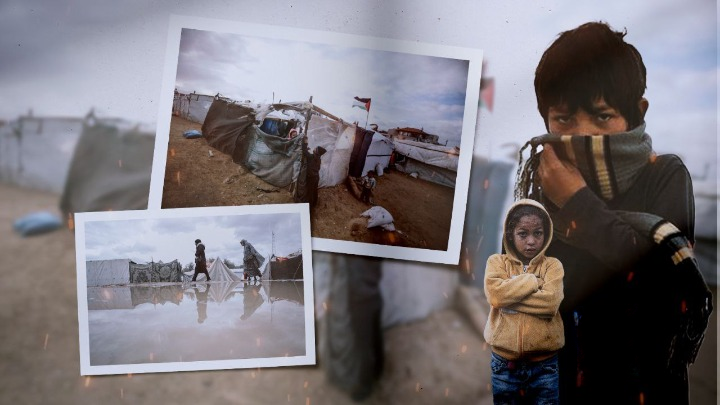
Gaza Submerged: Torrential Rains Flood Camps as the Ongoing Aggression Deepens Suffering
The city of Gaza is witnessing a dual catastrophe, combining the destruction left by the Israeli onslaught with the harshness of nature. Five buildings collapsed on Thursday in different areas due to heavy rains brought by a deep and persistent low-pressure system. At the same time, thousands of tents sheltering displaced families were flooded, raising serious fears for their safety amid severe shortages of essential supplies and medical materials.
Building Collapses and Flooded Tents
The Civil Defense reported that three buildings collapsed in the Tel al-Hawa and al-Nasr neighborhoods west of the city, and two buildings collapsed in the al-Zaytoun neighborhood to the southeast. These buildings had been housing displaced Palestinians. Thankfully, no injuries were reported.
Civil Defense officials warned residents not to return to damaged structures, as continued rainfall increases the risk of further collapses and structural failures already weakened by previous Israeli bombardment.
More than 2,500 tents have been submerged by rainwater, with Civil Defense teams working to evacuate families to safer areas.
Collapsed Drainage Systems and Rubble Worsen the Crisis
Gaza Municipality spokesperson Husni Mehanna stated that the city can process no more than 20% of rainwater, after seven of eight major pumps were destroyed, and nearly half of the sewage network damaged, in addition to 40% of rainwater drains being knocked out of service due to Israeli strikes.
Mehanna added that rubble from the aggression, along with accumulating waste, has blocked water pathways, turning streets into wide swamps. This significantly increases the danger of tents and buildings being flooded. He urged the international community and humanitarian organizations to provide urgent assistance to confront the unfolding disaster.
Urgent Need for Aid
Head of the Government Media Office in Gaza, Ismail al-Thawabteh, revealed a sharp escalation in the humanitarian crisis:
More than 22,000 tents have been completely damaged, while tens of thousands more have been flooded by the storm, transforming entire camps into muddy, waterlogged expanses.
Al-Thawabteh reported that around 1.5 million displaced people are living in these camps, with many families residing in tattered tents already worn down by bombardment and repeated storms. He stressed that the situation requires immediate intervention to provide shelter—especially with winter setting in. The Gaza Strip urgently needs around 300,000 new tents, yet only 20,000 tents have entered the Strip since the crisis began.
UNRWA Warns of a Deteriorating Disaster
The United Nations Relief and Works Agency (UNRWA) warned that rain and cold weather are worsening already severe living conditions in the camps, particularly amid overcrowding and lack of sanitation. The agency affirmed that these conditions threaten the lives of children, women, and the elderly.
UNRWA called on the international community to facilitate the entry of humanitarian aid without restrictions, including medical supplies and shelter materials, to help protect families from winter cold and alleviate their mounting suffering.
The Israeli Occupation Escalates the Crisis
While displaced families struggle against harsh weather, Israeli forces continued to violate the ceasefire agreement, carrying out heavy artillery shelling in eastern Khan Younis and repeatedly firing from helicopters over the southern parts of the city. These assaults resulted in the killing of five Palestinians, including a child and a woman, further intensifying the humanitarian emergency.
Hamas called on the guarantor countries of the ceasefire and mediators to pressure Israel to allow shelter materials into Gaza and reopen the Rafah crossing in both directions. The movement emphasized that Israel bears full responsibility for the catastrophic conditions resulting from its obstruction of tents and essential supplies.
A Double Catastrophe
As the storm system continues, displaced families face a double tragedy—the devastation of war and the brutality of nature—amid severe shortages of basic necessities, tents, and medical supplies. Civil Defense officials highlighted that children, women, and the elderly face the gravest dangers, lacking even the minimum necessities for survival as their tents collapse under continuous rainfall.
The Civil Defense stressed that every hour poses a real threat to the lives of those in the camps, urging immediate intervention from the international community and humanitarian organizations to provide shelter, relief materials, and protection from freezing temperatures and rushing floodwaters.
Catastrophic Figures After Two Years of Aggression
It is worth noting that Israel’s genocidal assault on Gaza continued for two full years, ending with a ceasefire agreement on October 10, 2025. However, Isr