
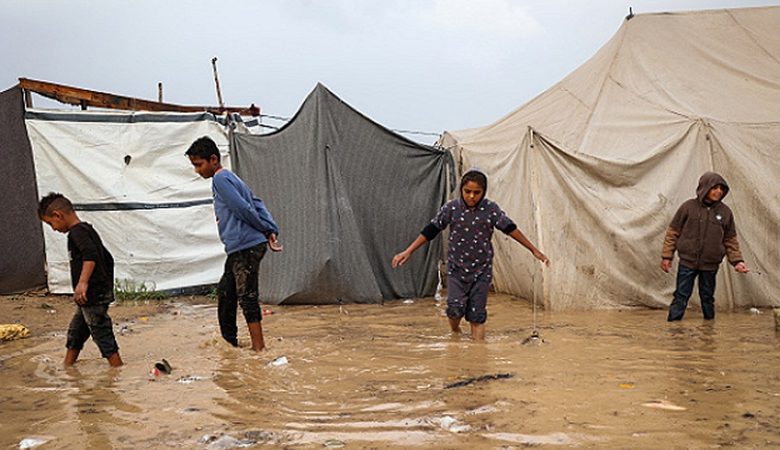
Severe Weather Deepens the Tragedy: Gaza Between a War of Extermination and Flooded Camps
In a besieged territory enduring more than two years of an ongoing war of extermination, the polar storm and the “Perun” low-pressure system were not merely passing weather events. They have become a compounded humanitarian disaster—deepening open wounds and exposing the scale of collapse caused by the Zionist blockade, the destruction of infrastructure, and the sprawling informal camps sheltering 1.5 million displaced people.
As winter rains fall and fierce winds blow, tents, homes—and hearts—collapse with them, in a tragedy that renews itself by the hour while the world takes no meaningful step to stop it.
Rising Death Toll: Nature Becomes a Tool of Killing Amid the Absence of Shelter
Over the past 24 hours, the death toll linked to the storm has risen to 14 martyrs, including three children who died due to the collapse of homes previously damaged by the aggression and from extreme cold inside tents that offer no protection from heat or frost.
Field sources report that the bitter cold, heavy rains, and violent winds battered exposed displacement camps, causing deaths from hypothermia amid the absence of heating and any form of humanitarian protection.
Ambulance and civil defense teams face major obstacles reaching affected areas due to destroyed roads and severe shortages of equipment. Warnings continue to mount that the number of martyrs will increase as harsh weather persists.
Collapsing Homes and Flooded Tents: A Recurrent Winter Disaster, Vastly Worse This Year
Gaza’s Government Media Office confirmed that the low-pressure system has resulted in more than 12 deaths and missing persons, in addition to the collapse of 13 homes across the Strip—most recently in Sheikh Radwan and Al-Karama neighborhoods in Gaza City.
The most devastating impact, however, has been the flooding and sweeping away of more than 27,000 tents by torrents and strong winds, leaving thousands of families displaced once again after having already been uprooted by the aggression.
According to official data, over a quarter of a million displaced people were affected within just hours, as floodwaters tore through fragile tents and caused widespread inundation inside the camps.
This scene lays bare the depth of the humanitarian crisis gripping the Strip, particularly as the occupation continues to block the entry of shelter materials—including more than 300,000 tents, caravans, and mobile homes—despite the urgent need for them.
Child Deaths Expose the Blockade: Infant “Rahaf Abu Jazar” Bears Witness
On Friday, a second infant death was recorded within hours due to the extreme cold and flooded tents. Baby Rahaf Abu Jazar died inside her family’s tent in the Al-Mawasi area of Khan Younis—a scene that encapsulates the tragedy: children dying from rain, not because rain kills, but because shelter is denied by the blockade.
Medical sources in Gaza confirmed that the number of children who died since morning rose to two, as the Zionist occupation continues to prevent the entry of prefabricated housing and relief supplies, keeping crossings closed to blankets, heaters, insulation materials, and water-resistant tents.
Hamas and the Popular Front: What Is Happening Is a Direct Extension of the War of Extermination
In clear political statements, Hamas affirmed that the collapses and flooding in Gaza are an extension of the war of extermination—this time using climatic tools—adding that the international system has demonstrated complete incapacity to protect civilians or provide even the minimum requirements of relief.
Movement spokesperson Hazem Qassem explained that the homes collapsing today are not new; they are buildings previously bombed during the aggression and have now turned into graves over their residents’ heads with the first severe storm—further proof that the war continues by other means.
The Popular Front for the Liberation of Palestine described the international failure as a full-fledged betrayal, stating that what is unfolding represents a global moral collapse in the face of scenes of drowning, freezing, and death affecting children, women, and the elderly. The Front called for the immediate entry of water-resistant tents and caravans as the bare minimum needed to keep the displaced alive.
Harrowing Scenes Inside the Camps: A Crisis Escalating by the Hour
Field reports indicate that camps in northern and western Gaza have turned into lakes of mud and stagnant water. Children are forced to sleep on soaked ground, while respiratory illnesses and skin infections spread amid acute shortages of medicines and antibiotics.
Hundreds of families have resorted to using plastic bags and old clothes to plug holes in their tents, while others dug primitive channels to drain water in desperate attempts to prevent flooding.
Civil defense teams receive hundreds of distress calls every hour as floods expand, yet they possess only limited, worn-out tools—wholly insufficient to confront even a fraction of the disaster.
A Compounded Tragedy—and the World Watches
The low-pressure system is no longer a natural event; it has become a new witness to the scale of the extermination facing Gaza’s people. Hunger kills, cold kills, drowning kills—while crossings remain closed, shelter is denied, and aid is besieged by decisions of an occupation backed by the United States and Western powers.
Between the devastation of aggression and the hell of winter, Gaza’s people stand alone against a storm layered upon a greater one: a blockade lasting more than two years, an aggression that has not stopped, and a shameful international silence that colludes with the killer.