
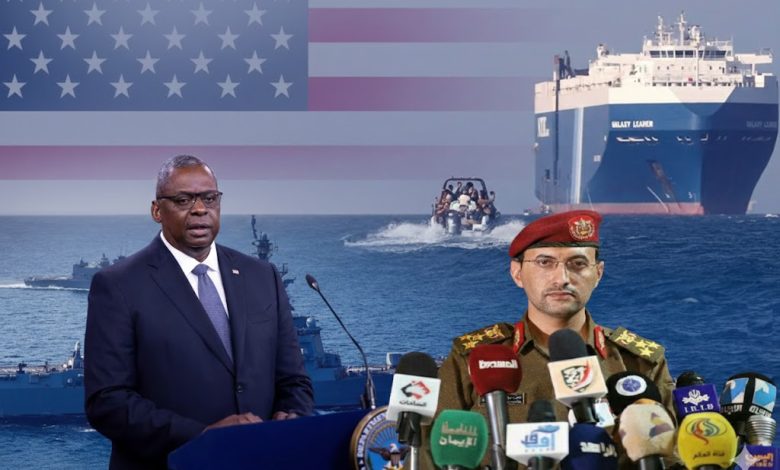
Two Years of American Failure in the Red Sea: “Prosperity Guardian” and the Early Collapse of Washington’s Reckless Bets
On the second anniversary of the United States’ announcement of its naval coalition under the name “Prosperity Guardian” in December 2023, the outcome of this operation is now laid bare as far more than a passing military setback. It stands as a stark testament to the failure of the American wager to reimpose hegemony by force in the Red Sea. From its very inception, the operation represented a direct U.S. move to support the Zionist entity at the height of the genocidal war on Gaza, coupled with an attempt to criminalize Yemen’s stance in support of the Palestinians by cloaking the campaign in the rhetoric of “protecting international navigation.” This narrative deliberately ignored the political and moral context that ignited the confrontation—namely Sana’a’s open engagement in the battle to strip away the cover from the aggression on Gaza.
After two full years of naval deployment, military escalation, and airstrikes, neither the United States nor its international coalition has managed to achieve any of its declared objectives. Navigation has not stabilized, deterrence has not been established, Yemeni operations have not ceased, and the rules of engagement have not changed. Instead, “Prosperity Guardian” has devolved into a direct act of aggression against Yemen, during which civilian and vital infrastructure was targeted, even as American and Western admissions have mounted regarding the coalition’s inability to impose stability or secure the Red Sea. This second anniversary thus serves as a political and analytical milestone confirming that the operation was never a guardian of prosperity, but rather yet another witness to the erosion of American power when it is wielded to protect a project of genocide and confronted by firm political and military resolve from Sana’a.
“Prosperity Guardian”: The Early Collapse of America’s Red Sea Gamble
This early failure becomes evident when examining Arab and international reactions to the coalition of aggression. Since its announcement, the U.S.-led operation known as “Prosperity Guardian” has faced major political and strategic challenges. Saudi Arabia and Egypt expressed official reservations about direct participation, undermining the coalition’s credibility from the outset and imposing clear limits on its scope of action. Both countries prioritized safeguarding their internal interests and avoiding direct entanglement in a confrontation linked to the Zionist entity, stressing that any military engagement must adhere to criteria that place their peoples’ interests first.
Other major Islamic countries likewise refused to join the coalition. Türkiye maintained its role as a regional mediator, distant from direct confrontation. Pakistan reaffirmed its commitment to popular support for Gaza, while Indonesia kept its distance from any alliance connected to the Israeli enemy, as reflected in official statements and local media reports. These positions exposed the limits of American influence in the Islamic world and highlighted the coalition’s lack of genuine political legitimacy, thereby reinforcing the resilience of Yemen’s stance and its capacity to withstand aggression while maintaining an independent posture in the Red Sea.
At the European level, participation was largely confined to intelligence sharing and symbolic coordination. France and Germany voiced reservations, while Spain and Denmark declined active involvement—further weakening the coalition’s ability to implement any effective maritime strategy. Meanwhile, Yemeni armed forces continued to carry out repeated attacks on coalition vessels, including major strikes on U.S. aircraft carriers between November 2023 and January 2025, which led to the withdrawal of some American ships from the area, as later acknowledged by the Pentagon itself. This confirmed Yemen’s sustained field superiority and the difficulty of imposing any new American equation.
These facts demonstrate that the “Prosperity Guardian” coalition lacked regional and international legitimacy and relied almost entirely on American and British force, while symbolic or absent support from other states underscored the failure of U.S. diplomacy to mobilize an effective alliance. The continuation of Yemeni operations, defiance of international pressure, and widespread Arab and global support for Palestinian resistance reveal the complete collapse of the coalition’s political and strategic objectives. Any American wager on political power proved to be an early illusion, exposed even before the operation reached full deployment.
An International Coalition Against Yemen: Tactical and Operational Failure
Beyond political and strategic shortcomings, tactical and operational failure emerged as further evidence of Washington’s inability to achieve its aims in the Red Sea.