
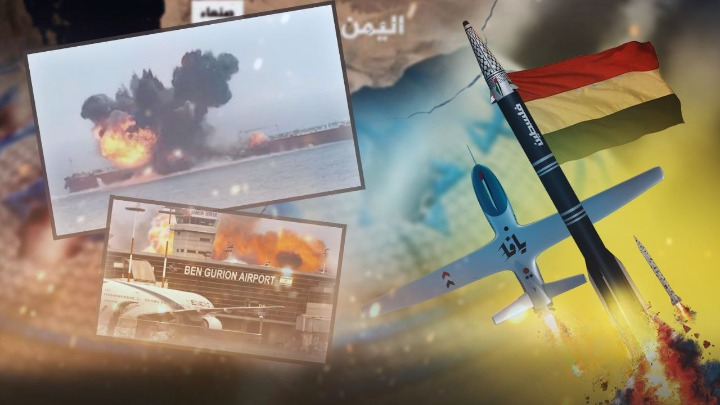
Yemen: The Qur’anic Model in Supporting Gaza and Shaping Deterrence Equations
At a time when positions have retreated and calculations of submission and normalization have taken precedence over values and rights, Yemen—its leadership and its people—has emerged as a unique Qur’anic model, redefining what it means to support Palestine. This has not been done through statements and slogans, but through sustained action, principled stances, and constant readiness for the coming battle.
Over two full years of Zionist aggression against Gaza, Yemen has presented an unprecedented experience of support—one that combines faith-based conviction, sovereign decision-making, and field action—transforming Sana’a into one of the foremost capitals confronting the Zionist–American project.
Two Years of Action, Not Words
Across 735 days, Yemen did not stand by as a spectator to the genocide in Gaza. Instead, it chose direct engagement in the Ummah’s battle, viewing the Palestinian cause not as a transient political issue, but as a matter of identity, dignity, and religious duty.
Throughout this period, the Yemeni leadership—headed by Sayyed Abdul-Malik Badr al-Din al-Houthi—affirmed that supporting Gaza is a natural extension of the Qur’anic approach, which regards standing with the oppressed as a responsibility that allows no hesitation or compromise.
The Red Sea: When It Spoke with a Yemeni Decision
The maritime blockade imposed by Yemen on Zionist-linked shipping constituted one of the most prominent pillars of support. The Red Sea and Bab al-Mandab were transformed into a sovereign arena that reshaped global maritime routes.
According to statements by the Yemeni Armed Forces:
More than 228 vessels linked to the Israeli enemy were targeted, including 25 Israeli ships, the first being the Galaxy Leader in November 2023.
An additional 76 vessels that violated the ban were targeted across:
The Red Sea (41 vessels)
The Gulf of Aden and the Arabian Sea (13 vessels)
The Indian Ocean (5 vessels)
The Mediterranean Sea and Haifa Port (7 vessels)
This blockade resulted in:
The closure of Umm al-Rashrash (Eilat) Port for two years.
Significant economic losses for the Zionist entity.
Forcing violating shipping companies to reroute via the Cape of Good Hope.
Yemeni Steadfastness
In response to this role, the enemies—led by the United States and Britain, with European and Zionist backing—launched a wide-scale aggression against Yemen under the pretext of “protecting maritime navigation.”
The outcomes, however, ran counter to their declared objectives:
The Yemeni Armed Forces engaged in over 68 naval confrontations with U.S. aircraft carriers and warships.
22 U.S. MQ-9 drones were shot down.
Five U.S. aircraft carriers were forced to leave the theater of operations.
Yemen was subjected to nearly 3,000 airstrikes, without breaking its will or halting its support operations.
Sayyed Abdul-Malik confirmed that this steadfastness represented a clear failure of the American plan aimed at neutralizing Yemen and weakening its role.
Yemeni Missiles Deep Inside the Entity
In an unprecedented development, Yemeni missiles and drones reached deep into occupied Palestinian territory—sending a clear message that distance is no longer an obstacle and that deterrence is no longer the monopoly of traditional powers.
According to official statistics, total military support operations exceeded 1,830 operations, including:
Ballistic, cruise, and hypersonic missiles
Drones and naval combat craft
Key figures include:
74 missiles targeting occupied Jaffa, including:
42 “Palestine-2” hypersonic missiles
More than 60 drones launched at Jaffa
Over 60 missiles and 120 drones targeting Umm al-Rashrash
Advanced air defense systems—including Iron Dome, Arrow, and THAAD—failed to intercept these attacks.
The Qur’anic Project: A Strategic Power
Yemen’s role cannot be understood in isolation from the Qur’anic project founded by the martyred leader Hussein Badr al-Din al-Houthi. This project views the conflict with the enemy not merely as a weapons-based struggle, but as a battle of awareness, will, and belonging.
This approach affirms that:
Faith is not an emotional state, but a practical stance.
Trust in God is a cornerstone for liberation from fear and submission.
Reliance on God does not mean passivity, but active engagement in arenas of responsibility.
This vision has been reflected in:
Broad popular mobilization
Weekly million-strong marches
More than half a million activities
Training of over 1.1 million participants within mobilization programs
Preparing for the Next Battle
The Yemeni leadership maintains that halting the aggression against Gaza does not signify the end of the conflict, but rather a stage within a long trajectory of confrontation—necessitating:
Preserving elements of strength
Enhancing military and popular readiness
Confronting attempts