
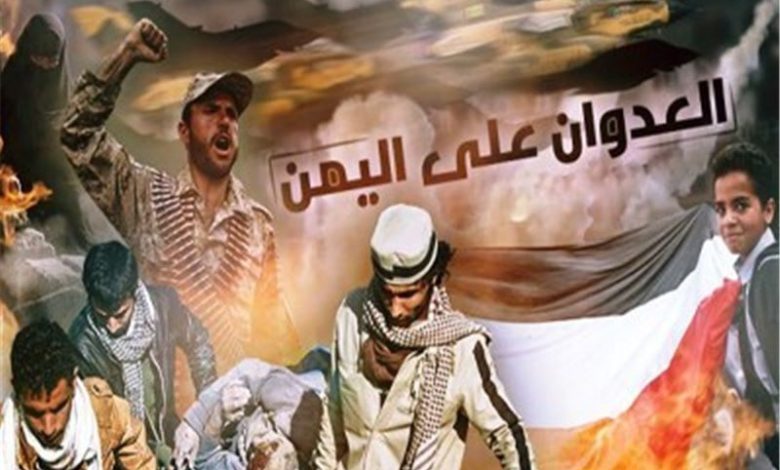
December 30: A Day That Repeatedly Bears the Criminal Imprint of the Aggression and Reveals the Features of a War That Targeted Yemen—Land and People
December 30 is not a passing date in Yemen’s collective memory. It is a bloodstained page whose chapters recur year after year under the fire of the U.S.–Saudi–Emirati aggression, which has turned this day into yet another witness to a war that targeted life in all its forms: homes, farms, communications, water projects, markets, and even vehicles carrying civilians.
On this day, facts are renewed that confirm what befell Yemen was nothing less than a comprehensive, multi-faceted aggression—vast in geography and prolonged in time—whose crimes do not expire with the passage of years.
2015 – Destruction of Civilian Infrastructure and Targeting of Service Facilities
On this day, hostile airstrikes hit the areas of Hailan and Al-Makhdarah in Marib, resulting in casualties and human losses, while Saudi army missiles shelled areas of Razih District in Saada. The telecommunications project in Al-Atfin area of Kitaf was also targeted. Various locations in Taiz were struck by missile attacks and air raids, in addition to the destruction of a bridge and civilian sites in Sana’a due to direct bombardment that caused extensive damage to residential neighborhoods and agricultural lands. The water wells project in Wadi Ram, Hajjah, was likewise bombed.
2016 – Expansion of Targeting in Border Governorates
A civilian was killed by Saudi border guards’ fire in Munabbih, Saada. Meanwhile, hostile aircraft carried out dozens of raids on Saada, Marib, Ibb, Sana’a, and areas near Najran, Asir, and Jizan. The shelling extended to densely populated areas, with cluster munitions used against mountains and border sites, causing significant damage to citizens’ property and farms.
2017 – A Year of Intensified Crimes Against Civilians
This date records one of the most devastating days, as women and civilians were targeted in Hodeidah Governorate, while other raids struck civilian vehicles in Al-Jarrahi. Residential areas in Sana’a, Saada, and Marib were bombed, and the districts of Al-Jawf and Haradh were subjected to a series of airstrikes that resulted in widespread damage to homes and property.
2018 – Continued Aerial and Ground Bombardment
Civilians were killed by artillery shelling from mercenaries on areas south of Al-Jarrahi. Targeting extended to Al-Sha‘b City in Hodeidah and Al-Ittihad Hotel on 7 July Street, in addition to a water project in Sahar, Saada, which was destroyed by two airstrikes. The aggression continued to use airpower and artillery to strike neighborhoods, farms, and inhabited villages.
2019 – Residential Areas Under Fire
Mortar and missile attacks were repeated in Hodeidah, targeting Al-Durayhimi, Hays, Maghari, and multiple villages. At the same time, mercenaries continued constructing military fortifications—an image that embodies constant preparation for a battle that targets civilians before military positions.
2020 – Farms and Border Communities Targeted
Civilians were injured by Saudi shelling that targeted Al-Raqou in Munabbih, while several areas in Saada and Marib were hit by airstrikes. In Hodeidah, reconnaissance aircraft carried out 11 sorties accompanied by artillery shelling and multi-caliber fire, in a clear violation of ceasefire agreements in place at the time.
2021 – Targeting of Vehicles and Civilian Facilities
Seven civilians were injured after a vehicle carrying food supplies was targeted in Maqbanah, Taiz. The Libyan neighborhood in Sana’a Municipality was also struck by an air raid that caused severe damage to homes and property. Hostile aircraft launched intensive raids on Marib, Al-Jawf, and Shabwa, while artillery shelling continued in Hodeidah.
2022 – Explosions from the Remnants of the Aggression
The aggression persisted through its remnants on the ground, as an unexploded ordnance detonated in Al-Durayhimi. Civilians in Al-Raqou, Saada, were injured by Saudi missile and artillery fire. Mercenaries also constructed fortifications in Taiz, reflecting continued military readiness despite political announcements of a halt to the war.
December 30: A Day That Does Not Fade from Memory
Across the years of aggression, this date forms a single tableau: a war without limits or restraints—bombardment of neighborhoods, destruction of civilian projects, targeting of farms, and violations against Yemenis in the minutiae of daily life. As years change, December 30 remains a steadfast witness to a tragedy the aggressor attempted to conceal, yet whose آثار remain etched in the memory of the land and before the eyes of the people.