
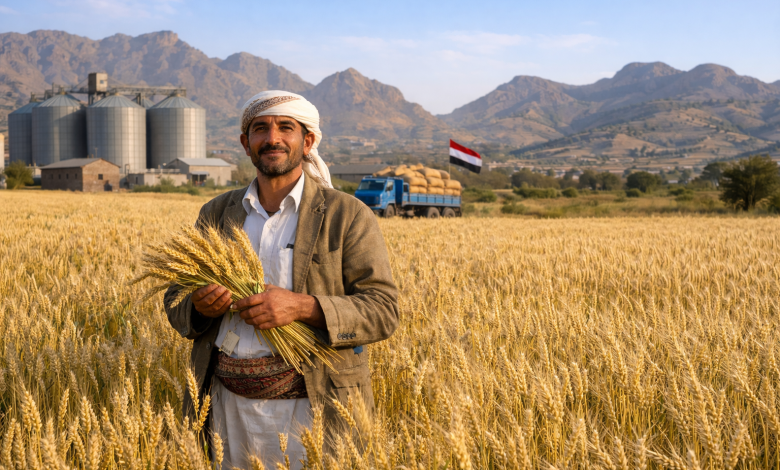
Reducing Imports and Raising Self-Sufficiency: Figures and Data Reveal the Transformation of Agriculture in Yemen after the September 21 Revolution
Agriculture in Yemen is no longer managed as a marginal productive sector detached from the structure of the economy. According to data from the Ministry of Agriculture, Fisheries, and Water Resources in Sana’a, it has been redefined as a direct economic intervention pathway aimed at addressing market imbalances and reducing dependence on external sources. The political transformation the country experienced following the September 21 Revolution—along with the restoration of national decision-making—created broader space to reorder economic priorities, foremost among them revitalizing the agricultural sector as a production base with a sovereign dimension.
Official data issued by the ministry indicate that policies governing agricultural marketing and import management are no longer isolated regulatory measures, but rather economic tools designed to balance supply and demand, curb foreign currency leakage, and redirect financial resources inward. Amid pressures related to imports, price stability, and producers’ incomes, figures showing reduced import bills, expanded contract farming, and higher self-sufficiency rates demonstrate that the Ministry of Agriculture is operating within a broader economic orientation adopted by the Sana’a government. This orientation seeks to transform agricultural activity into a practical lever for strengthening financial and food stability and narrowing reliance on external markets.
Reducing the Import Bill and Boosting Local Production as a National Economic Achievement
Official data from the Ministry of Agriculture, Fisheries, and Water Resources in Sana’a show a tangible decline in the cost of importing basic food commodities during the current year. The reduction reached approximately 12 percent compared to the previous year, equivalent to savings of about 7.9 billion Yemeni rials. The ministry emphasized that this decrease was not accidental, but rather the result of systematic policies to regulate imports, stimulate local production, and maintain balance between supply and demand. These measures reflect the state’s capacity to manage financial resources efficiently and channel them toward supporting domestic agricultural production, thereby enhancing self-sufficiency and reducing dependence on external sources.
In a special interview with Ansar Allah website, the Director of Marketing at the Ministry of Agriculture explained that the adopted measures included regulating imports of agricultural products such as grains, vegetables, and fruits, with priority given to meeting domestic consumption needs. He added that these steps helped limit foreign currency leakage and increase internal financial returns, enabling the funding of farmer support programs and improving prices for local products. These policies show that the government is not merely regulating the market, but is actively redirecting financial resources to serve food security and mitigate price volatility amid ongoing aggression and blockade.
Ministry data further reveal that the expansion of contract farming and supported production projects has raised self-sufficiency rates for certain strategic crops to over 65 percent, including basic grains and seasonal vegetables. The Director of Marketing noted that this represents a significant improvement compared to previous years and reflects the agricultural sector’s ability to withstand external and economic pressures, transforming it into a genuine economic driver—particularly after the blessed September 21 Revolution, which enabled the state to exercise sovereign decision-making in managing the agricultural sector.
Despite continued harsh conditions caused by blockade and aggression, official figures indicate that the Yemeni government, represented by the Ministry of Agriculture, succeeded in reducing the market’s reliance on external imports of essential products by more than 10 percent, redirecting the resulting financial surplus to support local production projects and farmers. The Director of Marketing stressed that this achievement is not merely an administrative success, but an indicator of the state’s capacity to confront ongoing economic challenges, stabilize the market, and deliver tangible economic outcomes that directly serve citizens and the national economy.
Contract Farming as a Tool to Strengthen Food Security
Contract farming in Yemen has witnessed notable expansion in recent years, becoming one of the main tools relied upon by the Ministry of Agriculture to ensure food stability and achieve local self-sufficiency. This policy is based on signing direct contracts with farmers to produce strategic crops such as grains, vegetables, and fruits, providing farmers with marketing guarantees and reducing risks associated with market fluctuation