
From Bombing to Displacement: Blind man, his family face Gaza’s harsh winter
The weather depression in the Gaza Strip is no longer just a change in weather conditions; it has turned into a daily nightmare threatening the lives of thousands of displaced people and exposing the fragility of their living reality, especially for those who have nothing left of their homes but memories.
On harsh winter nights, when winds howl and rain pours heavily, shelter tents flood, and the ground turns into muddy swamps, while the displaced stand helpless against a cold that seeps into their exhausted bodies. Here, the cold is not measured in degrees, but in the depth of fear and the magnitude of helplessness in protecting children from the consequences of the harsh winter.
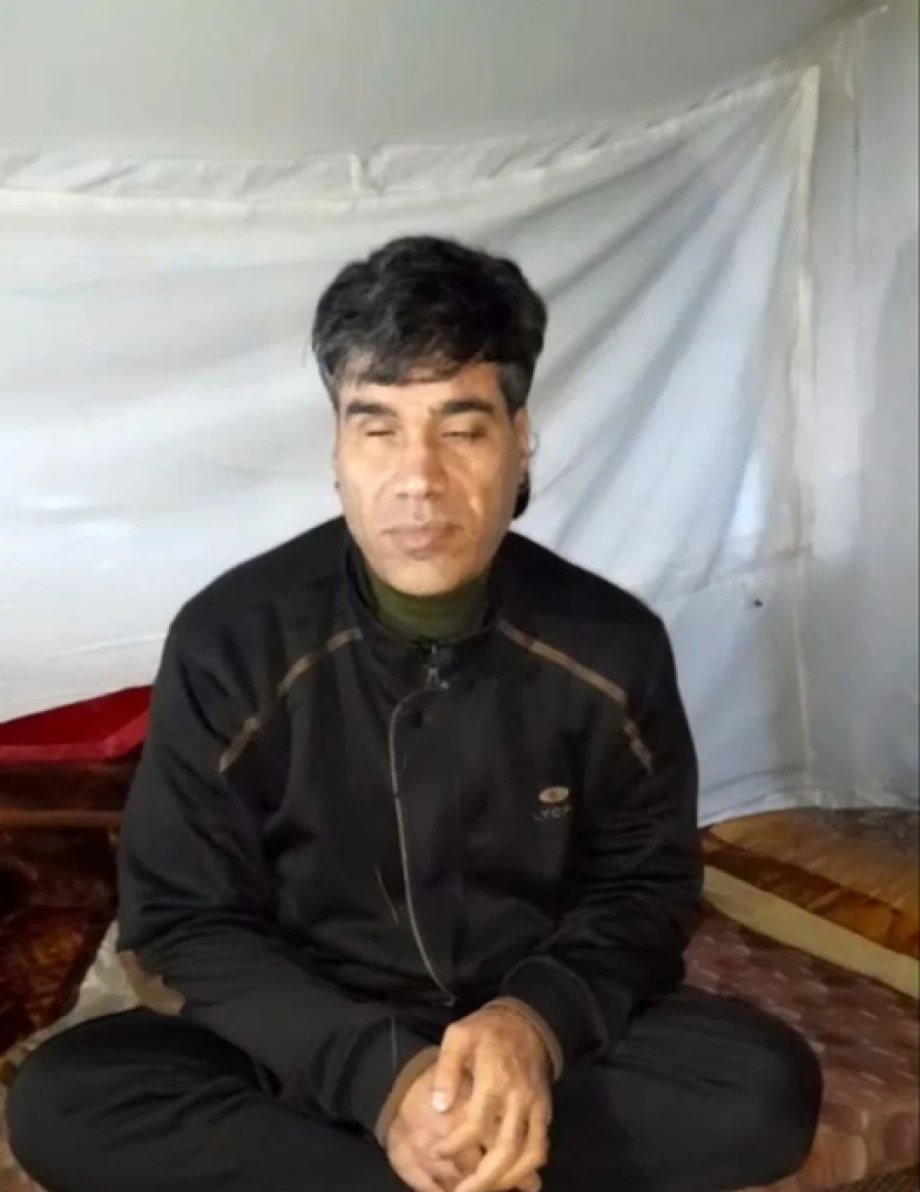
Amid this bleak humanitarian scene, the story of the Mahdi al-Balawi family emerges as one of the harshest images of the compounded suffering endured by the displaced in Gaza. Mahdi (42 years old), a father of six, blind, suddenly found himself without a home and without the most basic elements of a secure life after his apartment in the Sheikh Radwan neighborhood was completely destroyed during the first week of the war.
Displacement was not a single stop in Mahdi’s life, but a long series of forced journeys. From Gaza to Rafah, then to Khan Yunis, before returning during the truce in January 2024, only to be forced to displace again later. This movement exhausted the body, wore down the spirit, and piled loss upon loss.
The tragedy deepens when we learn that Mahdi is not the only one who lost the blessing of sight; his eldest son Hamed (17 years old), a high school student, and his eldest daughter Amal, are also both blind. Three blind people living in one tent, in an environment lacking the most basic safety conditions.
Mahdi told the (Palestine) newspaper in a voice that encapsulates the pain: “Everything is difficult… setting up the tent, walking on broken streets, the sewage water surrounding us, even reaching the community kitchen or fetching water requires someone to help us.”
In a heartbreaking scene, his sighted daughter – who is young in age – takes on the task of holding his hand and guiding him to food and water distribution points, making the child her father’s crutch, an image that summarizes the cruelty of reality and the reversal of roles.
The family’s suffering did not stop at displacement and loss of shelter; it extended to hunger and malnutrition, especially during the famine periods that struck the Strip. Despite this, Mahdi clung to a thin thread of hope, repeating: “God willing, things will improve.”
With the arrival of winter, the tent becomes an additional burden. The weather depressions, with their heavy rains and fierce winds, show no mercy. Mahdi describes winter nights, saying:
“Water invades the tent and we drown. We tried to cover it with tarpaulin but to no avail. The blankets got soaked, and the wind almost tore the tent apart.”
In those moments, Mahdi stands helpless; he cannot see, and he cannot protect his children from the bitter cold, except by waiting and praying. Even summer was no kinder, as the tent turned into a stifling oven, negatively affecting their health, making the suffering continuous in all seasons.
Adding to the cruelty of the reality is the absence of lighting around the tent, making movement for Mahdi and his blind children nearly impossible and doubling their dependence on others.
Today, Mahdi al-Balawi sends out a distress call to all living consciences, demanding the provision of a humanitarian tent to protect his family from the winter cold and summer heat and grant them the minimum of their violated dignity.
The story of Mahdi al-Balawi is not a number in a displacement register, nor a fleeting scene in news bulletins, but a muffled human cry from the heart of a tent collapsing under the rain. A blind man trying to see his children with his heart, and a family facing the elements and the cold with exhausted bodies and a hope that is almost extinguished.
With every new weather depression, the danger increases, the chances of survival shrink, and the painful question remains present without an answer: How long will these families continue to be left alone to face the winter cold and the fires of the Zionist war together? Saving the al-Balawi family, along with thousands of afflicted families, is no longer a postponable humanitarian option, but an urgent necessity before the harsh winter turns into a silent tragedy claiming what remains of lives.