
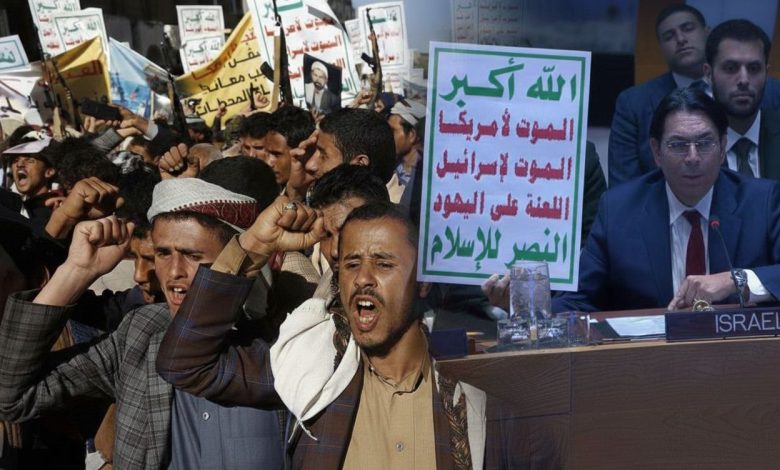
When the Enemy Presented the Evidence with His Own Hand:
“The Slogan” at the Security Council as a Zionist Admission of the Collapse of Hegemony and the Rise of Yemen
The scene of the representative of the occupying entity raising the “Slogan” inside the chamber of the UN Security Council was neither a passing detail in a routine UN session, nor a procedural slip, nor even a calculated propaganda display. Rather, it was a pivotal moment that exposed a profound shift in the balance of conflict—a historic moment of revelation in which the enemy, unknowingly, was compelled to deliver a public testimony to the failure of his project and to the arrival of the Yemeni Qur’anic voice at the heart of an international system long monopolized by tyrants and criminals.
The representative of the occupation intended to condemn, but ended up confessing.
He sought to demonize, but transformed the slogan into a global icon.
He aimed to isolate Yemen—only to internationalize it and grant it legitimacy before the world.
From the Mountains of Marran to New York:
The Journey of a Slogan Not Meant to Be Contained
The “Slogan” emerged from the remote mountains of Marran not as a fleeting reaction nor as an emotional chant, but as a sovereign, liberatory Qur’anic stance—an explicit declaration of dissociation from tyranny that named the enemy plainly at a time when the nation was being pushed to lose its compass, conditioned into false neutrality, humiliating silence, and the recycling of empty terminology.
Its five phrases were never isolated words detached from context; they were an expression of a battle of awareness against a rogue imperial project that accumulated crimes, legitimized occupation, and confiscated the will of peoples—foremost among them the Palestinian people.
Today, after more than two decades of distortion, criminalization, mockery, and siege, the enemy finds himself forced to carry this very slogan in his own hands and display it before the cameras of the world, inside the highest international political forum. What irony could be more telling than this?
When Accusation Turns into Confession
Raising the slogan inside the Security Council was not an act of strength—it was a mark of structural weakness.
What has no weight is not targeted.
What has no impact is not summoned.
What is not feared is not raised in the chamber of global decision-making.
The representative of the entity attempted to present the “Slogan” as “hate speech,” but in doing so he inadvertently declared that it is present, influential, disturbing, and impossible to exclude. Here, precisely, the mask fell: when an enemy that possesses the tools of media dominance and political pressure is forced to invoke the slogan of his adversary, he announces the failure of all prior efforts at erasure.
The Enemy Serves the Truth Unwittingly:
The Qur’anic Vision Realized
What transpired at the Security Council embodied, with striking precision, what the Martyr of the Qur’an, Sayyid Hussein Badr al-Din al-Houthi (may God be pleased with him), established when he affirmed that one of the greatnesses of Islam is that when you move for the sake of truth, everything serves you—even your enemies.
This was not emotional rhetoric, but a profound Qur’anic reading of the nature of the struggle.
As the enemy attempts distortion, he expands dissemination.
As he seeks isolation, he enforces internationalization.
As he raises the banner of “accusation,” he delivers a historical testimony to the authenticity of the path.
Thus, the Security Council—intended to be a platform of condemnation—was transformed into a forced platform of acknowledgment of the effectiveness of the Qur’anic project and of the international system’s inability to contain or ignore it.
An Existential Fear the Diplomatic Language Cannot Conceal
Behind the polished words and procedural phrases, an existential fear was clearly present—a fear of a project that does not recognize the rules of engagement drafted by colonial powers, does not submit to media blackmail, and refuses to manage conflict within the ceilings of fragmentation.
The enemy’s representative openly acknowledged that Yemen has become a threat transcending geography, and that confrontation is no longer confined by borders or distances. This is the most dangerous admission that can come from a representative of an entity whose security doctrine was built on superiority, deterrence, and psychological dominance.
The Slogan:
The Weapon That Terrified Them More Than Missiles
What terrifies the enemy is not only missiles and drones, but meaning itself. The slogan is not a rifle, yet it shatters the language of international hypocrisy, redefines the enemy, and strips the Zionist project of its moral cover.
For this very reason they waged war against it.
For this reason they sought to criminalize it.
And for this reason, fear ultimately drove them to raise it with their o