
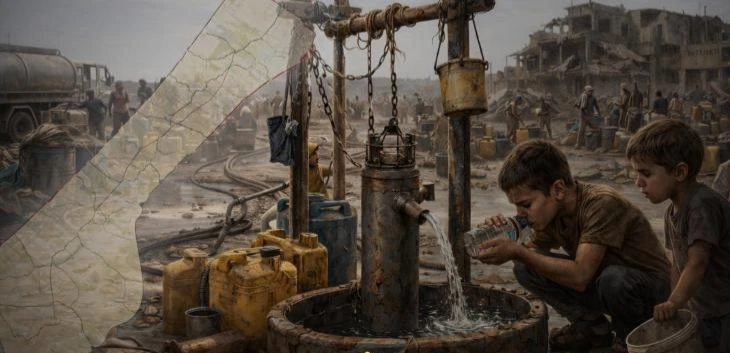
Gaza’s Wells: When Water Costs a Life
Death in Gaza no longer comes solely from the sky through Zionist bombardment but now lurks beneath the feet of its people. After two years of widespread targeting that destroyed vital infrastructure, water and sewage networks, and treatment plants, residents find themselves besieged by thirst and pollution, forced to dig the earth with their hands searching for a lifeline.
In a city exhausted by destruction, primitive pits dug to compensate for the absence of basic services have turned into death traps. Descending into the depths of the earth was not a voluntary choice but a necessity imposed by a humanitarian catastrophe that disabled pumps, severed pipes, and dried up taps in overcrowded homes.
Near Hamama School in the Sheikh Radwan neighborhood northwest of Gaza City, a new tragedy occurred that encapsulates the magnitude of the catastrophe. Young man Hamza Ashour (25 years old) was working with several citizens digging a well to provide fresh water for residents in an area where the water pump had stopped due to the war. Moments passed until the soil around him collapsed, and he fell into the deep pit before it was filled in over him.
His father stood among the crowds, staring at the piles of accumulated dirt, waiting with every movement of the bulldozer for his son to emerge alive. Minutes that seemed like an eternity passed, with rescue attempts carried out using primitive tools under complex circumstances. Hamza’s head appeared with the pipe of one of the bulldozers, followed by his still body, shocking those present. Later, civil defense crews announced the recovery of the body from inside the pit, in an incident that highlighted the deadly risks of emergency solutions amidst the collapse of basic services.
The Director of Public Relations and Media at the Civil Defense in Gaza, Mohammed Al-Midana, told “Sind” News Agency that the past two months have witnessed several deaths and injuries among young people attempting to dig water wells or absorption pits for sewage using primitive methods without professional safety conditions.
He explained that civil defense crews dealt with multiple reports of soil collapses and suffocation inside narrow pits, due to lack of adequate ventilation, pit depth, and lack of proper engineering support for the sides.
Al-Midana pointed out that some incidents resulted from the accumulation of toxic gases inside absorption pits, leading to rapid loss of consciousness for those who descended into them, affirming that rescue operations under such conditions are complex, dangerous, and require specialized equipment that may not be available at the time of the incident.
He called on citizens not to risk individual digging and to seek assistance from specialized bodies that adhere to public safety procedures, warning that many victims fell while attempting to spontaneously rescue others.
For his part, the spokesman for Gaza Municipality, Hosni Muhanna, stated that citizens resorting to digging wells and absorption pits has become an emergency choice imposed by the catastrophic conditions resulting from the widespread destruction of the water and sewage infrastructure.
He explained that eight main sewage stations were targeted, most of them destroyed, while damage affected approximately 212 kilometers of water and sewage networks, leading to the collapse of the drainage system and increased risk of environmental pollution and the spread of wastewater among residential neighborhoods.
Muhanna clarified that the absence of urgent technical alternatives has pushed citizens toward unsafe individual solutions, increasing the likelihood of collapse, suffocation, or groundwater pollution incidents, along with health risks resulting from sewage leakage, especially in densely populated areas.
Amidst this reality, fears are escalating over long-term humanitarian and health consequences that may threaten residents’ lives and exacerbate the environmental crisis in one of the most densely populated areas in the world. Despite efforts by municipalities and civil defense crews with limited capabilities, the magnitude of the catastrophe remains beyond containment capacity.
In Gaza today, the story is no longer just about a collapsed well, but about a city forced to dig into its own body searching for water.
Between thirst and danger, residents continue their daily struggle for survival, while the question remains hanging: How many more souls must be lost before water returns safely to Gaza’s homes?