
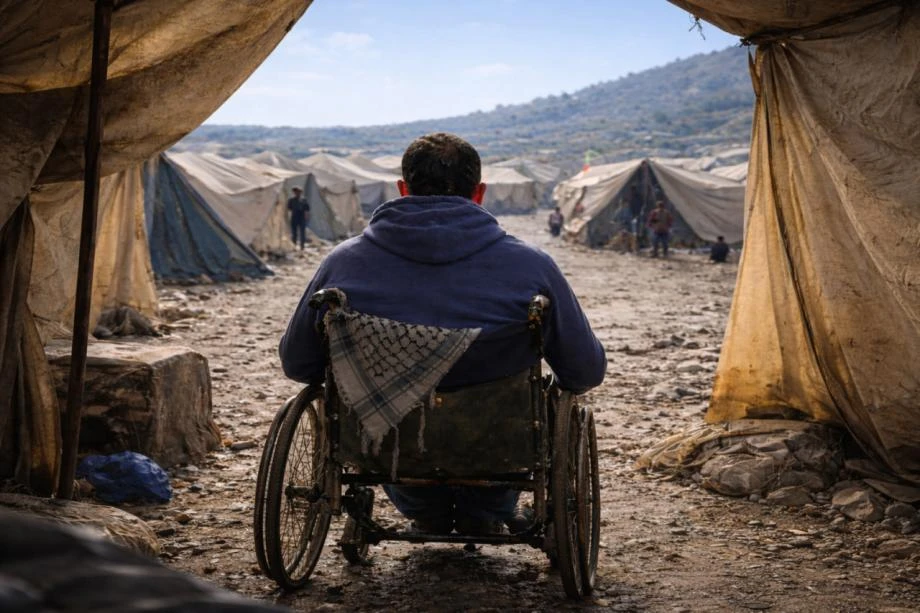
Body suspended between pain, hope: Ahmed al-Nahal awaits window of escape from Gaza
On a tattered bed inside a tent that offers no protection from the heat or the cold, Ahmed al-Nahal lies staring at a canvas ceiling, his fate hanging between a travel list that might save him and a reality that threatens him with permanent disability.
Since an explosive Israeli bullet pierced his body, pain is no longer his only enemy; waiting has become a daily companion, gnawing at his nerves and testing his family’s patience in a race against time to get their father back on his feet.
On July 27, 2025, Ahmed (31 years old) was standing in front of his house in the Sudaniya area, northwest of Gaza, watching aid convoys pass through amidst crowds exhausted by hunger.
A single moment changed everything; an explosive bullet pierced his chest and knocked him unconscious in front of his brother, beginning a grueling treatment journey that is far from over.
His wife, Aya, recalls the scene with a heavy heart, telling the newspaper Falastin: “I collapsed the moment he fell… I couldn’t even accompany him to the hospital. The hours of waiting felt longer than a lifetime.”
Inside the hospital, Ahmed underwent a series of complex surgeries. His spleen, parts of his lung and liver were removed, and his torn intestines were repaired. Shrapnel had shattered vertebrae in his lower back and fractured two others.
He spent fifteen days in intensive care, then four months at Al-Shifa Medical Complex, before his family was forced to take him out due to the escalating Israeli attacks and their fear of another raid on the hospital.
His wife, Aya, adds, her voice heavy with pain: “His body is covered in surgical scars… Every day his pain increases, and we only have a few painkillers.”
Last September, the family was displaced to a tent east of Deir al-Balah. There, his condition deteriorated again. A severe drop in his blood count necessitated frequent blood transfusions, and deep ulcers on his back and feet required daily dressing changes and constant turning, all amidst a critical shortage of medical supplies; even a wheelchair was unavailable.
“He spends his days lying motionless, unable to move, and I try to care for him with my five children in unbearable conditions,” says Aya, as the children take turns watching their father in heavy silence, as if afraid his body will fail them again.
With his injury, Ahmed lost his source of income, compounding their economic hardship. The dampness inside the tent caused chest infections in their infant, while their needs piled up beyond the family’s capacity. Only the opportunity to travel abroad for treatment represents a genuine glimmer of hope that might restore his ability to move and work.
Aya concludes, her voice choked with tears, “We don’t want a miracle… we just want him to stand among his children again.”
In Ahmed’s story, the trauma of war intersects with the harsh realities of displacement and poverty, and his wound becomes a daily test of resilience.
While the waiting lists drag on and the hours of waiting lengthen, hope remains suspended, clinging to the opening of a crossing and the issuance of a decision that will restore a man to his feet and grant five children the chance to see their father standing, not lying prostrate. Between the pain that grips his body and the hope that resides in their hearts, Ahmed’s life remains hostage to a moment that may bring him back to life… or leave him a prisoner of a bed and a tent.