
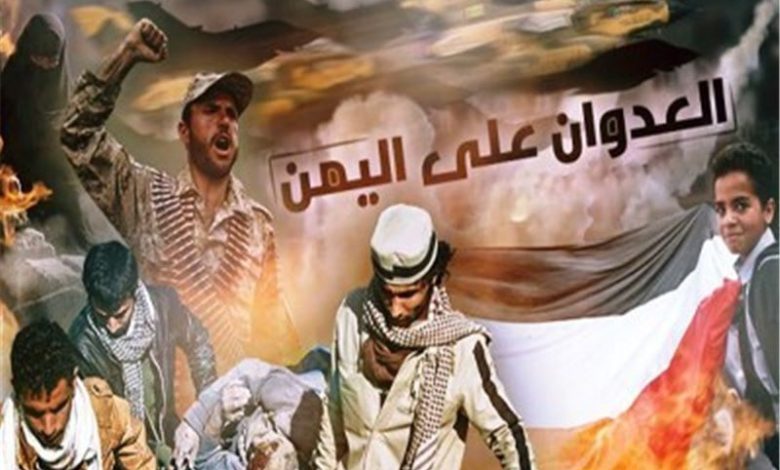
February 18th: The Aggression Writes a New Chapter of Bloodshed and Destruction
On February 18th, the war unfolded as the American-Saudi-Emirati aggression intended: airstrikes on markets, targeting of gas trucks and farms, shelling of residential neighborhoods, and the systematic destruction of infrastructure and communications.
This was not just another day in the aggression’s calendar, but a milestone where patterns of crime intensified: direct killing, a siege by fire, the use of prohibited weapons, and attacks on the very foundations of life in cities and villages alike.
2016: From Gas Trucks to Central Markets
February 18, 2016, witnessed multifaceted crimes. In Ibb, three civilians were killed and three others wounded in two airstrikes on Beit al-Awdi in the al-Sabrah district.
In al-Jawf, two civilians were killed when a gas truck was targeted in Aqabat Bart al-Anan, a crime that impacted the daily lives and basic needs of the citizens.
In the capital, Sana’a, airstrikes targeted the Al-Nahdain, Al-Sabeen, Bani Al-Harith, and Al-Tahrir districts, causing widespread damage to homes and shops. A crusher at the Amran Cement Factory was also targeted, directly striking a vital production sector.
In Marib, the central market in Sarwah was subjected to eight airstrikes, a blatant attack on commercial facilities and the livelihoods of citizens. These attacks were accompanied by the dropping of cluster bombs in Al-Sharijah, Lahj, and the airport area in Hodeidah, in clear violation of international law.
2017: Communications and Schools in the Crosshairs
On February 18, 2017, the aggression took a different turn by targeting service infrastructure.
In Sa’dah, a Saudi missile strike on homes and farms in Haydan resulted in the death of one citizen and injuries to four others. Airstrikes also destroyed a communications network in Majz, reflecting a deliberate effort to sever communication lines for the population.
In Taiz, airstrikes targeted Al-Omari schools in Dhubab and the village of Shabara in Mocha, in a direct attack on educational facilities.
2018: Farms and Civilian Vehicles Directly Targeted
On this day in 2018, a civilian was killed and three others were wounded in an airstrike on a farm in Al-Tuhayta, Hodeidah. Two civilians were also killed when a civilian vehicle was targeted in Kataf, Saada, in a recurring pattern of targeting civilian transportation.
2019: Border Escalation and Intensive Bombardment of Cities
On February 18, 2019, a civilian was killed by Saudi border guards in Munabbih, Saada, coinciding with intense airstrikes on Baqim, Al-Buqa, and Najran, and missile and artillery shelling that targeted homes and farms.
The airstrikes extended to Hajjah, Sana’a, Al-Jawf, and Al-Bayda, while Hodeidah witnessed one of its most intense days of artillery bombardment, with more than 125 shells fired at residential neighborhoods and farms, along with the establishment of new military fortifications, in clear violation of the ceasefire agreements.
2020: Hodeidah Under Open Fire
On February 18, 2020, airstrikes continued on Ma’rib and Al-Jawf, while Hodeidah endured a day of intense shelling.
Artillery and rocket fire targeted the residential area of July 7, the mountainous region, Al-Fazah, Kilo 16, and the city of Ad-Durayhimi, with dozens of shells and Katyusha rockets fired at villages and farms.
The repeated targeting of bridges, factories, and homes, coupled with military movements to establish new fortifications, reflects a systematic policy of attrition against civilians.
2021: Intensified Airstrikes and Aerial Reconnaissance
On February 18, 2021, a woman was injured by artillery shelling in Hajjah, while warplanes launched 15 airstrikes on Sirwah and Madghal, and other strikes on Mahliyah, Al-Dhaher, and Al-Hazm.
In Hodeidah, reconnaissance aircraft intensified their raids on Al-Fazah, Al-Tuhayta, and Al-Durayhimi, in conjunction with continuous artillery shelling.
2022: Border Crimes and the Migrant Tragedy
February 18, 2022, witnessed a compound crime, as five civilians and three African migrants were killed or wounded by Saudi army fire in Al-Raqw, Munabbih District, in an incident that revealed the cross-border humanitarian dimension of this war.
Airstrikes also continued on Hajjah, Ma’rib, and Sana’a, in conjunction with artillery shelling in Hodeidah and repeated reconnaissance flights.
Crimes Documented in the Blood of Victims
February 18th encapsulates the nature of the aggression: targeting markets, bombing gas trucks, striking factories and bridges, destroying communication networks, killing civilians in border villages, and shelling densely populated neighborhoods.
It is a day that reveals the features of a total war against the Yemeni people, crimes documented in the blood of victims, their details bearing witness to crimes that will not be forgotten.