
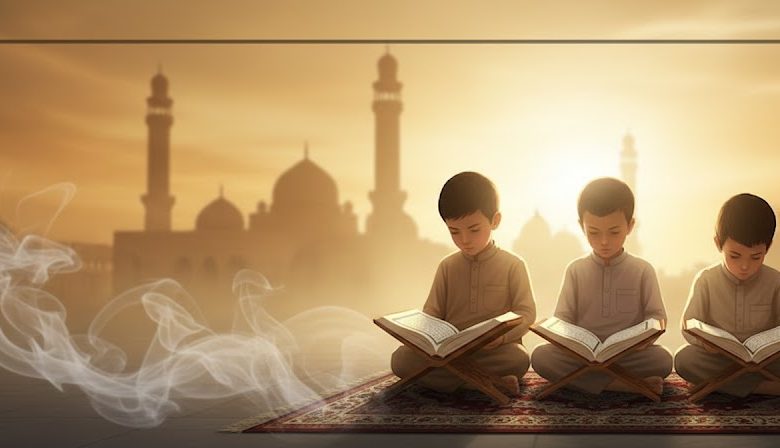
Fortresses of Awareness: How Does Connection to the Quran Protect Children’s Innate Nature from Western Pollution?
In the present age, faith-based education for children represents an existential necessity that transcends the concept of traditional education. It transforms into a comprehensive process of shaping the individual, aiming to restore their pure nature from the clutches of the materialistic distortions the world is witnessing. In this context, the vision of Sayyid Abdul-Malik Badr al-Din al-Houthi stands out as a strategic starting point, emphasizing that instilling faith-based values in the hearts of rising generations is in compliance with the Almighty’s words: “O you who have believed, protect yourselves and your families from a Fire whose fuel is people and stones.” This divine guidance represents a bulwark protecting the soul from erosion in the face of waves of atheism and moral laxity. The goal of this cultural project is not merely to produce educated individuals, but to cultivate personalities imbued with a profound faith that grants them psychological resilience and social effectiveness. This makes faith-based education the only reliable bridge connecting children to their Creator, ensuring their dignity and self-respect in an era where hegemonic powers are vying to dilute identities and obliterate authentic, innate values.
This educational path, as embodied in the lectures and guidance of the Supreme Leader, is intrinsically and inextricably linked to the Holy Quran, the source of knowledge and spirituality described by God as: “Indeed, this Quran guides to that which is most upright.” Reciting the Quran and maintaining a constant connection with its verses is of strategic importance in shaping the “insight” of the young generation. The Quran is not simply a set of texts recited for blessings; it is a way of life and a precise compass guiding human action toward truth. When a child is connected to the Quran from a very young age, they develop within themselves a value system that rejects misguidance, guided by the Almighty’s words: “There has come to you from God a light and a clear Book.” This close connection to the word of God purifies the mind from extraneous cultural impurities and creates a generation that moves by the light of revelation to build a future governed by justice and sovereignty derived from the guidance of God Almighty.
Quranic Purification as a Strategic Shield Against Cultural Invasion
A deep analysis of the educational system begins with the fact that the human soul is the true arena of conflict, as the Quran emphasizes in the verse: “And [by] the soul and He who proportioned it and inspired it [with discernment of] its wickedness and its righteousness, indeed he has succeeded who purifies it.” In this context, the concept of “purification” (tazkiyah) emerges as a methodological precursor to education, in accordance with God’s presentation of it in His words: “And He purifies them and teaches them the Book and wisdom.” As Sayyid Abdul-Malik Badr al-Din al-Houthi emphasizes in his lectures on “purifying the soul,” connection with the Quran fills the spiritual void and protects society from falling into the quagmire of moral decay promoted by Western cultures under the false banner of “freedom.” Quranic purification acts as a shield, granting children an inherent immunity that enables them to distinguish right from wrong and prevents the erosion of their character in the face of cultural distortion that targets chastity, modesty, and the innate values with which God created humankind.
Looking at the reality on the ground, we find that generations raised in the nurturing environment of the Quran possess a steadfastness that embodies the words of God Almighty: “God strengthens those who believe with the firm word in this life and in the Hereafter.” The enemy seeks to remove the Quran from the lives of children in order to transform them into mere consumers of their culture, devoid of will and identity. Therefore, the cultural alternative offered by the Quranic approach relies on instilling trust in God, which grants the young generation a solid psychological immunity that enables them to face pressures with a tranquil heart, in accordance with the words of God Almighty: “Those who believe and whose hearts find rest in the remembrance of God. Verily, in the remembrance of God do hearts find rest.”
Faith-based education, in its essence, is a process of liberation from alienation. The young person who recites God’s verses understands that their dignity is derived from their Creator, not from Western models and trends. This emotional transformation translates into young people possessing a self-respect that prevents them from being led astray by the “false role models” promoted by cinema and social media, making them solid rocks against which all conspiracies of cultural distortion shatter.
The Holy Quran and its Methodology of Thinking in the Face of Misguidance
The impact of the Quran extends beyond the spiritual realm to encompass the “cognitive framework” of children’s minds. It is the “clarification” that God described when He said: “And We have sent down to you the Book as clarification of all things and as guidance and mercy.” Reciting and reflecting upon the Quran cultivates a proactive mindset in young people, in response to divine commands to strive and work, as in the verse: “And say, ‘Work, for Allah will see your deeds, and [so will] His Messenger and the believers.’” We witness in our reality that the generation connected to the Quran possesses a universal perspective that prevents them from being deceived by misguidance, because they possess the “criterion” (al-Furqan) that God promised in His words: “O you who have believed, if you fear Allah, He will grant you a criterion (al-Furqan).” This divine scale ends the state of intellectual confusion and enables young Muslims to discern the poisons disseminated by Western systems to indoctrinate the minds of the nation’s youth.
The Quranic methodology instills in children a leadership personality that rejects injustice, enabling them to embody the verse: “And to Allah belongs all honor, and to His Messenger, and to the believers.” In this regard, Quranic courses stand out as an environment for building the “Quranic individual” who acts responsibly towards the issues of their nation, foremost among them the oppression of the Yemeni people and the central cause of the Muslim Ummah. This generation, connected to the Quran, is best equipped to consciously express its identity, in accordance with the verse: “And strive against them with it a great striving,” meaning with the Quran and its compelling arguments that break the West’s monopoly on the concepts of rights and present the most refined and virtuous Islamic model.