
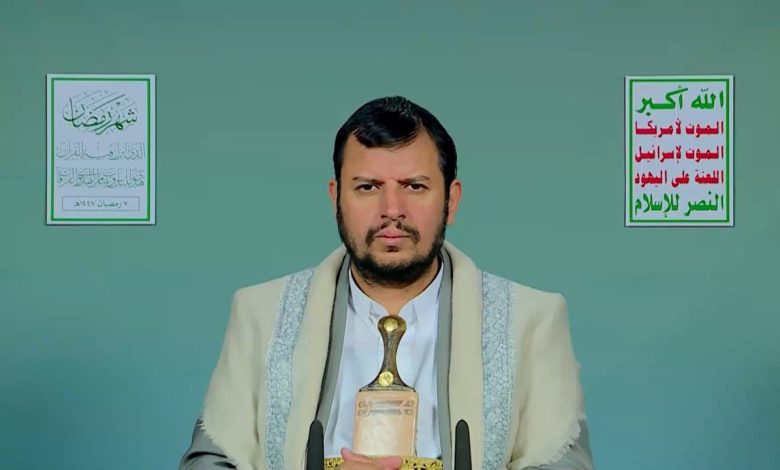
The Seventh Ramadan Lecture by Sayyid Abdul-Malik Badr al-Din al-Houthi, 7 Ramadan 1447 AH
I seek refuge in God from the accursed Satan.
In the name of God, the Most Gracious, the Most Merciful.
All praise is due to God, Lord of the Worlds. I bear witness that there is no god but God, the King, the Truth, the Manifest. And I bear witness that our master Muhammad is His servant and messenger, the Seal of the Prophets.
O Allah, send blessings upon Muhammad and the family of Muhammad, and bestow Your grace upon Muhammad and the family of Muhammad, as You sent blessings and bestowed Your grace upon Abraham and the family of Abraham. Indeed, You are Praiseworthy and Glorious. And, O Allah, be pleased with his chosen and virtuous companions, and with all Your righteous and striving servants.
O Allah, be pleased with Muhammad and the family of Muhammad, and with all Your righteous and striving servants. O Allah, guide us and accept our deeds, for You are the All-Hearing, the All-Knowing. Accept our repentance, for You are the Oft-Returning, the Most Merciful.
O brothers and sisters:
Peace, mercy, and blessings of Allah be upon you.
In discussing the story of the Prophet Moses, in light of the blessed verses of the Quran in (Surah Al-Qasas), in the previous lecture we reached the words of God, Glory be to Him, the Most High: {And the wife of Pharaoh said, “He is a comfort to me and to you. Do not kill him; perhaps he will benefit us, or we will adopt him as a son.” And they did not perceive.} [Al-Qasas: 9]. We concluded the lecture by discussing this blessed verse, which clarifies for us the important role of Pharaoh’s wife, whom the Quran praised even in her stance after the mission of the Prophet Moses, peace be upon him, when she believed in him. Indeed, the Holy Quran presented her as one of the noble examples of believing women. When the ark of Moses, peace be upon him, arrived at Pharaoh’s palace, and she saw it, God instilled love in her, and she loved him immensely. She developed a deep affection and tenderness for him, and she interceded on his behalf. Pharaoh accepted her intercession for the newborn child, whose identity and family were unknown. This, as we explained in the previous lecture, is supported by the blessed verses and was achieved through the intervention of God, the Exalted.
On another note: Moses’ mother, after the mission was completed, having successfully fulfilled it, did so out of faith in God’s true promise. Otherwise, it would have been extremely difficult and arduous for a loving, believing, mature, and upright mother to cast her son into the sea in a small basket, amidst its waves. But relying on God’s promise, may He be glorified and exalted, when He revealed His message to her, promised her, reassured her, and commanded her to do so, she carried out her mission with faith, despite the immense difficulty of her motherhood.
After completing the mission, she knew the destination of the ark, where it would go, as God had informed her in His revelation. However, after she had fulfilled her duty and the ark had disappeared from her sight—she watched until it vanished—she no longer knew the remaining details. She knew that the destination would be the coast, specifically Pharaoh’s palace, that the Pharaohs would take it, and that God would protect it. But what happened after the mission was completed? Did the ark arrive safely? Did Pharaoh’s family take it? What was its condition? What was its state? After completing her mission, she was expected to return home. However, as a mother, with her maternal tenderness, feelings, and emotions, she was in a state of great anxiety and intense psychological distress regarding her son’s fate and the condition of her infant. How was he? These were questions she didn’t know the details of. Had he reached the Pharaohs? Had he passed the danger they posed? This intense psychological pressure is expressed in the Holy Quran, where God Almighty says: {And the heart of Moses’ mother became empty [of all else]. She was about to disclose [his identity] had We not strengthened her heart so that she would be among the believers.} [Al-Qasas: 10]. She had successfully completed her mission, but—as we said—she was ignorant of the details of his condition.
After returning home, as expected, she was plagued by these anxieties: questions about his condition, his whereabouts, and the last time she saw him on the waves, until the scene vanished and she could no longer see him. Her psychological state after completing her mission and returning home, coupled with her lack of knowledge about the fate of her infant whom she had cast into the sea in his coffin, was one of intense anxiety, psychological distress, and fear for her child. She felt no peace or tranquility; she was in a state of extreme psychological turmoil and overwhelming anxiety, a natural reaction for a mother.
At the same time, it has become clear to us, through the blessed verses, that the Prophet Moses (peace be upon him) had already passed the danger of drowning and being killed, but she needed detailed information about her son’s condition.
{She was about to disclose it} [Al-Qasas: 10], meaning: her grief, anxiety, psychological distress, and fear for her infant reached such a point that she almost revealed the matter. She almost cried out from the depths of her being, divulging all her secrets and disclosing the news about her son. She almost went to the people and spoke about the matter due to the intense psychological pressure she was under. However, secrecy and maintaining confidentiality were essential parts of the plan, and crucial for its success within the framework of divine providence. This is a very important point. If she had revealed her situation and that the child was indeed her son, tossed about by the waves and cast into the sea, and the Pharaohs had discovered it, the matter would have been very different. It would have posed a great danger to the infant.
Here we see how divine care manifests itself in times of hardship, which have a profound impact on a person’s psychological state. This may be the case in such situations.