
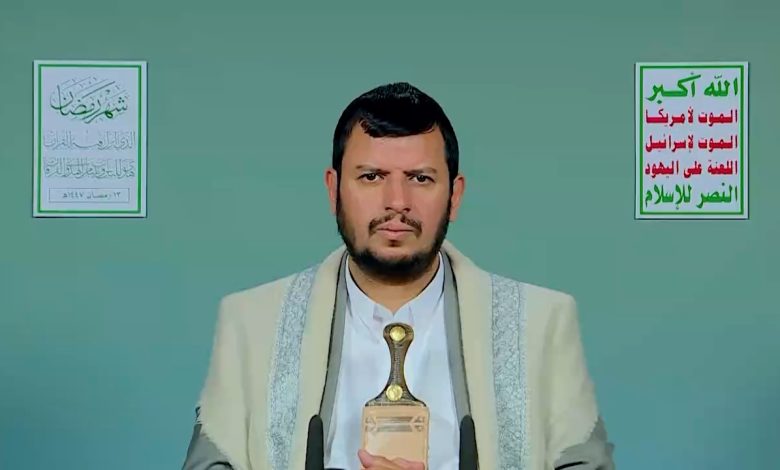
The Thirteenth Ramadan Lecture by Sayyid Abdul-Malik Badr al-Din al-Houthi, 13 Ramadan 1447 AH
I seek refuge in God from the accursed Satan.
In the name of God, the Most Gracious, the Most Merciful.
All praise is due to God, Lord of the Worlds. I bear witness that there is no god but God, the King, the Truth, the Manifest. And I bear witness that our master Muhammad is His servant and messenger, the Seal of the Prophets.
O Allah, send blessings upon Muhammad and the family of Muhammad, and bestow Your grace upon Muhammad and the family of Muhammad, as You sent blessings and bestowed Your grace upon Abraham and the family of Abraham. Indeed, You are Praiseworthy and Glorious. And, O Allah, be pleased with his chosen and virtuous companions, and with all Your righteous and striving servants.
O Allah, be pleased with Muhammad and the family of Muhammad, and with all Your righteous and striving servants. O Allah, guide us and accept our deeds, for You are the All-Hearing, the All-Knowing. Accept our repentance, for You are the Oft-Returning, the Most Merciful.
O brothers and sisters:
Peace, mercy, and blessings of Allah be upon you.
In the previous lecture, in the story of the Prophet Moses, we reached the blessed verses of the Quran, in the words of God, the Exalted: {He said, “My Lord, indeed I have wronged myself, so forgive me.” And He forgave him. Indeed, He is the Forgiving, the Merciful. (16) He said, “My Lord, for the favor You have bestowed upon me, I will never be an assistant to the criminals.”} [Al-Qasas: 16-17]
In the last lecture, we discussed how the Prophet Moses (peace be upon him) was deeply concerned with seeking forgiveness from God (may He be glorified and exalted) for an unintended consequence in his actions—a consequence that wasn’t even considered a crime, but rather a mistake in his approach. This demonstrates:
His great concern and profound desire to ensure his actions were correct, serving the righteous cause and pleasing God (may He be glorified and exalted).
His commitment to discipline in his actions, guided by God’s grace and wisdom.
All of this was before his prophethood; he was a close friend of God, possessing this same concern, faith, and righteous conduct.
Therefore, his concern was not about what might result from it, what might affect his personal situation, his security, his circumstances, his previous position, his material blessings, his high status, and his social standing, as he was considered to be the foster son of Pharaoh’s palace and consequently received attention, as God Almighty had provided for him, and all praise is due to God, may His glory be exalted. So, what might result from the situation in terms of risks to his life, losses in common parlance, meaning: sacrifices in terms of his living conditions, his life circumstances, his stability… and so on, this was not the source of concern for the Prophet Moses, peace be upon him. He was ready, within the framework of the righteous position, to sacrifice everything. Rather, his concern was that no mistake would occur in his position, even unintentionally, and that its result would have a certain impact, even on the level of obtaining forgiveness from God. Therefore, he turned to God, asking for forgiveness, {So He forgave him. Indeed, He is the Forgiving, the Merciful} [Al-Qasas: 16].
The situation he reached after that incident was a new and sensitive stage, a turning point in every sense of the word, a crossroads. The situation was no longer the same. He could continue at the same pace and in his previous position within that society. The Pharaohs would carefully consider what had happened and would take decisive action to get rid of Moses (peace be upon him). If he continued on this path—caring for the oppressed and the downtrodden, striving for their liberation, and attending to their needs—he was at a crossroads:
Either he would continue this role, but under different circumstances and in a different situation.
Or he would move to another position.
He was given the choice to apologize and turn away from this path, to try to appease those parties, to appease the Pharaohs, to seek their forgiveness, and to address what had happened by showing them kindness, abandoning his current approach, his current stance, and the concerns that had driven his actions, namely, caring for the vulnerable and striving for their salvation and deliverance.
This stage was different from anything that had come before, and the incident itself was a turning point; what followed would be different from what came before. So, what was the approach of the Prophet Moses (peace be upon him)?
His stance was as God described in the Quranic verses: {He said, “My Lord, for the favor You have bestowed upon me, I will never be an assistant to the criminals.”} [Al-Qasas: 17]. It was a profound position. He understood all the potential consequences of what had transpired: the increased focus on him as a target, the complete change in his circumstances. He could no longer move about safely, unhindered, under the protection he once enjoyed, nor could he continue to advocate for the oppressed in the same way as before, with the same access granted to him by the Pharaohs. The situation had become precarious.
This is a stage where the Pharaohs will move to take decisive action against him, and he will sacrifice everything: his security, his comfortable life, his living conditions, even risking his life, with all that this entails for the stance he took, a stance of righteousness. He was completely proud and steadfast in his position, and he uttered this great and important statement to express it: {He said, “My Lord, for the favor You have bestowed upon me, I will never be an assistant to the criminals.”} [Al-Qasas: 17]. This expresses his reliance on God, “Glorified be He.”