
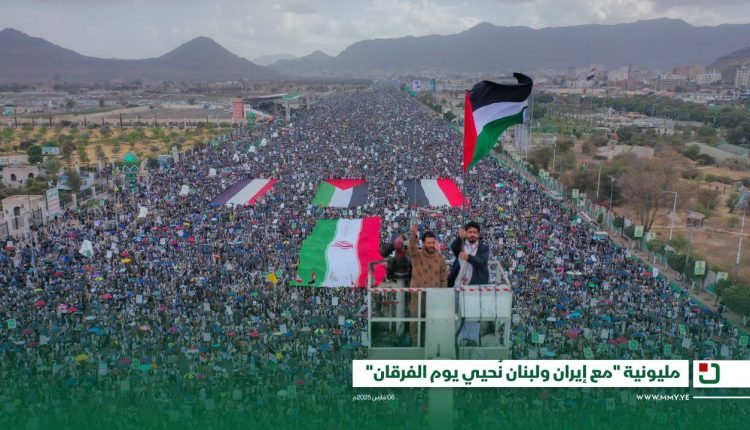
Millions in Sana’a and all liberated provinces declare the nation’s alignment in the battle for awareness and destiny.
In an exceptional display of popular awareness and unwavering principle, massive crowds took to the streets in the capital, Sana’a, and across the liberated provinces to commemorate the Battle of Badr, the Day of Distinction, in marches under the slogan “With Iran and Lebanon, we commemorate the Day of Distinction.” They affirmed that this anniversary is a renewed source of faith, drawing lessons from the struggle between truth and falsehood, and recalling God’s laws of victory and empowerment. These crowds carried profound political and religious messages, clearly expressed in the statement issued by the marches, which emphasized that the anniversary of Badr reminds the Islamic nation of the inevitable triumph of truth, no matter how powerful falsehood may be, and that today’s battle against the Zionist-American project is but a natural extension of that historical conflict between the front of faith and the front of tyranny.
The Day of Distinction: From Badr to the Contemporary Battles of the Nation
The statement issued by the marches affirmed that commemorating the Battle of Badr is a pivotal moment in Islamic history, referred to in the Holy Quran as “The Day of Distinction” because it marked a decisive moment in establishing the foundations of truth and defeating the forces of tyranny, despite the imbalance of material power. This symbolic revival of Badr carries profound significance in the current context. Yemenis across all arenas believe that the nation is facing a new form of global tyranny led by international Zionism through its American and Israeli proxies. They see the ongoing battle as not merely a limited political or military conflict, but a civilizational and faith-based struggle over the future, independence, and identity of the nation. From this perspective, the crowds renewed their pledge to God and His Messenger to remain steadfast on the path of jihad in the way of God and to commit to confronting the forces of hegemony and arrogance, considering this a religious and moral duty mandated by the Holy Quran and a responsibility to defend the nation.
Broad Popular Support for the Resistance Axis
The statement clearly highlighted the Yemeni public’s support for the resistance axis in the region, affirming solidarity with the Iranian people, their Islamic regime, army, and Revolutionary Guard. It praised the strikes launched by Iran and resistance forces against the Zionist entity and American bases in the region. The statement also commended the heroic actions of Hezbollah in confronting the Israeli enemy and the effective operations carried out by the Iraqi resistance against the American military presence. This stance reflects a growing public awareness in Yemen regarding the nature of the ongoing conflict in the region, which many view as a single battle against the Zionist-American hegemonic project, rather than merely separate conflicts between disparate states or forces.
A Message of Deterrence and Open Military Readiness
Among the most prominent strategic messages conveyed in the statement was the affirmation of complete readiness for military escalation and action at any moment dictated by the developments of the battle. This clearly indicates the popular and military preparedness to confront any potential escalation. This affirmation reflects an understanding that the confrontation with the Zionist-American enemy may enter more sensitive phases, especially in light of the ongoing escalation in the region and attempts to expand the circle of conflict by targeting countries and forces supporting the resistance. The statement also affirmed that Yemen considers itself in an open war with its enemies, thus placing the millions gathered within the framework of comprehensive popular mobilization and continuous readiness for any field or political developments.
Confronting the “Greater Israel” Project
In a deeper strategic dimension, the statement asserted that the events unfolding in the region are linked to a broader scheme seeking to impose the “Greater Israel” project and subject the region to Zionist hegemony. This project aims to enforce obedience to the Zionist entity and transform the region’s peoples into weak, subservient entities. This necessitates that the nation confront this scheme by all possible means. Hence, the call was made to the peoples of the nation to raise their awareness of the magnitude of the looming dangers and to take serious action to confront them, relying on and trusting in God, as public awareness is one of the most important factors in thwarting hostile plans.
A Message to Arab Regimes
The statement also addressed direct messages to some Arab regimes that have opened their territories to American bases or provided forms of indirect support to the American-Zionist project in the region. The statement called on these regimes to repent to God for these policies, which it described as a crime against the nation. It warned that turning Arab countries into military bases for enemies poses a threat to the region’s security and stability. It also emphasized that American bases in the region have become a burden and a disgrace, calling for their expulsion from Muslim lands, as they are a primary tool for implementing aggressive American policies.
Condemnation of Targeting Civilians and Attempts to Expand the War
The statement condemned the strikes carried out by the Zionist entity and the United States against civilian targets in some countries of the region, considering these attacks to be part of attempts to drag those countries into a wider conflict with Iran. Participants in the marches believe this strategy aims to ignite widespread regional wars to change the balance of power in the region and weaken the resistance axis.
Significance of the Yemeni Scene
The massive crowds in Sana’a and the other liberated governorates reflect several important implications, most notably the continued popular support for the issues of the Arab nation, foremost among them the Palestinian cause. This also demonstrates the level of mobilization and awareness that has become a prominent feature of the Yemeni scene. Furthermore, this widespread public presence confirms that Yemen has become an active player in the regional conflict equation, and that the popular stance constitutes a fundamental pillar in shaping the country’s direction in the face of external challenges. At the same time, this scene highlights the strong connection between the religious and political dimensions in popular discourse, where Quranic and historical examples, most prominently the Battle of Badr, are invoked to frame the current conflict within a faith-based framework that affirms that victory ultimately belongs to the righteous.
In conclusion
On the anniversary of the Battle of Badr,