The Flames Backfire: When the American Consumer Pays the Price for Aggression Against Iran
The cries of anger emanating from the sides of highways in New Jersey, USA, were not merely an echo of fleeting protests, but rather a stark declaration of the failure of the “maximum pressure” strategy to protect the home front of its proponents.
The moment the Trump administration believed that tightening the noose around the Islamic Republic of Iran would lead to the collapse of its economic system, the spark of this escalation rebounded, igniting the pockets of American citizens and placing their well-being at the mercy of inflation.
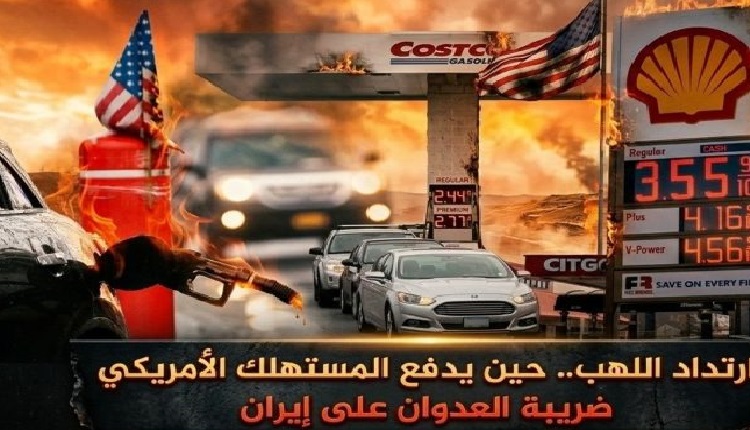
While the political planners in Washington were drawing up scenarios for sanctions, gas stations in Pennsylvania, California, and Texas were recording unprecedented record highs, turning the daily commute of the average American worker into an unbearable financial burden.
This is the paradox of “the flames backfired,” where the consumer in the West is now paying a heavy price for decisions made behind closed doors in the White House, finding himself a forced partner in bearing the costs of a confrontation that has brought him nothing but anxiety, debt, and a loss of control over his meager budget.
The “Gallon” Earthquake and the Cracks in the American Home Front
The story begins behind the wheel of trucks and family cars on American highways, where the sight of a gas meter exceeding seventy dollars for just ten gallons has become a daily nightmare.
The emotions there are devoid of diplomacy; they are a mixture of sheer frustration and simmering anger.
Citizens in New Jersey describe the situation as “utter chaos” created by the Trump administration, where the logic of political power no longer protects the average citizen who watches their wallet empty before their eyes.
The sudden surge in wholesale gasoline prices, which jumped by more than 0.44 cents overnight, was not just a passing figure in economic reports, but an earthquake that struck the purchasing power of the average American.
Today, the American worker finds themselves forced to work grueling overtime, not to improve their standard of living, but simply to secure the fuel needed to get to work and ensure their survival.
This economic pressure has generated palpable discontent, and the pressing question on the American street is: Why should we bear the consequences of political gambles that turn “making a living” into a painful daily struggle?
Anxiety about the near future now dominates the scene, especially given experts’ certainty that the current surge is merely the beginning of catastrophic consequences that will affect all aspects of life.
From Trucks to the Table: The Cycle of the Collapse of Living Standards
The danger of the current crisis lies not only in the price of fuel at the pump, but also in the “ripple effect” that is impacting the shipping and logistics sector.
Diesel, the lifeblood that powers the American shipping fleet, has witnessed exorbitant price increases, forcing cash-strapped transport companies to pass the cost directly on to the customer. At the end of the chain, the consumer stands alone to bear the cumulative burden of these increases.
Markets and major stores in the United States have begun to show signs of a forced shift in the prices of basic commodities; Fresh and frozen produce, meat, and dairy products—commodities requiring frequent shipments to maintain their quality—are now poised for price hikes that will make securing a meal a difficult task.
The impact hasn’t been confined to the land; it has extended to the skies. Airlines, instead of directly raising ticket prices, have resorted to imposing exorbitant “fuel surcharges,” further isolating citizens and limiting their options.
The closure of the Strait of Hormuz, the vital artery through which nearly half of the world’s oil flows, has presented the global economy, and the US economy in particular, with a harsh reality: targeting a major oil producer like Iran inevitably destabilizes the global economy and places the entire world on the brink of a prolonged “stagflation” crisis, restructuring the global energy map on the ruins of Western prosperity.
The Paradox of Resilience: The Reality in the Streets of Tehran
In contrast to this turbulent scene within the US, a paradox has emerged that has astonished international observers and been highlighted by CNN.
While reports spoke of a suffocating siege and ongoing aggression against the Islamic Republic, field visits to Iranian cities revealed an economic reality completely different from Western expectations.
Iranian markets were not only resilient but also bustling with life. Shops were open, and supplies were plentiful, including fresh fruits, vegetables, and domestically produced goods.
Even more surprising was the absence of the panic buying and long fuel lines that have become commonplace in some American states. Gasoline and diesel were readily available in Iran, and citizens there went about their daily lives calmly, reflecting internal stability despite external pressures.
This scene sends a political and economic message: the “zero exports” strategy and direct aggression have failed to break the will of the Iranian people. On the contrary, they have strengthened self-reliance and secured domestic supply chains, while leaving the American citizen to face alone the monster of inflation and the high cost of living resulting from his administration’s policies.
Conclusion: Lessons from the Crisis and Restructuring Reality
Ultimately, economic reality proves that the world is not a collection of isolated islands, and that attempts to harm major energy powers like Iran cannot go unpunished.
The current situation presents the US administration with a popular and historical reckoning. While the American citizen is drowning in fuel debt and high living costs, the world is witnessing how sanctions have become a double-edged sword, their blade striking the very side that wielded them.
Prolonging this aggression will only lead to radical shifts in the global economic landscape, forcing countries to redraw energy maps and seek alternatives that move beyond the hegemony that sacrifices the stability of nations for narrow political agendas.
The American consumer has paid an unsolicited price, and the world has learned a new lesson: that Tehran’s economic stability