
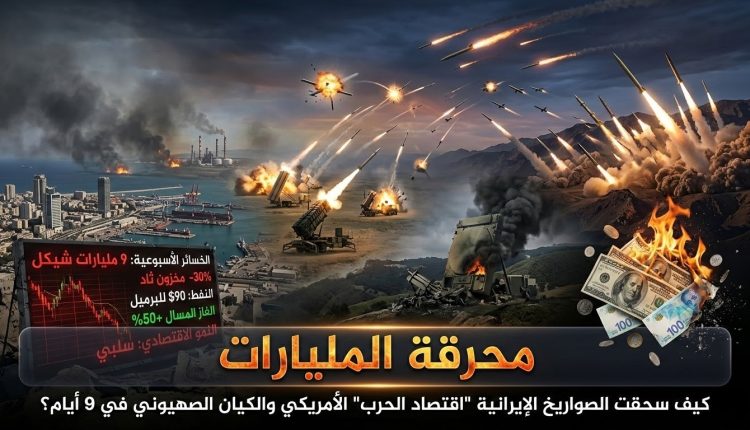
A Billion-Pound Inferno: How Iranian Missiles Crushed the US and Zionist “War Economy” in 9 Days
Behind the smoke of ballistic missiles and the roar of Iranian drones that traversed the skies of the region during the past nine days of fierce confrontation with the US-Zionist aggression, the world awoke to the reality of a new strategy, one not merely written in military statements, but formulated in the language of numbers and harsh financial calculations.
The battle was not simply a test of firepower; it transformed into a “billion-pound inferno” that consumed enormous budgets and depleted strategic reserves that were thought to be inexhaustible.
In just over a week, the illusions of a “swift victory” were shattered by a solid Iranian strategy based on the principle of “prolonged attrition,” which made the cost of defense a burden exceeding the combined capacity of the US economy and the Zionist entity’s financial system.
The “Cost Trap” and the Suicidal Interception
Leaked data from the Pentagon reveals an unprecedented financial shock; In the first week alone of the treacherous aggression against Iran, the direct cost of US military operations reached approximately $6 billion, with an astonishing daily expenditure of $1 billion.
These figures are not merely operational expenses; they represent the bill for the sheer volume of firepower and air sorties that failed to achieve any strategic breakthrough.
The shocking paradox lies in the “economics of confrontation.” Washington found itself forced to use THAAD interceptor missiles, each costing $12 million, and Patriot missiles, costing $4 million each, to counter Iranian suicide drones, the most advanced of which cost no more than $45,000 to manufacture.
This staggering cost gap means that intercepting a single drone could cost Washington the equivalent of producing hundreds of drones. This transformed the defensive battle into a systematic financial suicide and a severe depletion of strategic reserves, with Washington losing nearly 30% of its available THAAD missiles within days.
Early Warning System Paralysis and Technological Blindness
Tehran not only drained the financial coffers but also dealt a very costly technological blow to the American early warning system and the regional defense alliance.
Iran’s success in neutralizing and destroying four advanced radars linked to the THAAD system in countries of the region (Qatar, Saudi Arabia, the UAE, and Jordan) was not merely a military achievement, but also a significant financial and technological loss.
The cost of a single radar of this type ranges from half a billion to one billion dollars.
By striking these technological “eyes and ears,” American and Israeli operations rooms lost the advantage of real-time monitoring, forcing Washington into a state of strategic vulnerability.
This “technological blindness” means that protecting Zionist bases and interests now requires double the expenditure to try to compensate for the deficiency, which military reports describe as a “loss of the backbone” of defensive capabilities in the region, leaving Zionist targets completely exposed to incoming waves of attacks.
The Zionist Economy: Staggering Under the Weight of 70 Billion Shekels
On the other side of the aggression front, the Zionist entity’s economy is experiencing a rapidly accelerating collapse that can no longer be concealed.
Figures indicate weekly losses in the commercial sector reaching 9 billion shekels, with daily military costs exceeding all previous war averages.
Zionist estimates paint a terrifying scenario; a mere four weeks of war would raise the losses to 70 billion shekels, rendering the 2026 budget prepared by the Ministry of Finance “out of context” and irrelevant to the new reality.
With growth stalled and the deficit widening, the political leadership in Tel Aviv has begun searching for a way out of this war, which has transformed into an endless economic war of attrition, especially given the failure of the aggression to destroy Iran’s missile capabilities or nuclear program, and the continued presence of hundreds of ballistic missiles ready for launch in Tehran’s arsenals.
Energy and Waterways: The Global “Hormuz” Earthquake
The economic impact has not been confined to the battlefield; it has extended to shake global energy markets.
Although Iran did not officially close the Strait of Hormuz, the escalation of tensions in the region made its use extremely risky, driving insurance and shipping rates to record highs.
The world witnessed an immediate 50% jump in liquefied natural gas prices after Qatar declared force majeure, and oil prices surged to nearly $90 a barrel, with expectations of reaching $120.
This disruption to supply chains has plunged European countries and the United States into a severe energy crisis, exacerbating domestic public and economic pressures on the Trump administration, which found itself fighting on both a failing military front and a raging global economic front.
Conclusion: The Equation of Miscalculations
Ultimately, the past nine days of confrontation have demonstrated that brute military force and expensive technology cannot resolve conflicts when confronted with a solid Iranian wall, built for a protracted war of attrition.
The American-Zionist dream of regime collapse or a shift in the balance of power has shattered, transforming into a financial and technological nightmare.
The “billion-dollar conflagration” that the region witnessed at the beginning of the ongoing confrontation revealed a profound strategic flaw in American calculations. Washington failed to grasp that Tehran possessed the capacity to impose a “mutual pain” equation with minimal offensive costs and maximum defensive costs.
Today, the region faces a new reality: Iran is closer than ever to imposing new sovereign equations, while the aggressor camp is mired in a quagmire of debt and military and technological losses that could reshape the map of influence in the Middle East in ways Washington never anticipated.