
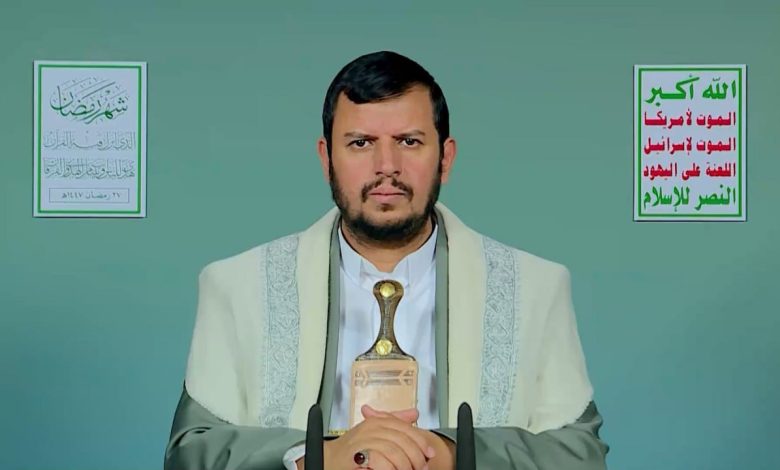
In his twenty-sixth Ramadan lecture, the Leader cites Moses’ confrontation with Pharaoh as a Quranic lesson for overcoming tyranny and building national consciousness.
In his twenty-sixth Ramadan lecture, the Leader, Abdul-Malik Badr al-Din al-Houthi, continues his profound Quranic reading of the story of the Prophet Moses (peace be upon him), focusing on one of the most pivotal scenes in the history of the struggle between truth and tyranny: the direct confrontation between Moses and Aaron (peace be upon them) and Pharaoh in his palace.
Through this Quranic scene, the Leader offers a rich analysis that reveals the nature and methods of tyranny, and contrasts them with the approach of divine messages in confronting despotism and liberating oppressed peoples. The Quranic story here is not presented merely as a historical event, but as an enduring model of the struggle between truth and falsehood, between the divine message that liberates humanity and the tyranny that seeks to enslave and subjugate it.
This lecture highlights how Moses’s address in Pharaoh’s palace was not merely a traditional religious call, but a comprehensive project for liberating humanity from political, intellectual, and ideological enslavement. It was based on reminding people of God’s Lordship, rescuing the oppressed, and establishing proof through evidence and miracles.
First: The Moment of Historic Confrontation… Two Messengers from the Oppressed in the Palace of Tyranny
The Leader begins by accurately portraying the Quranic scene: Moses and Aaron, peace be upon them, enter Pharaoh’s palace alone, without material power or political influence, to confront one of the greatest tyrants in history.
Pharaoh at that time possessed all the elements of power:
Absolute authority.
A large army.
A host of leaders and ministers.
Political and media prestige.
A society that was almost entirely subservient to him.
Indeed, the level of tyranny reached such a point that people deified him and submitted to him completely.
In contrast, Moses and Aaron, peace be upon them, came from a vulnerable and oppressed group, the Children of Israel, without power or resources.
However, the Leader draws attention to a fundamental truth in this context:
Moses and Aaron entered this situation surrounded by divine protection, as God promised them: {He said, “Fear not, for I am with you both, hearing and seeing.”}
This explains their ability to reach Pharaoh and deliver the message despite all the surrounding oppressive circumstances.
Secondly: The Divine Message to Pharaoh… Three Major Themes
The Leader explains that the message Moses and Aaron carried to Pharaoh contained three major themes that formed the core of the divine call.
1. Reminding of God’s Lordship
The first theme of the message was the correction of the doctrinal concept that Pharaoh had distorted.
Moses and Aaron focused in their address on a fundamental truth: that God is the Lord of all worlds.
Here, the Leader explains that focusing on the concept of Lordship carries profound implications:
God is the Creator.
He is the One who manages the affairs of the universe.
He is the Provider and Bestower of blessings.
He is the true Owner of everything.
Therefore, true Lordship means that worship and obedience are due to God alone.
The Leader points out that this address was, in itself, a direct challenge to Pharaoh’s tyranny, whose arrogance had reached the point of forbidding even the mention of God’s name in society.
2. Liberating the Oppressed
The second theme of the message was clearly political and social: {Send the Children of Israel with us}
The demand to free the Children of Israel was not merely a humanitarian request, but a step towards liberating an entire nation from Pharaoh’s system of enslavement.
The Leader explains that Pharaoh practiced against the Children of Israel:
Complete enslavement.
Forced labor.
Humiliation and degradation.
Murder and persecution.
Thus, Moses’ message was a project to rescue an oppressed nation from the grip of tyranny.
The Leader connects this Quranic scene to the reality of the nation today, pointing out that tyrants in our time also seek to enslave and humiliate peoples, foremost among them the Zionist entity, which practices policies similar to Pharaoh’s tyranny.
3. Glad Tidings and Warning
The third theme of the message was the combination of:
Glad tidings for those who follow guidance.
Warning for those who deny and turn away.
The divine call is not merely a doctrinal discourse, but a comprehensive methodology for goodness and human dignity.
Human beings have no justification for rejecting God’s guidance, because this guidance is, in reality, the path to their success and dignity in this world and the hereafter.
Third: Pharaoh’s Methods in Confronting the Truth
After Pharaoh listened to the message of Moses and Aaron, he began to employ a set of methods that tyrants typically resort to in order to confront the truth.
The Leader meticulously examines these methods.
1. Personal Defamation
Pharaoh’s first act was to attempt to defame Moses.
He reminded him that he had been raised in his palace, accused him of ingratitude, and alluded to the previous murder incident.
The aim was not to seek the truth, but rather to tarnish Moses’ image in the eyes of the people so they would not accept his message.
2. Raising Doubts and Controversy
Pharaoh then resorted to contrived theological debate, asking, “Who is your Lord, O Moses?”
But Moses answered him with clear proofs:
God is the One who gave everything its form and then guided it.
He is the Lord of the heavens and the earth.
He is the One who manages the affairs of the universe.
These are proofs that the Leader described as clear, innate proofs that every person can understand with their intellect.
3. Ridicule and Propaganda
When Pharaoh was unable to respond with reasoned arguments, he resorted to ridicule and media manipulation.
He said to the assembly, “Do you not hear?” Then he accused Moses of madness.
This is a common tactic among tyrants when they are unable to confront the truth with logic.
4. The Threat of Force
After his arguments completely collapsed, Pharaoh resorted to the explicit language of tyranny:
“If you take a god other than me, I will surely put you among the prisoners.”
Here, the leader clarifies that when tyrants fail in the intellectual battle, they resort directly to oppression and force.
Fourth: The Miracle… The Moment of the Collapse of Tyranny’s Aura
When the discussion reached this point, Moses, peace be upon him, showed the sign…