
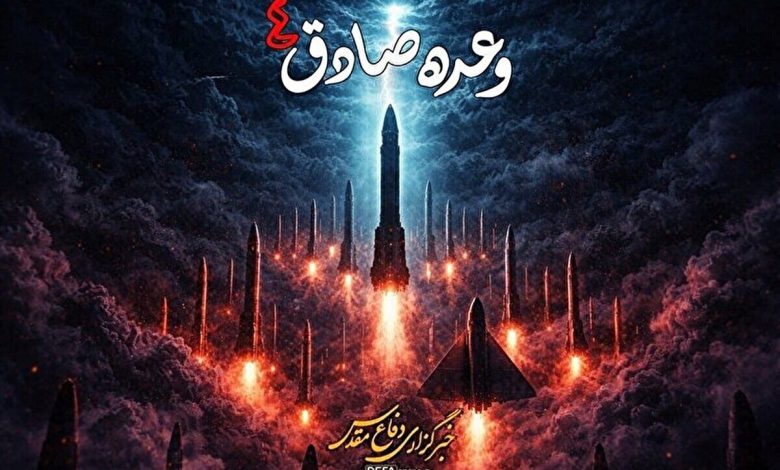
“True Promise 4” Escalates to a Decisive Climax: Iran Strikes US Bases and Targets the Zionist Nuclear Core
In a development reflecting an unprecedented escalation in the confrontation, the Islamic Republic of Iran continued its qualitative military operations within “True Promise 4,” through successive waves that transcended the traditional framework of retaliation, transforming into a strategic war of attrition waged with a long-term strategy and a broad target bank.
From striking more than 70 targets deep within the occupied territories to targeting US bases in the Gulf, a new equation is emerging: a widening front, eroding deterrence, and escalating costs for the American-Zionist enemy.
Successive Waves: From 79 to 82: Calculated Escalation and Precise Strikes
The Khatam al-Anbiya Headquarters announced details of waves 79, 80, 81, and 82 of “True Promise 4,” revealing an unprecedented scale of strikes targeting enemy military, security, and strategic sites simultaneously.
The operations targeted more than 70 sites within the occupied Palestinian territories, including Haifa, Dimona, and Hadera. Strikes also targeted US bases scattered throughout the region, including Azraq, Sheikh Issa, Ali Salem, and Arifjan, clearly demonstrating the comprehensiveness of the target bank and the wide scope of the engagement.
Wave 82: Striking the Sensitive Heartland: From Radars to Nuclear Infrastructure
The 82nd wave of attacks marked a significant turning point. Executed under the banner of “Ya Ali al-Akbar,” it involved a complex assault that began with swarms of suicide drones before ballistic and cruise missiles were deployed.
The strikes targeted vital installations, most notably:
Destruction of a Patriot radar at Sheikh Issa Air Base.
Targeting the P-8 and MQ-9 reconnaissance aircraft sites.
Striking fuel tanks and satellite communication systems.
Bombing the enemy’s military command and control center.
Targeting industries associated with the nuclear infrastructure south of the Dead Sea. Enemy media outlets also acknowledged a rocket landing in the heart of occupied Jaffa (Tel Aviv), causing widespread paralysis and forcing settlers to remain in shelters for hours.
US Bases Under Fire: From the Gulf to Erbil
In parallel with striking deep inside Israel, Iran intensified its targeting of US bases, striking strategic locations in the Gulf, in addition to targeting gatherings of US forces and their proxies in Erbil.
In a significant development, Qadir-class naval cruise missiles were launched toward the US aircraft carrier USS Abraham Lincoln, forcing it to change its position and temporarily suspend operations. This clearly indicates the battle has shifted to the sea and poses a threat to one of the most important symbols of American power.
220 Operations on a Single Front: The Integration of the Resistance Axis
Within the context of Operation 82, the Islamic Revolutionary Guard Corps announced the execution of extensive operations in coordination with the forces of the Resistance Axis, totaling 220 operations, distributed as follows:
110 operations by the Iranian Armed Forces.
87 operations by the Islamic Resistance in Lebanon.
23 operations by the Islamic Resistance in Iraq.
This operational integration reflects the unity of the fronts and the crystallization of the “joint battle” equation, thus increasing pressure on the enemy and opening multiple fronts simultaneously.
Continued Defensive Superiority: Downing Aircraft and Foiling Infiltrations
On the defensive front, Iran announced the downing of a US F-18 fighter jet over Chabahar, in addition to destroying an enemy reconnaissance drone after it violated Iranian airspace in Qazvin province.
The Revolutionary Guard Corps confirmed that its air defense systems are in a state of high readiness, capable of detecting and intercepting any threat, which enhances Iran’s ability to manage a comprehensive battle combining offense and defense with high efficiency.
Field Messages: Ground War a Costly Option for the Enemy
In assessing the implications of the escalation, Brigadier General Amir Jahanshahi, Commander of the Iranian Army’s Ground Forces, emphasized that any attempt by the enemy to transition to a ground war would be more dangerous and costly, stressing that the armed forces are monitoring all movements and preparing for all scenarios.
A New Equation of Fire Redraws the Balance of Power
The unfolding events of the escalating waves of “Operation True Promise 4” reveal that Iran is not merely responding, but rather working to reshape the conflict environment and impose new deterrent equations. These equations are based on expanding the front, striking deep within enemy territory, and targeting the enemy’s military and economic centers of gravity.
With American bases and aircraft carriers now within the target range, and with the resistance fronts becoming more integrated, the region appears to be facing a profound strategic shift. Its defining characteristic is the end of secure superiority and the beginning of a phase where equations are imposed by fire, and the balance of power is rewritten on the battlefield.