
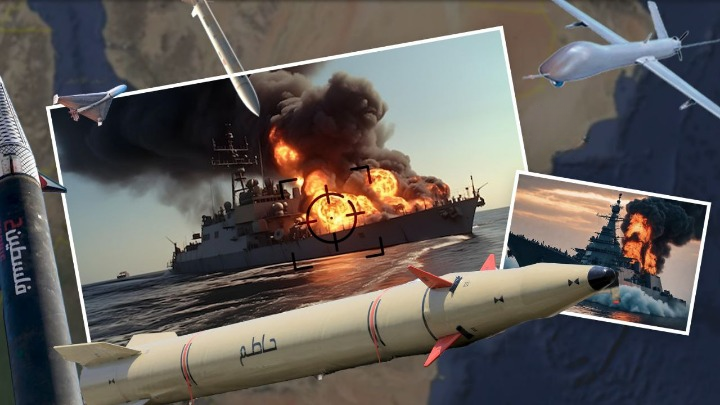
Bab al-Mandab Makes Its Mark: Yemen Terrifies the USS Gerald Ford and Shatters the Prestige of American Fleets
In a scene reflecting the profound shifts in the balance of power in the region, Brigadier General Esmail Qaani, commander of the Quds Force of the Iranian Islamic Revolutionary Guard Corps, revealed one of the most prominent examples of American failure in the Red Sea. He asserted that the American aircraft carrier USS Gerald Ford did not dare to cross the Bab al-Mandab Strait, fearing the might of the heroic resistance fighters and the steadfast Yemeni people.
In a striking statement on Saturday, Qaani said that the criminal US President Donald Trump should dismiss the commander of the aircraft carrier USS Gerald Ford, as he did with other military leaders. He pointed out that the American commander hesitated for two full weeks before fabricating excuses to withdraw and flee the Red Sea and the region. He added that the fate of all American terrorist forces is to flee the region, fearing the strikes of the Resistance Axis.
He explained that this withdrawal is not an exceptional case, but rather part of an escalating trend of American retreat, emphasizing that the fate of all American terrorist forces in the region is to flee. This is a reference to the growing capabilities of resistance forces and the establishment of new deterrent equations imposed by the battlefields.
These statements come in the context of a series of dismissals within the American military establishment recently, with the dismissal of approximately 12 high-ranking officers, including the Chief of Staff of the Army, indicating the extent of the failures Washington is facing in managing its foreign conflicts.
In the same vein, Ebrahim Azizi, head of the National Security and Foreign Policy Committee in the Iranian Parliament, reiterated that the American presence in the region has become precarious and has no option but to withdraw, revealing that American forces have suffered significant field losses.
Azizi stated in a post on the “X” platform that “five American warplanes and helicopters were shot down, and you experienced a dark day. You have no choice but to flee the region,” directly describing the scale of the blows suffered by American forces.
Tehran also announced in recent hours the downing of two American fighter jets, a significant development reflecting the escalating level of engagement and the widening scope of the confrontation. This confirms that a new phase of the conflict has begun, one aimed at breaking American hegemony and establishing deterrence equations from the Red Sea to the heart of the region.
These developments collectively reflect a strategic shift in the conflict landscape. American aircraft carriers are no longer able to project power as effectively as before, given the growing capabilities of the resistance axis, particularly Yemen, which has become a pivotal player in protecting maritime routes and establishing deterrence equations in one of the world’s most strategically important regions.