
$11 Billion in Losses for Yemen’s Culture, Tourism, and Antiquities Sectors Due to the Brutal Aggression: Detailed Explanation
The US-Saudi-Emirati aggression against the Yemeni people was not merely a military conflict over territory, but rather a battle targeting Yemeni identity and memory, according to the latest official data released by the Ministry of Culture and Tourism in a report commemorating National Resilience Day. The data not only presented financial figures but also painted a picture of systematic destruction affecting a history spanning thousands of years.
The Price of a Decade of Isolation: A Collapse of Figures
Yemen has been transformed from a promising global destination that aspired to bolster its foreign currency reserves into a crippled tourist hub.
According to a report issued today, Monday, Shawwal 18, by the Ministry of Culture, the cultural sector has suffered direct losses exceeding $11 billion.
This hemorrhage was not accidental, but a direct result of the aggression and suffocating blockade imposed on Yemen by the Saudi-led coalition for the past 11 years. This has led to a reduction in tourism’s contribution to the GDP from 6% to a near-total deficit (less than 1%).
It has cut off the livelihoods of half a million families who depended on this sector.
It has caused the disappearance of nearly 400,000 foreign tourists and half a million Yemeni expatriates who used to inject economic lifeblood into the country annually.
The Silent Assassination of Heritage: Cities Adrift:
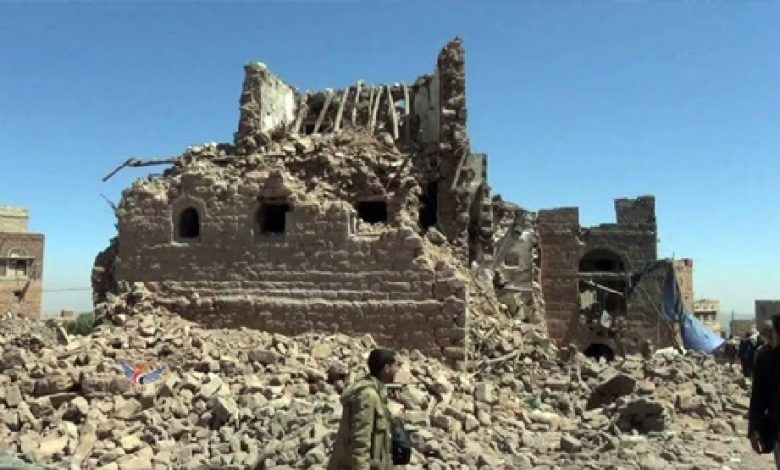
The US-Saudi-Emirati aggression has left behind a “silent massacre” of historical landmarks. The report indicates that the targeting was not random, but rather struck at the very heart of Yemeni identity through:
The destruction of historical cities: More than 5,000 historic houses have been damaged, and the walls of ancient cities listed on UNESCO’s World Heritage List have collapsed.
The aggression targeted the “guardians of history”: 48 castles and fortresses that had stood for centuries were destroyed by modern American, Saudi, and Emirati missiles.
The destruction of the tourism infrastructure: More than 250 hotels and dozens of other facilities were reduced to rubble, resulting in the dismissal of 95% of the workforce.
The greatest theft: The hemorrhage of antiquities and manuscripts
The report addressed a crime no less serious than the bombing: “organized looting.” The aggression and its proxies exploited the chaos to carry out the largest theft of Yemeni antiquities:
8,000 artifacts were smuggled abroad, of which the General Authority for Antiquities has identified 2,000 pieces being sold at international auctions with unprecedented audacity.
14,000 rare manuscripts, representing intellectual and scientific treasures, were seized from libraries and museums and smuggled across borders.
Legal Action: Will the International Community Respond?
The Ministry of Culture and Tourism has not only monitored the situation but has also placed the international community and its organizations, foremost among them UNESCO, before a historical responsibility. Silence in the face of the destruction of this “land of humanity” constitutes complicity in the crime.
The report emphasized that Yemen will not relinquish its legal right to: “prosecute those involved and recover every grain of sand or artifact looted during the years of aggression, as these are rights that do not expire with time.”
Today, the tourism and cultural sector in Yemen faces the challenge of “rising from the rubble,” with technical committees still working to inventory what remains of the heritage, awaiting the moment the American-Saudi-Emirati aggression ceases so that what can be salvaged of the history of “Happy Yemen” can be restored.