
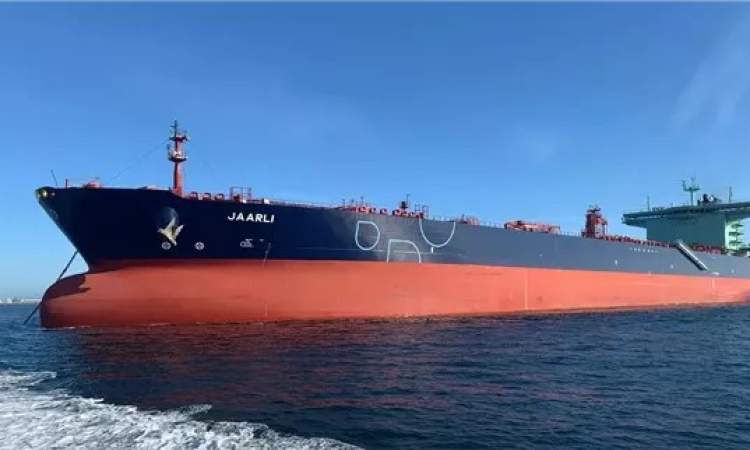
CNN: One oil tanker transits the Strait of Hormuz after paying fees to Iran
The Iranian Revolutionary Guard Corps Navy announced on Friday that the management of the Strait of Hormuz has entered what it described as a “new phase,” according to the semi-official Iranian news agency Tasnim.
The Revolutionary Guard Corps Navy stated, “During these two days of military silence, both enemies and friends have realized, through experience, that the management of the Strait of Hormuz has entered a new phase.”
The Iranian Revolutionary Guard Corps Navy had previously issued a statement on Thursday regarding what it called “alternative routes” for navigation in the Strait of Hormuz, according to Tasnim.
The Islamic Revolutionary Guard Corps (IRGC) Navy stated that, “Given the current state of war in the Gulf and the Strait of Hormuz, and the potential presence of various types of anti-ship mines in the main shipping lane of the Strait of Hormuz, all vessels intending to transit the Strait of Hormuz are hereby notified, in accordance with the principles of navigational safety and protection against potential collisions with sea mines, to coordinate with the IRGC Navy in the Strait of Hormuz.”
Last Wednesday, the IRGC announced that maritime traffic in the Strait of Hormuz had slowed sharply and then come to a complete standstill, following what it described as an Israeli violation of the ceasefire in Lebanon.
Meanwhile, a CNN analysis of shipping data revealed that only one oil tanker, subject to US sanctions, had transited the Strait of Hormuz on Friday, as of 5:30 PM Tehran time (10:00 AM Eastern Time). This was after the tanker paid transit fees to Iranian authorities.
The oil tanker MAP 5, flying the Botswana flag, transited the vital waterway earlier on Friday, according to its Automatic Identification System (AIS) data on the MarineTraffic vessel tracking platform.
However, ships can disable AIS data transmissions, which reveal their location, meaning more vessels could be crossing the strait undetected by maritime tracking systems.
A dhow, flying the Indian flag and likely a small cargo ship, also transited the strait into the Gulf of Oman. Two other vessels, a Panamanian-flagged cargo ship and an Indian-flagged cargo ship, passed through the waterway into the Arabian Gulf.
Shipping traffic through the strait, which typically carries a fifth of the world’s oil, has remained low since US President Donald Trump announced a ceasefire between the United States and Iran late Tuesday.
A return to the pre-war average of 107 shipping vessels transiting the strait daily, according to Lloyds List data, is crucial for the global economy. Huge supplies of oil, natural gas and fertilizers remain far from the markets, driving up prices and threatening supply shortages.