
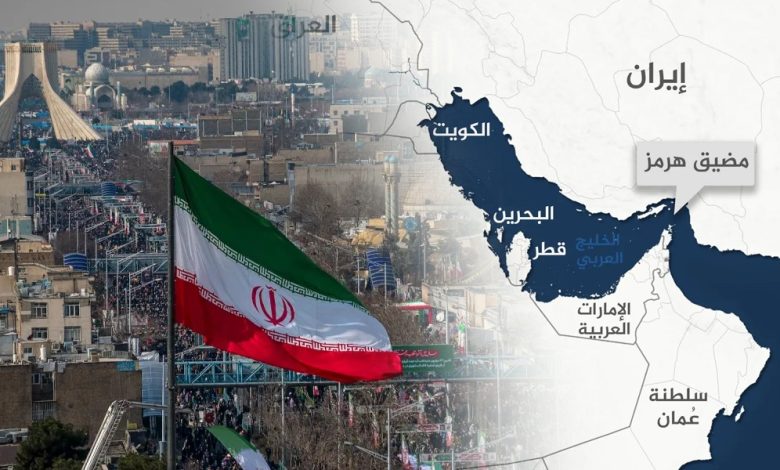
Hormuz in the Deterrence Equation: Iran Imposes New Rules of Engagement and Affirms Comprehensive Readiness
Amid escalating regional tensions and increasing signs of confrontation on multiple fronts, Iran emerges as a pivotal player, continuing to solidify deterrence equations and redraw the rules of engagement in the region. This is based on escalating military readiness and a political discourse that emphasizes the shift from a defensive posture to one of imposing a balance of power.
These developments come at a time when strategic maritime routes, most notably the Strait of Hormuz, are witnessing heightened political and military tensions, reflecting the magnitude of the ongoing shifts in the regional balance of power.
Constant Readiness and Preparedness
The Commander-in-Chief of the Iranian Army, Major General Amir Hatami, affirmed that the Iranian Armed Forces, across all branches—land, air, sea, and air defense—are at the highest levels of readiness, stressing that any threat will be met with a “decisive and painful” response.
He explained that Iranian forces continue to perform their defensive duties according to a doctrine based on constant readiness, protecting national sovereignty and territorial integrity, and maintaining full coordination among the various military formations.
Rapid Development of Capabilities
In the same context, Brigadier General Majid Mousavi, commander of the Aerospace Force of the Islamic Revolutionary Guard Corps (IRGC), revealed that Iran continues to rebuild and develop its missile and drone systems at an accelerated pace during periods of de-escalation, noting that the current level of readiness surpasses that of previous confrontations.
He emphasized that this development reflects a qualitative shift in Iranian military capabilities and places it in an advanced position within the regional deterrence equation.
A Speech Emphasizing Defense
For his part, Iranian President Masoud Pezeshkian stressed that his country is not seeking to expand the scope of the war, affirming that its actions fall within the framework of “legitimate self-defense” only.
He also reiterated Iran’s commitment to its rights, particularly regarding the nuclear issue, and its rejection of any attempts to impose restrictions on it outside of fair legal and international frameworks.
Hormuz: A Pivotal Point
Meanwhile, the Strait of Hormuz has emerged as a major issue, with Iranian Parliament Speaker Mohammad Bagher Ghalibaf asserting that the strait is now under Iran’s de facto control and that American threats have lost their practical impact.
He indicated that Iran has emerged from recent experiences stronger and more resilient, and that any attempt to impose external will on this strategic waterway will be met with a direct response.
The Iranian Foreign Ministry also stated that the notion of “unconditional freedom of passage” is no longer valid, signaling a reformulation of the rules governing the strait in light of the new realities.
On the Ground: Deterrent Messages
On the ground, reports indicate that Iranian armed forces forced two oil tankers to change course and return while attempting to transit the Strait of Hormuz. This move practically reflects the level of field readiness and aligns with the ongoing political escalation.
These actions demonstrate the shift of Iranian deterrent messages from the political level to direct field action, reinforcing the Strait of Hormuz’s position as a key tool of strategic pressure in any future escalation.
A Steadily Forming Equation
The sum of Iranian statements and actions reveals a new phase in establishing a deterrence equation, based on a combination of high military readiness, firm political rhetoric, and meticulous management of sensitive strategic locations.
In this context, the Strait of Hormuz emerges as a pivotal point in this equation, as Tehran works to solidify a new field and strategic reality that makes any movement in this vital waterway subject to deterrence considerations, reflecting the magnitude of the shift in the regional balance of power.