
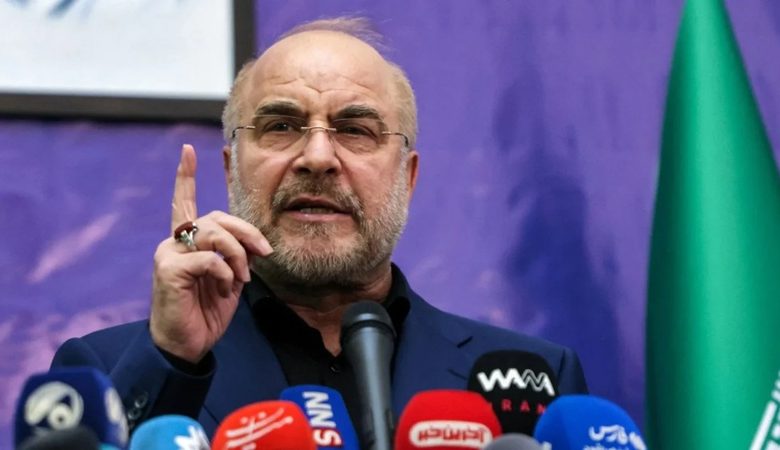
Qalibaf: Hormuz Under Iranian Control… and US Threats Fall Apart
Iranian Parliament Speaker Mohammad Baqer Qalibaf asserted that the Islamic Republic emerged victorious from the “third imposed war,” which began with American treachery and the assassination of leaders and the martyred Imam. He emphasized that the enemy failed to achieve any of its objectives, and Trump was forced to request a ceasefire after 40 days of confrontation.
In an interview with Iranian television, Qalibaf explained that Iran emerged from this war significantly stronger in both offensive and strategic capabilities. He revealed the development of new defensive capabilities within a few months, enabling it to target 180 drones.
He indicated that targeting the F-35 fighter jet was not accidental, but rather a complex technical operation that allowed the enemy to understand the nature of Iran’s capabilities and the path Tehran is pursuing. He affirmed that the enemy’s bombing failed to destroy missile capabilities or damage launch platforms.
He added that the enemies sought to incite internal chaos but failed, and then decided on a ground offensive, which also failed. He continued, “We were resolute when we pursued our work in the military sphere, and today we continue our work with the same resolve.”
He affirmed that Iran is “fully prepared to respond should the enemy make any mistake, at any moment.”
Qalibaf emphasized the absence of any disconnect between the military, the public, and diplomacy, noting that the Iranian people’s steadfastness and their presence in the streets for 50 nights is the reason for the strength of the military position.
He added that the United States, which mistook Iran for Venezuela and sought to incite internal chaos and breach its western borders, completely failed in its endeavors. Furthermore, no one responded to Trump’s call for NATO to participate in reopening the Strait of Hormuz.
The Speaker of the Parliament revealed that Washington sent messages and proposals comprising 15 points through Pakistan after failing to meet its demands, indicating that the Supreme National Security Council had thoroughly reviewed them.
He emphasized that the task of securing the people’s rights is now being undertaken by “powerful diplomacy,” stressing that American threats have become ineffective after Iran’s firm response to every warning.
Qalibaf also pointed to the complete readiness of the armed forces to respond to any mistake the enemy might make at any moment, saying, “Just as the people are ready in the streets, so too are the armed forces fully prepared,” with the aim of preventing the enemy from imposing its will and securing the rights that the Iranian people have won through their strength.
Qalibaf indicated that the enemy had submitted a 15-point proposal, which was presented by the Pakistani side and thoroughly reviewed by the Supreme National Security Council.
Qalibaf revealed details of the negotiations that led to the ceasefire, confirming that Tehran rejected the American 15-point proposal and instead presented 10 points guaranteeing the rights of the Iranian people and stipulating a ceasefire in the region, particularly in Lebanon, as a fundamental condition for the resumption of normal traffic in the Strait of Hormuz.
Qalibaf explained that the Iranian side, in close coordination with the Supreme Leader, insisted on its ten points, which included Hezbollah as an integral part of the agreement. He added that their discussions centered on Hezbollah also being part of the ceasefire.
He further stated that when the Pakistani Prime Minister posted his tweet, he also mentioned Hezbollah, and that all of this “forced the Americans to accept the Iranian conditions, ultimately compelling Trump to publish the Iranian demands on social media to ensure their implementation.”
Qalibaf Regarding the frozen Iranian funds, Qalibaf stated that their release, along with a ceasefire in Lebanon, was among Iran’s demands that must be met. He continued, “We said that if the demand for a ceasefire in Lebanon and the release of the frozen funds is not met, we will not discuss the remaining ten points.”
Qalibaf revealed that he spoke for two hours and fifteen minutes with the Pakistani army chief about the ceasefire in Lebanon, and that it was the first issue he discussed with the Americans. He added, “We said that if the ceasefire in Lebanon is not implemented, we will not continue negotiations and will start a war. That is why we closed the Strait of Hormuz.”
Qalibaf emphasized that American threats have become ineffective in the face of Iran’s firm responses, asserting that the Strait of Hormuz is now under the control of the Islamic Republic, which has transformed its capabilities there from “latent to active.”
Qalibaf clarified that Iran is not seeking to destabilize security, but rather invites non-hostile countries to utilize the Strait. He noted that he informed the American side of the necessity of “building trust first” in response to their talk of “good relations.” “Intention.”
Qalibaf considered negotiation to be “a method of struggle” to restore the rights of the Iranian people, for which Tehran is prepared to shed blood, asserting, “For me, there is no difference between negotiating papers and war maps.”
Qalibaf declared that the Iranian people had managed to bring a superpower called the United States and the Zionist entity to its knees, emphasizing that “no negotiations took place before the ceasefire, and Trump is a master of deception.”
He explained that “the 10-point plan was presented in the last 48 hours before the ceasefire,” adding, “Ultimately, our will prevailed, and now we also say that if the naval blockade against us continues, we will continue to close the Strait.”
Regarding the ongoing negotiations to reach an agreement, Qalibaf said that “some issues in the negotiations with the Americans have reached a conclusion and result, while others have not,” adding, “We are still far from a final agreement, and we insist on certain issues, and these demands are non-negotiable.”
He concluded, “In general, it must be said that we have made progress in the negotiations, but gaps remain.” The issue remains significant, and now Washington must decide whether to earn the trust of the Iranian people. If they wish to respond in good faith, they must abandon their unilateral and domineering approach.
Regarding Iranian policy, Qalibaf concluded the interview by saying: “Our policy is to adhere to our commitments step by step. Things shouldn’t proceed in a way that allows us to fulfill our obligations while they renege on theirs.”