
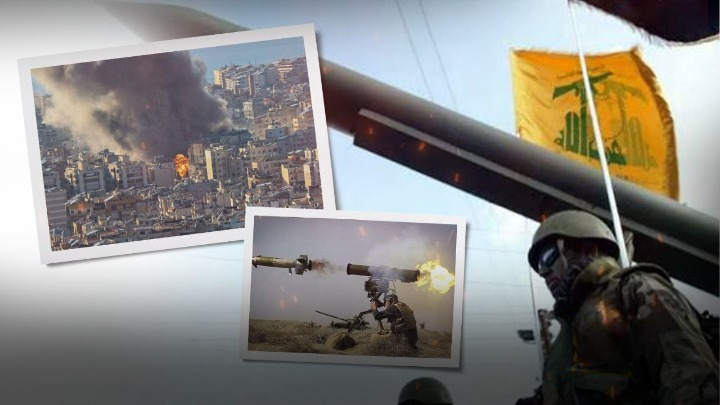
Ongoing Escalation in Southern Lebanon: Resistance Responds Effectively as Enemy Violations Continue Amid Growing Incapacity
Amidst the ongoing Zionist violations of the ceasefire agreement, the situation on the ground in southern Lebanon is escalating, reflecting a renewed confrontation between the Islamic Resistance in Lebanon and the Israeli enemy. The Resistance’s military operations are intertwined with the enemy’s crimes of shelling, destruction, and bombing of border villages and towns, confirming that the declared “truce” has become nothing more than a flimsy cover for expanding its aggression.
Qualitative Operations by the Resistance and Direct Targeting of Enemy Positions
The Islamic Resistance in Lebanon announced the execution of a series of military operations in recent hours, including missile and artillery strikes and drone attacks, demonstrating an advanced level of readiness and capability to counter various Israeli enemy movements.
In a notable development, the Resistance targeted the settlement of Shtula with a missile barrage at night, reflecting the continued inclusion of settlements within its deterrent target bank.
In southern Lebanon, an Israeli military bulldozer was targeted while demolishing homes in the town of Rashaf. A drone accurately struck its target, sending a clear message that the Israeli destruction operations within Lebanese villages are now exposed and will be met with direct confrontation.
The resistance also targeted a gathering of Israeli soldiers and vehicles near the Jamil Bazzi School in Bint Jbeil with artillery fire, as part of its campaign to strike Israeli field positions along the border.
In another operation, the resistance targeted a gathering of Israeli soldiers in the town of Qantara with a drone, confirming a direct hit.
A significant development: An Israeli drone shot down in southern Lebanon.
In a parallel development, Hezbollah announced the downing of an Israeli Hermes 450 drone in the airspace over the Tyre-Housh area with a surface-to-air missile, marking a significant escalation in the aerial confrontation.
The enemy army admitted losing contact with the aircraft before acknowledging its downing, indicating a decline in the ability of the Zionist enemy’s air defense systems to operate freely in the skies over southern Lebanon.
This coincided with Zionist admissions of soldiers being wounded during clashes in southern Lebanon, reinforcing indications that any Israeli ground movement or military deployment has become vulnerable to direct targeting.
Heavy enemy losses and an internal assessment: “Back to the Lebanese quagmire.” The Hebrew media, for its part, reflected a growing state of confusion, with a military source admitting to a Hebrew newspaper that the situation in southern Lebanon is extremely dangerous, noting that the rules of engagement have changed radically since the period preceding the regional escalation.
In a striking commentary, Zionist media outlets warned that the entity may have “slid back into the Lebanese quagmire,” referring to the previous 18-year military experience in southern Lebanon.
Hebrew analyses also pointed to the absence of an “ideal solution” to extricate itself from the current situation, reflecting an erosion of the ability to impose stable deterrence equations.
Zionist Violations: Bombing, Demolition, and Direct Targeting of Civilians
In parallel with the resistance’s field operations, the Israeli enemy continues its violations of the ceasefire agreement through a series of attacks that include artillery shelling, airstrikes, and the demolition of homes in border villages.
Two civilians were killed in an Israeli airstrike on the town of Tulin in southern Lebanon, a dangerous escalation that brings back to the forefront the policy of targeting civilian areas.
The attacks also targeted the town of Deir Amas, coinciding with heavy artillery shelling of several southern areas, in addition to demolition operations in Bint Jbeil and the town of Hanin, and widespread explosions in residential areas.
These operations reveal an escalating pattern of systematic targeting of residential infrastructure in an attempt to forcibly alter the situation on the ground, while simultaneously preventing the return of residents or the establishment of their presence in the border villages.
Field Analysis: House Demolitions as a Pressure Tactic and a New Reality on the Ground
Field data indicates that the policy of demolishing houses is no longer merely an isolated military operation, but has become part of a broader approach aimed at reshaping the geographical reality along the border strip.
Conversely, the scenes of residents returning to their destroyed homes and clinging to their land present a paradox on the ground, contrasted with the escalating crisis facing the Israeli enemy entity in the northern settlements, where waves of internal displacement have continued since the recent confrontations.
The Resistance’s Position: Establishing the Equation of Deterrence and Preventing Violations
In this context, the Islamic Resistance affirms that its operations are a direct response to Israeli violations, within a clear framework based on preventing the “ceasefire” from becoming a cover for unilateral targeting.
Statements issued by resistance leaders indicate that overlooking violations has only led to an expansion of the aggression, which proves that effective deterrence can only be achieved through direct force and field readiness.
Lebanese Political Stances Differ and Tensions Emerge in Official Interpretations
On the political level, a discrepancy exists between official Lebanese rhetoric advocating de-escalation and stability, and the reality on the ground, which demonstrates the continued and unabated Israeli attacks.
In contrast, members of the “Loyalty to the Resistance” bloc emphasized that any truce granting the occupation freedom of action is not a balanced agreement, but rather a form of political deception, warning against sliding into unequal negotiation tracks.
Summary of the Situation
The situation in southern Lebanon is becoming increasingly complex, with three main developments intersecting:
A coordinated escalation on the ground by the resistance through precise and gradual targeting.
The continuation of Zionist violations through shelling, bombings, and targeting of civilians.