
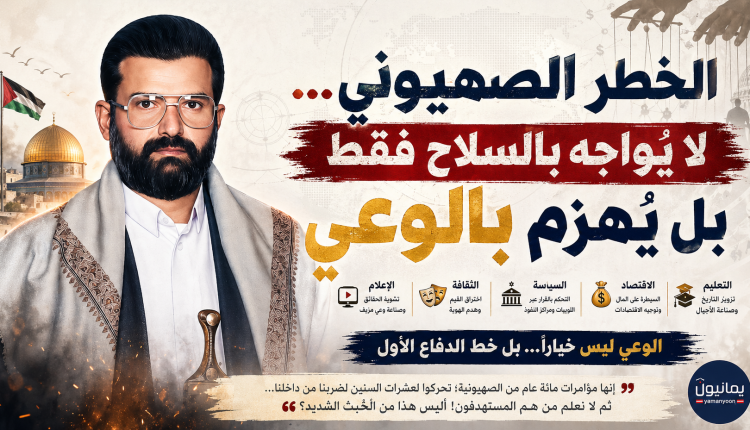
The Battle for Consciousness: How is the Conflict Being Reshaped in Contemporary Discourse?
The conflict in the region is no longer measured solely by what happens on the ground, but also by what is shaped in people’s minds. In a profound reading of the martyr leader Hussein Badr al-Din al-Houthi, may God be pleased with him, the confrontation transforms from a traditional conflict into a protracted project targeting consciousness before geography. Words, images, and narratives become tools no less influential than weapons. Within this context, the martyr of the Quran sounds the alarm, warning of an expansive Zionist project that does not stop at military occupation but penetrates the cultural and psychological depths of the nation.
From Direct Confrontation to “Managing Perception”
Developments in recent years, particularly since the Gaza War following the October 7 attacks, demonstrate that the battle is no longer confined to the land, but extends to who narrates the events, how they are presented, and which narratives disseminate globally. International and Arab media outlets have faced repeated global criticism regarding their coverage of the war, reflecting the sensitivity of “narrative management” in the conflict.
Media as a Tool of Influence
The media is no longer a neutral conduit, but rather an arena of competition. Platforms like X and TikTok have become major arenas for shaping public opinion. A single video can shift the course of a global debate within hours. Conversely, digital disinformation campaigns, organized accounts, and manipulated algorithms are all factors used to influence the audience, which media studies call “information warfare.”
Political Influence and Lobbies
In the United States, the influence of lobbying groups is an integral part of the political system itself. AIPAC is a prime example, considered one of the most powerful lobbying groups in Washington. It provides extensive political and military support to Israel during the Gaza war, as evidenced by congressional votes reflecting this stance and official statements affirming the “strategic partnership.” These facts demonstrate that political influence is not achieved by chance, but through organized, long-term, and institutional efforts.
The Economy: When Interests Transform into Stances
Major corporations are no longer immune to the conflict. The stances of technology and media companies have influenced published content, and advertising decisions or content bans have sparked widespread controversy. In response, popular boycott campaigns and counter-economic pressure through public opinion have emerged. This demonstrates that the economy is no longer separate from politics, but rather an integral part of the equation of influence.
The Educational and Cultural Narrative
The conflict doesn’t stop at the present; it extends to how history is written, how issues are presented in curricula, and how they are portrayed in cinema and media. Here, the impact becomes deeper because it is long-lasting and shapes the consciousness of future generations.
The Paradox: Multiple Voices Within the West Amidst Arab Absence
Despite official support, Western countries like the United Kingdom and the United States have witnessed widespread popular demonstrations in support of Palestine, criticism from academics and journalists of the Zionist entity and warnings against its project, and a clear division in public opinion. This paradox confirms that the scene is not monolithic, but rather an arena of conflicting narratives within each society.
The Most Dangerous Shift: From the Outside to the Inside
At the heart of this perspective, the danger lies not only in international actors, but also in the weakness of critical awareness, the unconscious consumption of content, and reliance on a single narrative. Herein lies the real question: Do we read reality, or is it read to us?
Awareness as the First Line of Defense
In light of this complexity, awareness transforms into a strategic tool: verifying information, understanding contexts, and distinguishing between news and opinion. This is what is known today as media immunity and critical thinking.
In Conclusion
The conflict today is no longer solely on the ground, but also in the interpretation of what is happening on the ground. Whoever possesses the ability to influence awareness wields a significant portion of power. Ultimately, the open question remains: Are we active participants in understanding what is happening, or merely passive recipients of it?