
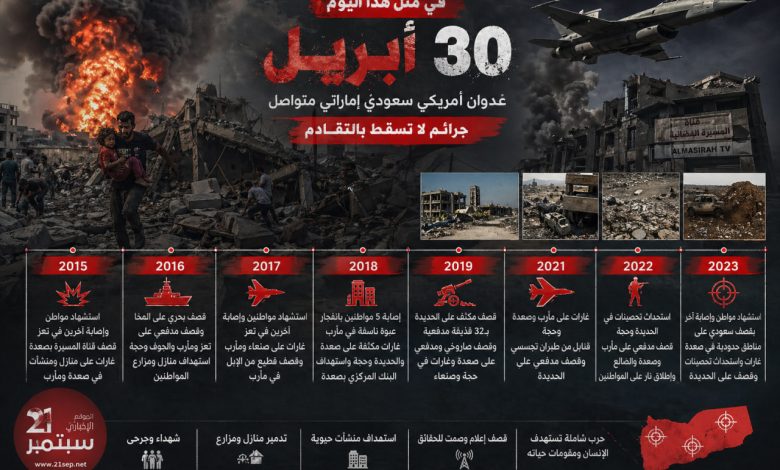
From Taiz to Saada and Hodeidah: April 30th Witnesses an Aggression Targeting the Yemeni People and Every Aspect of Their Lives
April 30th is not merely a passing date in the annals of the American-Saudi-Emirati aggression. Rather, it represents a concentrated example of a comprehensive war targeting Yemen—its land, its people, and its institutions. The repeated events of this day reveal an escalating pattern of aggression that has left no aspect of life untouched by bombing or direct targeting.
By tracing the crimes committed on this date throughout the years of aggression, the outlines of a strategy based on expanding the “target bank” become clear. This strategy encompasses homes, roads, vital infrastructure, media outlets, and even the livelihoods of citizens.
2015: The Shocking Beginning: Targeting Cities, Media, and Sources of Life
On April 30, 2015, the aggression launched a bloody day in several governorates, targeting the main street in Taiz, resulting in martyrs and wounded—one of the clearest examples of targeting civilians in public spaces.
In Saada, airstrikes targeted residential homes in the city of Dhahyan, causing civilian casualties, alongside heavy shelling of several districts.
However, the most serious incident was the targeting of the Al-Masirah TV channel’s office in Saada city, a move reflecting a clear intention to silence media outlets and suppress platforms that report the truth about what is happening on the ground. This was in addition to the targeting of military installations in Marib as part of an escalation of operations.
2016: The Sea Enters the Battle: Naval Bombardment and a Comprehensive Ground Expansion
The following year, operations took on a more diverse character, with warships joining the fray and shelling the coastal city of Mocha, in an escalation reflecting the aggression’s shift to the direct use of naval force.
Concurrently, mercenaries continued their artillery and missile bombardment of several governorates, targeting civilian homes and farms in Marib, Al-Jawf, Taiz, and Hajjah, using Katyusha rockets and heavy weapons, reflecting a large-scale escalation on the ground.
2017: Targeting Roads and Livelihoods
On April 30, 2017, the targeting of civilians on public roads became a recurring theme. An airstrike on the Al-Waziyah intersection in Taiz resulted in deaths and injuries.
The airstrikes expanded to include multiple areas in Taiz and Sana’a. The targeting of livestock emerged as a form of economic warfare, with the bombing of a herd of camels in Marib indicating a deliberate attempt to strike at the sources of citizens’ income.
2018: Intense Escalation and Targeting of Economic and Service Facilities
This year witnessed a significant escalation in the pace of airstrikes, particularly in Sa’dah, where dozens of airstrikes were launched in a single day, targeting citizens’ farms and properties, as well as economic institutions such as the Central Bank.
In Hodeidah and Hajjah, the intense bombardment of residential areas continued, while civilians in Marib were injured by an IED explosion, amidst a security vacuum reflecting the repercussions of the war.
2019… Hodeidah Under Fire: Intense Targeting of Neighborhoods and Farms
On April 30, 2019, artillery shelling intensified significantly in Hodeidah Governorate, targeting civilian farms and residential areas with dozens of shells, reflecting a clear focus on undermining food security and social cohesion.
Border shelling also continued in Saada, alongside airstrikes targeting Hajjah and Sana’a, confirming the continued geographical expansion of operations.
2021–2023… A Siege of Fire and Fortifications: A Protracted War of Attrition
In recent years, the aggression has adopted a policy of “combined attrition,” where airstrikes—especially in Marib—have been accompanied by continuous artillery shelling in Hodeidah and the dropping of bombs from reconnaissance aircraft on residential areas.
The mercenaries also continued to establish combat fortifications on several fronts, indicating their efforts to solidify the front lines, while simultaneously continuing to target civilians with shelling and sniper fire.
In 2023, border shelling continued in Saada, resulting in martyrs and wounded, confirming that the border areas remained under constant fire.
Summary of the situation: “An open target bank” and a comprehensive aggressive strategy.
The crimes of April 30th reveal clear features of an aggressive strategy based on:
Expanding the scope of targets to include all aspects of life.
Targeting media outlets to conceal the truth.
Striking infrastructure and the economy (roads, banks, farms).
Directly targeting homes and residential neighborhoods.
Using multiple weapons (air, sea, and artillery).
Adopting a policy of long-term attrition through shelling and fortifications.
This pattern reflects a comprehensive war that targets not only the front lines but the entire society.
April 30th: A memory that reveals the truth and a renewed resilience.
This date remains a living testament to the nature of the aggression and the scale of the crimes committed against the Yemeni people. It also reflects, conversely, the level of resilience that has prevented the achievement of the objectives of this aggression, despite its many years.
With these crimes being repeated year after year, Yemeni memory becomes an open record documenting the truth, and confirming that these crimes, no matter how long it takes, will remain present, as a responsibility that does not lapse, and a right that cannot be ignored.