
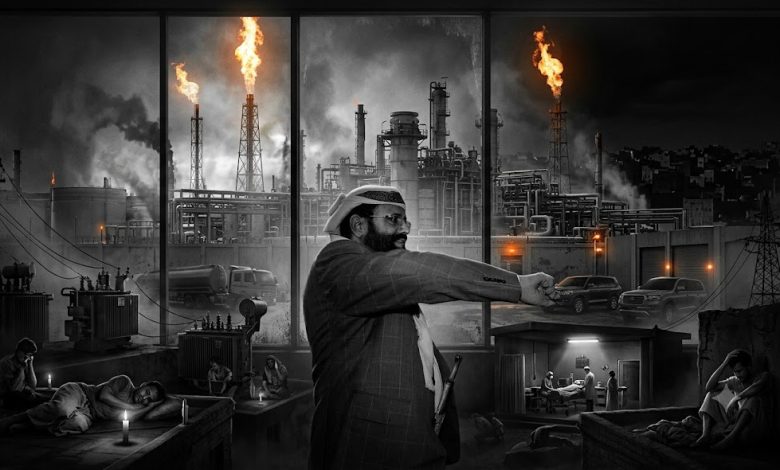
Marib is engulfed in darkness: How did the Islah militia and the hotel government plunder gas wealth and disrupt the largest gas plant in Yemen?
The occupied city of Marib and the areas controlled by the Islah Party militia and the factions of the “hotel government” loyal to the Saudi-Emirati coalition are experiencing one of the most severe service crises in their modern history, characterized by the complete collapse of the electricity grid coinciding with the peak of the sweltering summer heat. This crisis, with power outages exceeding 20 hours a day, cannot be dismissed as a technical issue or a result of resource scarcity. Rather, it is a stark manifestation of the destructive methodology employed by these subservient forces in managing sovereign institutions. The transformation of Yemen’s oil capital into a hotbed of darkness and deadly heat clearly reveals how basic services have been turned into bargaining chips for political gain and tools for illicit financial profit at the expense of the dignity and daily lives of Yemeni citizens.
The surreal paradox that shocks both observers and those within the country lies in the fact that this complete service paralysis is affecting the geographical area containing the Safer facility and its renowned gas-fired power plant, which represents the largest power generation stronghold in the Republic of Yemen, with a design capacity exceeding 340 megawatts. This strategic plant, built with Yemeni public funds to serve as a vital artery extending from Marib to connect the national grid to all governorates, including the capital Sana’a, is now incapable of even meeting the limited needs of Marib city and its immediate surroundings. This manufactured deficit exposes the mechanism by which sovereign wealth has been managed throughout the years of occupation, whereby this national asset was isolated and transformed from a pillar of the economy and public services into a closed factional spoils system, its revenues swallowed up by channels of partisan financial corruption under the full cover and complicity of the aggressor states.
Safer: From sovereignty to systematic dismantling
Before the Safer facility fell outside its national context, the gas turbines manufactured by General Electric operated with high efficiency under the supervision of Yemeni engineering staff, utilizing locally extracted associated natural gas at a near-zero production cost compared to heavy fuel oil. Current evidence demonstrates that the de facto authorities affiliated with the Islah Party have deliberately neglected the maintenance and periodic inspection of the three turbines for years. This has led to the gradual decommissioning of the first two turbines, leaving only one operating at less than half its capacity due to sediment buildup and the unavailability of essential spare parts. Leaked technical reports from within the facility indicate that the maintenance budgets, which were funded by oil and gas sales, have been consistently diverted to military expenditures and to enrich the personal accounts of the controlling faction’s leaders abroad.
This deliberate mechanical deterioration coincided with the rejection by the pro-aggression authorities in Marib of all initiatives launched by the Ministry of Electricity in the Sana’a government to reconnect the 400 kV Marib-Sana’a high-voltage power lines and repair the damaged substations. These initiatives would have been sufficient to restore the plant to full capacity and ensure a continuous flow of electricity to all. The insistence on keeping the gas-fired power plant inoperable and fragmented confirms the desire to hold the energy sector hostage to narrow interests. The corrupt figures in the “hotel government” fear that coordination with Sana’a would expose the extent of the looting and administrative and financial mismanagement they perpetrate within the control rooms at Safer. The direct result of this partisan obstinacy has been a sharp decline in the plant’s generating capacity to dangerously low levels, falling below 40 MW—an amount that doesn’t even cover a quarter of the actual needs of the governorate’s capital and its surrounding camps.
Operational data confirms that the Marib gas power plant is not currently inoperable due to objective reasons, but rather because it has been subjected to a process of “logistical liquidation” to serve commercially viable investment alternatives. Statements from field engineers indicate that the absence of specialized oils and air filters, along with the deliberate delays in bringing in technical teams from the manufacturer, were intentional actions by the facility’s management, appointed by the Islah Party. This exclusionary and destructive behavior has not only ruined the plant but has also deprived millions of Yemenis of their constitutional right to their national resources. It has transformed a strategic achievement, which cost th