
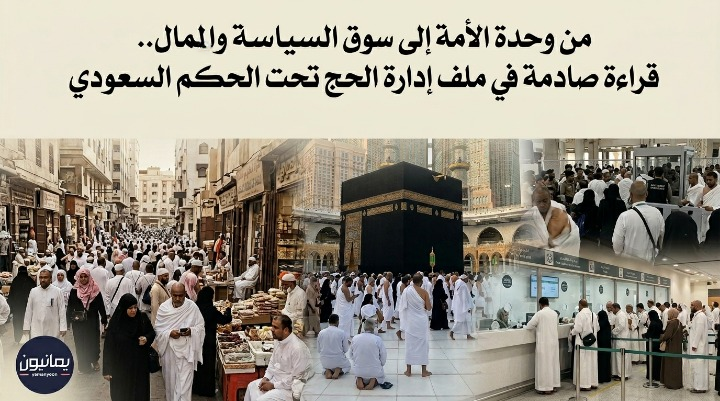
From The Unity Of The Nation To The Marketplace Of Politics And Finance: A Shocking Reading Of The Hajj Management File Under Saudi Rule
Between the sanctity of the ritual and the requirements of politics, during the blessed and virtuous days when the eyes of Muslims turn towards Mecca and the Hajj season as the greatest annual gathering of the year, the book “What has the Saudi regime left for Muslims of the Hajj pilgrimage?” by Judge Zaid Yahya Al-Mahbashi opens a thorny file related to the management of one of the greatest Islamic obligations, questioning what remains of the missionary and unifying goals of the Hajj in light of the Saudi regime’s continued political exploitation and economic investment of Islamic holy sites.
The book, issued by the Research and Information Center and the Yemeni News Agency (Saba), reviews the transformations that the Hajj pilgrimage has undergone, from being a comprehensive Islamic conference for unity, awareness and solidarity, to a ritual that has been subjected to systematic emptying of its intellectual, political and civilizational contents, as well as a number of issues related to this great season, starting with the high costs and the restriction of some pilgrims, up to the recurring incidents and the disputes of the management of the Two Holy Mosques, in an attempt to raise a fundamental question about the future of this pilgrimage and its role in unifying the Islamic nation.
Hajj as the Quran intends it: A message for the nation, not just rituals.
The book starts from a central idea that the Hajj, in its Quranic origin, was not just a devotional journey or a limited ritual practice, but rather an integrated project to build Islamic awareness, strengthen the unity of the nation, exchange experiences, and discuss the major issues of Muslims. It emphasizes that the various rituals carry deep educational, political, and moral implications that go beyond the formal performance of the rituals.
It also presents the view that throughout Islamic history, Hajj has been a season for renewing the covenant with God, demonstrating the strength and unity of Muslims, and building a state of civilizational interaction among the peoples of the Islamic nation. However, these goals have been reduced to formal practices that have emptied the pilgrimage of much of its content.
Accusations of emptying the Hajj of its civilizational content
This theme forms the backbone of the book, as the author directly criticizes what he describes as the role of Wahhabism and the Saudi regime in transforming the Hajj into a set of rituals isolated from the realities of the Muslim world and its major issues. He argues that the Hajj administration has worked to eliminate the political, educational, and social dimensions that have historically been associated with this religious duty.
The book cites the opinions of several religious and intellectual figures, including Allama Hamoud Al-Ahnumi, Sayyid Ali Khamenei, and the martyr leader Sayyid Hussein Badr Al-Din Al-Houthi, who believe that Hajj represents an arena for the unity of Muslims, a declaration of innocence from injustice and arrogance, and a confrontation of projects of division and hegemony. The author also focuses on the concept of “Hajj as a global conference for the Islamic nation,” considering that the absence of this dimension has contributed to weakening the impact of Hajj on the political and cultural reality of Muslims.
Politicization and political blackmail of Hajj
The book devotes considerable space to discussing what it calls the “politicization of Hajj,” through the control of quotas and visas and their use as a political pressure tactic against some countries or forces opposed to Saudi orientations. It cites a number of examples and incidents that it believes reflect the subjection of the pilgrimage to political and regional calculations. It points out that granting visas and determining the number of pilgrims is no longer related only to organizational considerations, but has become a tool for political influence and managing relations with Islamic countries. It reinforces this argument by referring to human rights and media reports and positions that criticized what it described as the exploitation of Hajj and Umrah to achieve political goals.
Hajj as a huge economic resource
One of the most prominent issues discussed in the book is the economic dimension of Hajj, as it focuses on the huge financial revenues that the Kingdom achieves from the Hajj and Umrah seasons, based on figures and international media reports that speak of billions of dollars generated by the sector annually. Here, he sees that the high costs of Hajj and related services have made performing the pilgrimage more difficult for large segments of Muslims, considering that the increasing fees and mandatory services have contributed to turning Hajj into a heavy financial burden for many of those wishing to