
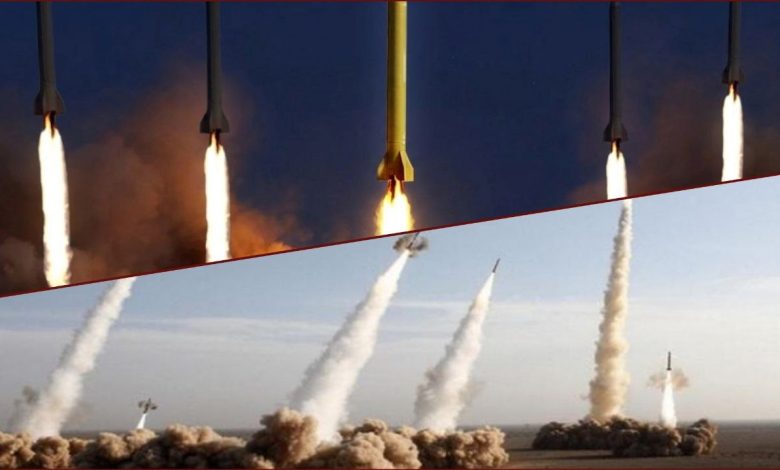
In response to American aggression, Iran strikes 85 military facilities and vows to expand its target bank in the region.
The confrontation between the Islamic Republic of Iran and the United States entered a new, more heated phase early Wednesday morning, after the Iranian armed forces launched a direct military response to the American aggression that targeted areas in southern Iran, announcing the implementation of extensive missile and air strikes against dozens of American military facilities and bases in the region, coinciding with the issuance of military, political and diplomatic positions that confirmed that the time of being satisfied with condemnation has ended, and that any new American aggression will be met with a stronger and wider response.
According to observers, the Iranian response reflects Tehran’s shift from a policy of containment to a direct deterrence equation, in a message confirming that targeting Iranian territory will not go unpunished, and that the extended American military presence in the region is now within range of the Iranian armed forces.
The Islamic Revolutionary Guard Corps announced the implementation of the initial response to the American aggression, through a joint military operation carried out by the naval and aerospace forces, targeting 85 American military facilities and sites with missiles and drones, including the headquarters of the American Fifth Fleet in Bahrain, Ali Al Salem Air Base in Kuwait, and a number of other American military sites.
The Revolutionary Guard stressed that the operation represents the beginning of the response and not its end, indicating that future strikes will be more powerful if Washington continues its attacks, in a clear indication that escalation options are still open to the Islamic Republic.
In a related development, the Revolutionary Guard announced the downing of an American MQ-9 drone over the airspace of Bushehr province in southern Iran, explaining that it was attempting to interfere in the theater of military operations, which reflects the vigilance of the Iranian air defense systems and their ability to deal with any hostile movements.
In the same context, the Iranian army announced that it had targeted US forces’ assembly points at Sheikh Isa Air Base in Bahrain, stressing that the attack was a direct response to US aggression and what it described as repeated violations of the ceasefire agreement.
The Iranian military stressed that all US military bases deployed in the region have become legitimate targets for Iranian drones and missiles, holding the United States fully responsible for the widening scope of the confrontation, and confirming that continued attacks will be met with an expanded response.
Early Wednesday morning, the United States launched an attack on sites in southern Iran, claiming it was in response to attacks targeting commercial vessels in the Strait of Hormuz. The US Central Command announced that it targeted Iranian air defense systems, command and control networks, coastal radars, anti-ship missile capabilities, and dozens of Revolutionary Guard boats.
In contrast, Iranian television asserted that most of the American raids targeted non-military areas, arguing that Washington is trying to justify its aggression with flimsy pretexts to cover up its military escalation in the region.
At the strategic military level, the Khatam al-Anbiya Headquarters of the Iranian Armed Forces issued a strongly worded statement, threatening the United States with a crushing response, stressing that American aggression would not go unpunished, and that the Iranian Armed Forces would not allow any party to interfere in the management of the Strait of Hormuz or impose new realities therein.
The statement emphasized that the only safe passage for commercial vessels and oil tankers through the Strait is the route designated by the Islamic Republic of Iran, in a message affirming Tehran’s commitment to its full sovereignty over the security of the maritime routes within its area of responsibility.
Politically, Iranian Parliament Speaker Mohammad Baqer Qalibaf asserted that the era of American intimidation and blackmail is over for good, stressing that the Islamic Republic will not succumb to military or economic pressure.
Qalibaf explained that the United States committed a series of violations of the memorandum of understanding to end the war, whether through military aggression on Iranian territory or the re-imposition of restrictions on Iranian oil exports, in addition to its attempts to impose unilateral arrangements in the Strait of Hormuz without coordination with Tehran.
He added that the Islamic Republic will not allow any external interference in the management of the Strait, stressing that the security of navigation can on