
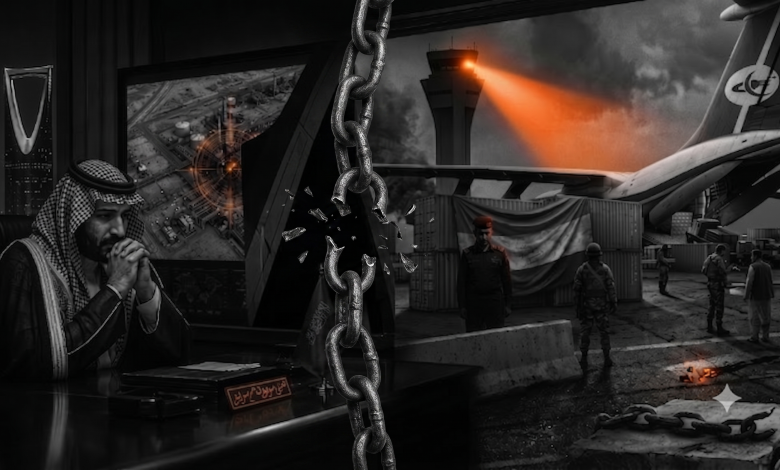
The fall of Hodeidah crosses Riyadh’s red lines: Sana’a dismantles the blockade and puts the Saudi economy under the weight of the countdown… and this is what awaits Aramco and the “Vision 2030” projects.
In recent hours, Yemeni airspace and airports have become the stage for a direct military and political confrontation, the outcome of which Sana’a has decisively won by asserting its sovereign air routes. This marks a direct strategic victory, breaking the air and sea blockade imposed for nearly eleven years. Despite the Saudi-led coalition’s warplanes bombing the runway at Sana’a International Airport to prevent the return of an Iranian civilian aircraft arriving directly from Tehran, carrying the official and popular Yemeni delegation participating in the funeral of the martyred leader of the Islamic Revolution, Ayatollah Ali Khamenei, Sana’a’s operational decision successfully overcame this obstacle with remarkable logistical success. This was achieved by activating the alternative emergency plan and directing the aircraft to land safely at Hodeidah International Airport under bombardment.
This major breakthrough on the ground, despite the American veto and regional aggression, was immediately followed by a decisive military shift announced by the official spokesperson for the Yemeni Armed Forces, Brigadier General Yahya Saree. In a statement, he officially confirmed the end of the de-escalation phase and the establishment of a new deterrent equation that holds Riyadh fully responsible for its aggression. The successful landing of the aircraft for the second time in a row represents a complete undermining of all the pressure and blockade tools that Washington and Riyadh attempted to employ to punish Yemen for its support of the Gaza Strip. The situation has thus shifted entirely from a phase of political negotiations and fragile truces to a front of imposing sovereignty by force of arms and air defense, and cementing the strategic defeat of the enemy.
Field weakness and the collapse of deterrence
The landing of the second Iranian plane at Hodeidah airport is linked to an escalating military situation in which Sana’a has demonstrated its field superiority and the inability of the Royal Saudi Air Force to enforce its red lines in Yemeni airspace. At 5:20 AM on Friday, July 3, 2026, a formation of Saudi warplanes violated Yemeni airspace in an attempt to intercept the same plane on its first flight, which was carrying more than 200 stranded, wounded, and sick Yemenis. The Yemeni air defenses responded immediately with surface-to-air missiles that engaged the hostile formation, forcing it to retreat and ensuring the plane’s safe landing in Sana’a and subsequent departure with the official delegation.
This aerial blow on the morning of July 3rd clearly explained the Saudi enemy’s resort, on the second flight, to the ground-based option of bombing the runway. Operations rooms in Riyadh realized their fighter jets were completely incapable of engaging Yemeni air defense systems in aerial combat, so they switched tactics to missile strikes on the airport to prevent the plane from landing at any cost. Instead of demonstrating strength, the destruction of the runway became a document of condemnation and Saudi military impotence in the face of Sana’a’s logistical flexibility, which ensured a smooth alternative landing in Hodeidah.
The operational evidence and field data of this enemy military failure were represented in the following summarized points:
Time of the breach and aerial interception: 5:20 AM, dawn on Friday, 18 Muharram 1448 AH (July 3, 2026 AD).
Targeted humanitarian cargo: A civilian aircraft carrying more than 200 stranded, sick, and wounded citizens abroad.
The charming field deterrent: immediate launch of surface-to-air missiles and direct engagement that forced the enemy warplanes to leave the airspace.
Alternative logistical flexibility: Successfully transferring the operational landing route at the moment of the construction bombing from Sana’a International Airport to Hodeidah International Airport.
This field tour proved the superiority of the operational will of the Republic of Yemen, which had prepared in advance a defensive cover and multiple geographical alternatives to manage its sovereign flights, making the direct air route between Sana’a and Tehran a strategic reality established by fire and impossible to cancel, and turning the bombardment of the beleaguered enemy into an exposed “military panic” that failed to achieve its deterrent objectives and the collapse of the plan to impose a blockade by suffocating the runways on the ground.
Economic gambling and political blindness
The targeting of Sana’a airport and the Saudi regime’s disregard for stern warnings reflect a state of political blindness and strategic panic. Riyadh, through reckless arrogance, has jeopardized the security of its vital infrastructure and i