
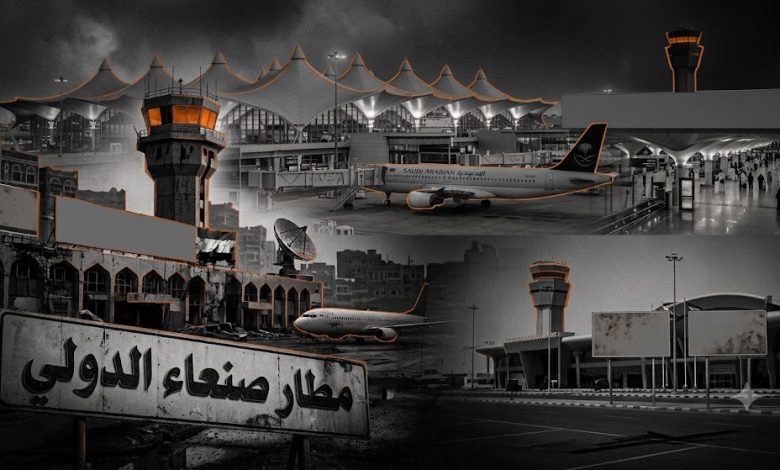
“Our sovereignty or your airspace will be paralyzed”… Sana’a closes Saudi airspace and imposes a “ban for ban” equation.
The Yemeni Armed Forces’ firm operational decision to ban international flights from Saudi airspace represents an unprecedented strategic shift in the conflict. Sanaa is no longer content with merely defending its facilities; it has openly and directly imposed a reciprocal air blockade, crippling Saudi air traffic and logistics. This declaration presents global air navigation with a clear and unambiguous equation: the security of Saudi airspace and airports hinges on the complete and total lifting of the blockade on Sanaa International Airport.
This direct warning to international airlines came as a preemptive step and the culmination of a swift military response that bombarded Abha International Airport with ballistic missiles and drones. This move was in retaliation for the Saudi-led coalition’s bombing of Sana’a airport’s runway, preventing humanitarian and sovereign aircraft from landing. This sovereign Yemeni decision, backed by missile power and drone capabilities, completely undermines Riyadh’s bets on keeping Yemen under economic strangulation without paying the price on its own soil.
Airspace ban: Saudi air traffic isolated
The decision to impose a no-fly zone over Saudi airspace aims to completely paralyze the enemy’s logistical and sovereign operations. The stern Yemeni warning to airlines was not for media consumption; it was a clear declaration that Saudi airspace would be transformed into an active military operations zone. This measure will impose significant financial and insurance costs on international airlines, which will be forced to reroute their flights to avoid the line of fire.
Disrupting air traffic in Saudi airspace would be a devastating blow to Riyadh’s ambitions to market itself as a global logistics hub. The leadership in Sana’a has unequivocally linked the safety of international commercial flights to the Saudi regime’s commitment to lifting the blockade on Sana’a airport, effectively turning Saudi airspace into a military hostage until the Yemeni people can enjoy their natural right to freedom of movement and travel.
The collapse of the enemy’s air deterrence and the failure of the ground blockade
The credibility of the no-fly zone decision rests on Yemen’s escalating operational superiority, which has demonstrated the Royal Saudi Air Force’s inability to enforce its red lines in the air. At 5:20 a.m. on Friday, July 3, 2026, a Saudi warplane attempted to intercept a Yemeni civilian aircraft carrying over 200 civilians and wounded individuals, but Yemeni surface-to-air missiles engaged them, forcing them to retreat.
This setback in the air led Riyadh to later resort to the option of “ground-based construction bombing” of the runway at Sana’a International Airport to prevent landing at all costs. However, Sana’a’s logistical flexibility thwarted this tactic by diverting the landing route and directing the aircraft to land safely at Hodeidah International Airport under bombardment. The bombing of the runway transformed from a show of force into a document of condemnation and Saudi military impotence in the face of Sana’a’s geographical and operational alternatives.
Automatic activation of the target bank and existential threat
In conjunction with the no-fly zone, Brigadier General Yahya Saree’s announcement of the end of the de-escalation phase shifted the military situation to a state of full readiness for automatic response. This shift places the Kingdom’s bank of sensitive oil and financial targets directly under attack without the need for prior warnings, and the targets are distributed according to strict criteria that include:
The energy sector: Aramco’s refineries and fields and the Yanbu petrochemical complexes, which represent the enemy’s financial lifeline.
The financial sector: Riyadh Stock Exchange (Tadawul) and major “Vision 2030” projects such as “NEOM” and “Qiddiya”.
Logistics sector: All airports, ports and waterways along the Red Sea.
Riyadh’s inability to provide a stable and secure environment in its atmosphere and facilities means the immediate destruction of foreign investors’ confidence and the evaporation of the Kingdom’s economic transformation plans, turning the latter into a hot conflict zone that repels capital.
The mercenary play and the fall of the masks of disavowal and blackmail
Data from the Yemeni Ministry of Foreign Affairs revealed Saudi Arabia’s failed attempts to “Yemenize the conflict” by pushing mercenaries to claim responsibility for the closure of Sana’a airport and to endorse the blockade. This farcical behavior aims to portray Riyadh as a “neutral mediator” in order to evade its obligations under the roadmap brokered by the Sultanate of Oman, most importantly the payment of salaries and the opening of ports of entry.
Yemeni diplomacy has decisively