
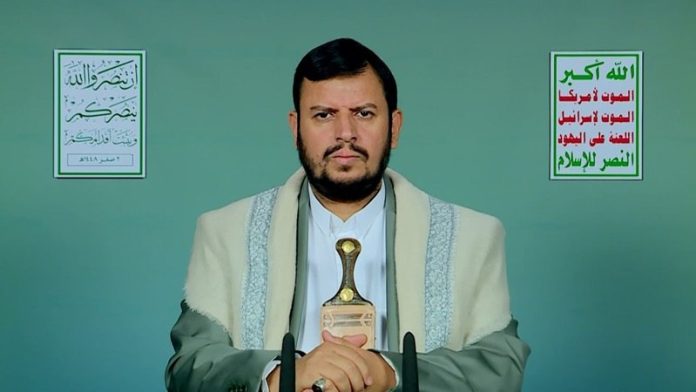
A reading of the call to arms and liberation speech
Not every speech is meant to be heard, and not every voice is meant to be read. But the speech of Mr. Abdul-Malik Badr al-Din al-Houthi, which lasted for about an hour and thirty-nine minutes, was more than just words spoken; it was a declaration of war par excellence, a mirror reflecting the experience of an entire people—an experience written in blood, hunger, and siege. The sharp criticisms leveled against Saudi Arabia in the speech were a digging into collective memory, a reawakening of wounds that have not healed, and a declaration that the battle to break the siege is no longer a choice, but an individual obligation for every Yemeni who sees freedom as a religious duty and submission as humiliation.
This report attempts to read the speech in its linguistic and field context, citing facts and figures, to present the reader with one truth: what happened in the July 16 speech was not just a sermon, but a declaration of a comprehensive escalation, coinciding with an unprecedented tribal mobilization, and million-strong demonstrations that raised the slogan “Breaking the Siege.”
First: The language of challenge and abstraction.
What distinguishes this speech from its predecessors is its remarkable boldness. The leader did not speak of “brothers” or “neighbors,” but rather took off the gloves and used harsh, abstract language, describing the Saudi regime as “oppressive,” “despicable,” “criminal,” and “humiliated.” He asserted that they are nothing more than “slaves” to America and Israel, and that their project is not patriotic, but merely an extension of the Zionist movement.
When the leader said, “Does the Saudi imagine he will succeed in escalating his aggression against our country again? He is mistaken and a failure, and he doesn’t know the true nature of our people,” and then boldly added, “Shame on him! Shame on him! We would never accept this from him,” he was stripping the Saudi regime of its legitimacy and redefining the relationship as one of absolute confrontation. This language was not uttered in a passing speech, but rather in the context of an existential break, where the “Saudi enemy” has become part of the same target list as America and Israel.
More importantly, these words were not confined to the pulpit; they were immediately translated into action. The speech coincided with a comprehensive public mobilization, as Yemeni tribes had already held unprecedented mass demonstrations to break the siege. All Yemenis were called upon to take to the streets on Friday, July 17th, under the unprecedented banner of “The Call to Arms and Liberation,” affirming that Yemen would not accept subjugation, and that freedom and breaking the siege were not merely slogans, but had become the decision of an entire nation, prepared to pay the ultimate price.
Secondly: Jihad… a faith-based foundation for freedom, not merely a military option
The leader did not open his speech with a political overview, but rather began with a deeper foundation of faith, when he said: “God has made jihad a path to victory, to glory, and to breaking the power of the tyrannical infidels,” and he emphasized that “when the oppressed and downtrodden do not act, the result is that evil will worsen and tyranny will increase.”
This point gave the discourse its spiritual dimension, transforming it from a mere analysis of geopolitics into an existential vision.
Jihad here is not a tactical choice, but a response to the innate freedom with which God endowed His servants. When the oppressed do not act, tyranny grows, and when the vulnerable remain silent, their history is written in iron and fire.
Third: The aggression was not an “intervention” but a systematic extermination
When the leader said, “The aggression against our people has continued for nearly 12 years without any justification or basis whatsoever,” he was not exaggerating. In March 2015, Saudi Arabia launched its aggression under the name “Operation Decisive Storm.”
Numbers alone may convey the picture, but they cannot convey the pain. Statistics from the “Eye of Humanity” center indicate that 60,891 civilians were killed or wounded as a result of direct bombing during 4,100 days of war. Among them were 4,362 children killed, 5,571 wounded, 2,651 women killed, and 3,348 wounded. These are not just numbers in reports; these were children in their schools, women in their homes, and men in their markets. One heart stopped, and the story of an entire family ended.
What makes the tragedy even more horrific is the pattern of targeting. Reports from the Yemen Data Project revealed that a third of Saudi airstrikes targeted civilian sites: schools, hospitals, markets, mosques, and even cemeteries were bombed!
The leader says, “The aggression against our country has shown no respect for either honor or lif