
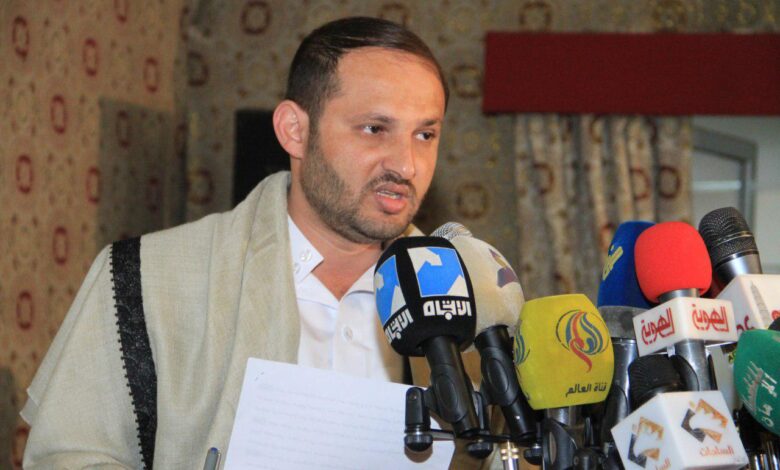
Abu Talib: Saudi Arabia thwarted opportunities to lift the blockade… and the equation of blockade for blockade is fair and justified.
The Secretary-General of the Political Bureau of Ansar Allah, Fadl Abu Talib, affirmed that Yemen’s compass is directed towards the Saudi enemy, and not towards any other party, as it is the one that led the aggression and the comprehensive siege on the Yemeni people since 2015 until today.
The Secretary-General of the Political Bureau of Ansar Allah indicated in tweets today on the X platform that the Saudi regime is investing in the suffering of the Yemeni people, which it created, and is betting on the factor of time, to turn it into a means of pressure to complete the destruction of the country’s foundations and its occupation.
He said: “The Saudi regime mistakenly believes that the Yemeni people do not know who is truly responsible for their suffering and that they have forgotten all the crimes committed against them,” noting that the comprehensive blockade on the Yemeni people has caused suffering and created a humanitarian crisis in Yemen, which is one of the worst humanitarian crises in the world.
I consider the equation of a blockade for a blockade to be fair, just, and equitable, and it takes into account the rights of the oppressed against the oppressive aggressor, noting that the demand to lift the blockade is not new, and that Yemen, leadership and people, has been demanding its lifting for twelve years, but to no avail.
He explained, “Over the past years, we tried to lift the blockade on Yemen through dialogue and political negotiations, but the Saudi regime refused. When we saw that the negotiations had no clear horizon, we resorted to the option of blockade for blockade.”
He explained that Yemen’s position is defensive and not that of the aggressor, because the Saudi enemy regime started the aggression and the blockade, and that today’s position is in response to the demands of the Yemeni people who are suffering greatly and enduring difficult living conditions as a result of the Saudi aggression and blockade.
He added, “Our demands are the demands of the Yemeni people in the north and south, and our compass is clear, pointing towards the Saudi enemy.”
He explained that Yemen’s position is defensive and not that of the aggressor, because the Saudi enemy regime started the aggression and the blockade, and that today’s position is in response to the demands of the Yemeni people who are suffering greatly and enduring difficult living conditions as a result of the Saudi aggression and blockade.
He continued, “Our demands are the demands of the Yemeni people in the north and south, and our compass is clear and points towards the Saudi regime.” He explained that the Saudi enemy, as usual, is pushing its mercenaries to be a tool in continuing the aggression and siege against the Yemeni people, who will not remain silent about their legitimate rights.
In response to the mobilization of the aggression’s mercenaries, Abu Talib said, “They reside in Riyadh hotels, so it is natural that they do not feel what the Yemeni people inside feel, and it is natural that the Saudis would push them to confront the people’s demands to lift the comprehensive Saudi blockade on Yemen.” He emphasized that Riyadh’s mercenaries want the blockade on Yemen to continue and reject any steps that would end it, and that this is essentially their job.
Regarding the role of the mercenaries of the aggression, Abu Talib stressed that their designated role from the beginning of the aggression until today is that they represent the pretext used by the Saudi enemy in its aggression and continued siege of Yemen, and they only appear when it wants to legitimize that, and that their legitimacy is based on legitimizing the aggression, the siege and the suffering.
He also noted that the call to lift the Saudi blockade on Yemen is a call that unites all Yemenis and does not pertain to a political component, geographical region, or religious group, but rather it is a demand of all the people of Yemen throughout the north and south.