
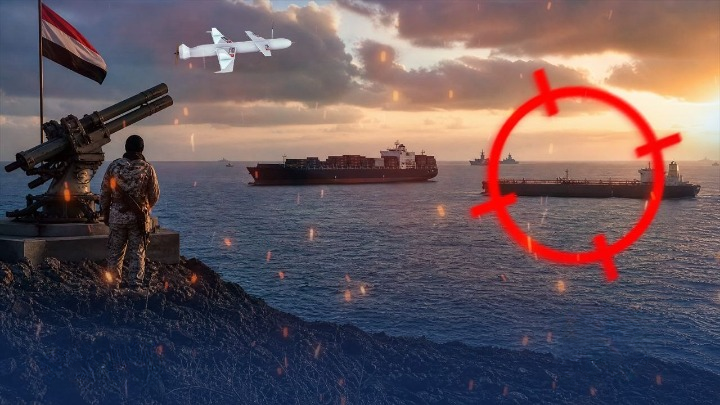
“Blockade for blockade”: How did the Yemeni deterrence equation shift to the heart of the Saudi economy?
For Saudi Arabia, the Red Sea is no longer just a maritime passage connecting it to global markets, but has transformed in recent years into a key pillar of its oil, trade and logistics strategy, after regional developments prompted Riyadh to shift a large part of its economic weight towards the west coast.
However, the implementation of the “blockade for blockade” equation, with the Yemeni armed forces announcing the imposition of a naval blockade on the Saudi enemy, then targeting two oil tankers and forcing about ten ships to retreat, reveals that this economic gamble is now facing an unprecedented challenge, and that the pressure is no longer limited to the military field, but has extended to one of the most sensitive joints in the Saudi economy.
The Red Sea: A growing Saudi gamble
Disruptions to shipping in the Strait of Hormuz have forced Saudi Arabia to redraw its oil export map, turning Red Sea ports, most notably the Fahd Industrial Port in Yanbu, into the main outlet for the flow of crude oil and petroleum products to global markets.
Data reported by Bloomberg shows that crude exports from Yanbu port reached a record high of 4.19 million barrels per day in June 2026, after the majority of Saudi exports were diverted to the Red Sea. Meanwhile, Aramco increased pumping through the East-West pipeline to its maximum capacity of 7 million barrels per day to ensure the continued flow of exports away from the risks of the Strait of Hormuz.
Estimates from companies specializing in tracking shipping indicate that Saudi Arabia has diverted more than 70% of its oil exports to this route, a shift that reflects the extent of the reliance on the Red Sea as the Kingdom’s primary energy artery.
Investments worth billions of riyals
The Saudi bet was not limited to exporting oil, but extended to transforming the western coast into a regional center for trade and logistics within the objectives of Vision 2030. Data from the United Nations Conference on Trade and Development (UNCTAD) indicates that the Red Sea and the Suez Canal accommodate about 12% of global trade, in addition to about 12% of global oil trade, which explains the size of Saudi investments flowing towards this corridor.
Jeddah Port is the beating heart of this system, with a capacity of up to 130 million tons annually, and more than 10.2 million standard containers across 62 berths, while it received more than 3,805 ships during 2024, and handled 47.09 million tons of goods.
The port also accounted for 22.1% of Saudi Arabia’s imports, and 11.7% of non-oil exports passed through it, in addition to its dominance over 80% of transshipment trade within the Kingdom, at a time when Saudi investments in port logistics centers exceeded 14 billion riyals in recent years.
Bab al-Mandab: A knot in the Saudi economy
This increasing reliance on the Red Sea has turned Bab al-Mandab into one of the most sensitive points for the Saudi economy. Kpler estimates that any disruption to navigation through the strait will force Saudi oil tankers heading to Asia to sail through the Suez Canal and then around the Cape of Good Hope, increasing the journey time from 24 days to 54 days, with fuel consumption doubling and transportation and insurance costs rising.
Reuters also predicted that any complete closure of Bab al-Mandab would reduce global oil supplies by about 7%, given that the majority of Saudi exports depend on this vital waterway.
From announcement to implementation
With the Yemeni armed forces announcing the execution of a qualitative operation targeting two Saudi oil tankers with ballistic and cruise missiles and drones, and forcing about 10 ships to retreat, the “siege for siege” equation entered the stage of practical implementation.
These developments come after field data indicating the success of Yemeni operations during the past period in disrupting more than 70% of the movement of ships linked to the enemies in the Red Sea and Bab al-Mandab, which reflects the widening impact of naval operations on shipping lanes.
The extension of the embargo to Saudi ports overlooking the Red Sea, most notably Fahd Industrial Port in Yanbu and Jizan Port, presents the most important Saudi oil export and trade outlets with a new reality, in which operational and economic risks are increasing.