
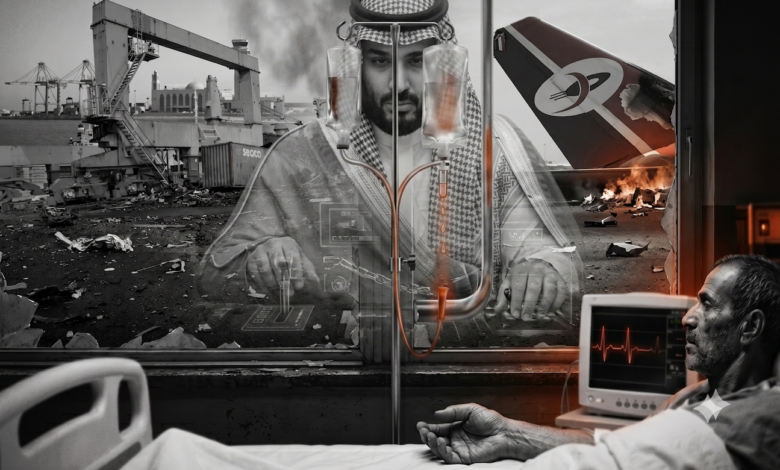
The crime of strangling access points: How did Saudi Arabia manage the blockade of ports and airports to bring down the Yemeni health system?
The health sector in Yemen is experiencing structural collapse and is in its most critical phase due to the comprehensive blockade and severe restrictions imposed by the US-Saudi aggression for over eleven years. The systematic strangulation of vital access points and the depletion of medical supplies goes beyond mere military pressure; it constitutes a strategy of slow killing and the erosion of human resilience in all liberated governorates.
The insistence on disrupting the vital medical lifeline and turning the need for treatment into a tool for political and military blackmail reflects a premeditated decision to undermine the service infrastructure of the Yemeni state. This catastrophic reality places the health system in a state of complete collapse, forcing millions of citizens and children to face an open confrontation with death due to the absence of primary and emergency care protocols.
Aggressive bureaucracy and disruption of maritime arteries
The battle to stifle medical aid is being waged through systematic and arbitrary measures at transit ports, where ships carrying shipments and medical supplies are forced to endure prolonged detention in Djibouti under direct US and Saudi orders. This disruption, which can last for months, spoils enormous quantities of cold-sensitive medications and drives up shipping and insurance costs, crippling already strained healthcare systems.
Field evidence confirms that the continued withholding of dialysis solutions and supplies for chronic diseases puts intensive care units and hospitals at imminent risk of shutting down. Transforming inspection mechanisms and administrative checkpoints into tools of soft warfare is primarily aimed at cutting off the lifeline to patients and keeping medical institutions under the threat of total collapse.
In this context, official figures released by the Ministry of Health, as stated by Minister Dr. Ali Shaiban, reveal the true scale of this humanitarian catastrophe. The direct and indirect targeting is no longer a matter of isolated incidents, but rather a deliberate plan to transform hospitals into buildings incapable of providing even the most basic services.
Disrupted facilities: More than 2,000 health centers and units are out of service, either completely or partially.
Kidney failure: 5,000 patients have previously died due to a lack of dialysis solutions and supplies.
Cancer patients: 120,000 patients are receiving inadequate treatment with a lack of 10 key drug classes.
Financial losses: Direct and indirect losses in the health sector exceeded $7 billion.
Air embargo and patient detention
The air embargo imposed on Sana’a International Airport represents one of the most brutal aspects of the aggression, depriving thousands of critical cases of their right to travel abroad for specialized treatment. The arbitrary control of flight destinations and the reduction of medical flights transform the airport into a closed crossing point, placing waiting lines directly in confrontation with a deferred death.
Preventing the entry of modern diagnostic equipment and medical spare parts exacerbates the suffering of cancer patients and those with other serious conditions within the country, given the lack of technology necessary for complex surgical procedures. This air blockade goes beyond mere pretexts and becomes a form of collective punishment directly affecting women, children, and civilians.
The daily tragedy worsens with the continued delays in establishing regular medical flights and opening new destinations, turning medical waiting lists into ever-growing death tolls. This ongoing air blockade negates all humanitarian claims by the enemy and makes breaking the embargo an existential matter that brooks no delay.
Maritime deterrence and breaking the equation
Faced with a diplomatic impasse and the harsh realities of the health situation, the revolutionary and military leadership in Sana’a adopted a “blockade for blockade” strategy, a strategic shift linking international maritime security to ending the humanitarian blockade. The use of armed force to target the maritime interests of the Saudi and American enemy reshapes the rules of engagement, making the cost of continuing the blockade far greater than the consequences of ending it.
The Yemeni public and its popular base stand fully behind this sovereign decision, considering the naval and missile operations a natural extension of the right to defend life and reclaim usurped rights. The operational link between the flow of medical supplies and medicines and the stability of shipping lanes has established a new reality on the ground that cannot be ignored.
Critical cases: There are 77,000 patients in urgent need of outpatient treatment.
Victims of the air embargo: 12,2