
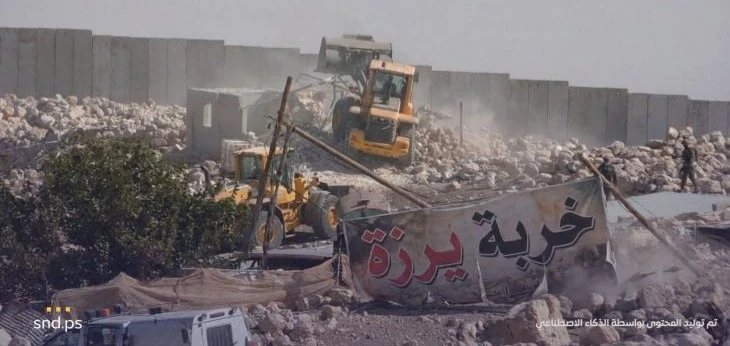
“The Crimson Thread”.. Project that isolates Palestinian Yerza & opens new chapter of displacement
In Khirbet Yerza, east of Tubas in the occupied West Bank of Palestine, space is not measured in dunams, but by the remaining air to breathe.
There, where the land is vast and fertile, a new Zionist settlement wall tightens its grip on the residents to the point of suffocation, bearing a symbolic name heavy with meaning: “The Crimson Thread.”
Stretching over approximately 22 kilometers, the wall flows like a concrete serpent from Ein Shibli in the north, passing through Tammun, ‘Atuf, and Al-Ras Al-Ahmar, to encircle Yerza from all four sides before ending at the Tayasir checkpoint. Its most dangerous segment wraps around the khirba itself, confiscating land and water, and paving the way for a complete isolation that residents describe as “the slow execution of life.”
Omar Al-‘Ainbusi, one of the sons of Yerza, sums up the future in a few words in his conversation with the “Sindh” news agency, saying: “This wall will make us feel that the earth has become too narrow for us despite its vastness.”
He says this while pointing to the water wells that were once the lifeline of the khirba. Out of about a hundred wells, some dating back to Roman times, only nine remain, one of which is for his family. The rest have been confiscated or sealed behind the “wall’s perimeter.”
The assault did not stop at land boundaries. Al-‘Ainbusi recounts the theft of the family’s livestock by settlers from “Hilltop Youth,” decisions to demolish a livestock shelter under the pretext of proximity to the wall, while pastures are closed off and water sources besieged. For a family of 22 members, including two elderly parents, the livestock wealth, their sole source of livelihood, appears sentenced to death.
In the background, the hills and fields are being turned into military training grounds for the Israeli enemy army: live ammunition, tanks, helicopters, and landmines. The area is declared a closed military zone, and landowners are prevented from accessing it. Thus, daily life is slowly strangled in a calculated manner.
The head of the local council, Mukhlis Masaeed, does not mince words in his description: “The trajectory is catastrophic and tragic. Yerza will turn into a small prison.”
According to the wall’s plan, out of about 20,000 dunams, only 383 dunams will remain, which is the core of the village. Thirty families, approximately 130 people, in addition to displaced families from Al-Malih, face the fate of complete evacuation.
Masaeed adds that settler attacks are ongoing, the latest being the theft of 70 head of cattle.
Yerza, whose roots date back to the Roman era and before, was once an agricultural hub and a vital passageway connecting Tubas with the areas beyond Tayasir. Today, its arteries are being severed.
The Zionist newspaper “Haaretz” indicated that the new wall is located about 12 kilometers west of the Jordanian-Palestinian border and aims to separate Palestinian villages from each other and from their pastures and fertile lands, mirroring the separation wall in the rest of the West Bank.
In Yerza, the people ask for nothing more than to stay, but “The Crimson Thread” is writing a new chapter of siege, where life is measured by a distance of fifty meters, water becomes a memory, and the land a wall. There, geography shrinks, and the capacity for steadfastness is tested.