
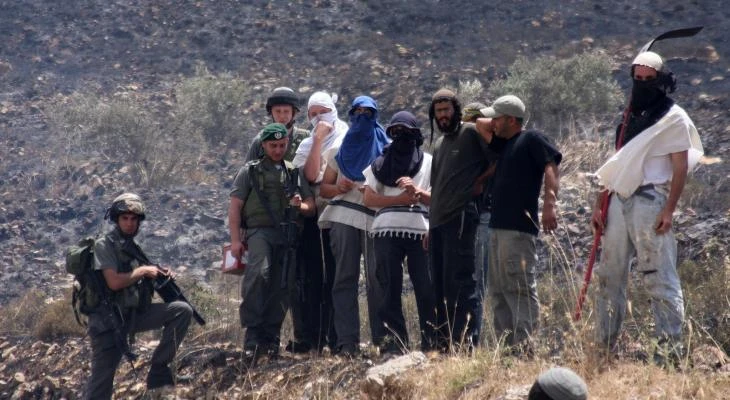
Wall, settlement commission: 23,827 violations conducted by Zionist
army, settlers in West Bank in 2025 The Head of the Palestinian
Colonization and Wall Resistance Commission (CWRC), Moayyad Sha’ban, stated on Monday that the Israeli enemy forces and settlers carried out 23,827 attacks against citizens and their property across various governorates of the West Bank during the past year. This reflects a record increase in the number of violations recorded in a single year. During a press conference held at the Commission’s headquarters in Ramallah to review the most prominent violations of 2025, Sha’ban noted that the enemy army committed 18,384 attacks, while settlers committed 4,723, with both parties jointly carrying out 720 attacks, according to the Sanad News Agency. These violations were distributed as follows: 1,382 against land and crops, 16,664 against individuals, and 5,398 against property. Sha’ban remarked that 2025 was a year “burdened with blood, maps, and decisions,” noting that the enemy authorities did not stop at expanding settlements but sought to “expand the very definition of control.” Dominance is no longer restricted to land as a physical space but has extended to redefining the entire geography, symbolism, and Palestinian presence. He added that the enemy authorities now impose de facto control over approximately 41% of the total area of the West Bank, tightening their grip on nearly 70% of Areas classified as (C), and monopolizing more than 90% of the Jordan Valley (Al-Aghwar) through an integrated system of military orders and expropriation measures. Violence, Fires, and Agricultural Sabotage Sha’ban explained that settler attacks resulted in the martyrdom of 14 citizens since the beginning of 2025. Settlers also ignited 434 fires in citizens’ property and fields, including 307 targeting private property and 127 in agricultural fields. These attacks were concentrated in: Ramallah: 181 incidents Nablus: 79 incidents Hebron: 42 incidents Tulkarm: 26 incidents Furthermore, the enemy army and settlers carried out 892 operations that caused the uprooting, damage, or poisoning of a total of 35,273 trees, including 26,988 olive trees. The governorates of Ramallah, Bethlehem, Nablus, Hebron, and Salfit suffered the greatest share of these losses. Displacement and Demolitions Settler terrorism has led to the displacement of 13 Palestinian Bedouin communities since early last year, consisting of 197 families (1,090 individuals). These communities, including Deir ‘Ala, Ein Ayoub, Al-Malihat, and others, were forced to move as settlers seized their sites. The Commission head reported that enemy authorities executed 538 demolition operations in 2025, resulting in the destruction of 1,400 structures—an unprecedented surge in the systematic targeting of Palestinian growth. Among these were 304 inhabited homes, 74 uninhabited homes, 270 sources of livelihood, and 490 agricultural facilities, primarily in Hebron, Jerusalem, and Ramallah. Concurrently, the number of “stop-work” and demolition notices issued to citizens rose to 991, with Hebron (276) and Ramallah (169) being the most targeted. Land Seizure and Settlement Expansion Last year, enemy authorities seized 5,572 dunums of land through 94 “seizure-for-military-purposes” orders. Additionally, 16,733 dunums of previously seized land were allocated for settler grazing, highlighting the state-sponsored nature of “pastoral terrorism.” Regarding settlement expansion, Sha’ban noted that “Planning Committees” studied 265 structural plans to build 34,979 housing units on 33,448 dunums of land. Of these, 20,850 units were approved. He highlighted the extreme danger of the “E1 Plan,” which was approved in August 2025 after a 30-year delay. This marks the first step of the “Greater Jerusalem” project, aimed at annexing three major settlement blocs (Ma’ale Adumim, Givat Ze’ev, and Gush Etzion) into the Jerusalem municipality. This plan aims to sever Jerusalem from its Palestinian context and create a Jewish demographic and geographic continuum. Legislative Tools and Popular Resistance On the legislative front, 2025 saw the weaponization of the legal system to deepen the settlement project. Numerous bills and amendments were pushed through the Knesset to legitimize existing outposts, expand the powers of settler local councils, and institutionalize legal discrimination in land management and planning. Moayyad Sha’ban concluded by calling for the development of “Popular Resistance” tools to ensure their effectiveness and continuity, shifting from seasonal actions to organized, impactful efforts. He emphasized the importance of a unified national political and media discourse that defines what is happening as “full-scale settler-colonialism.”