
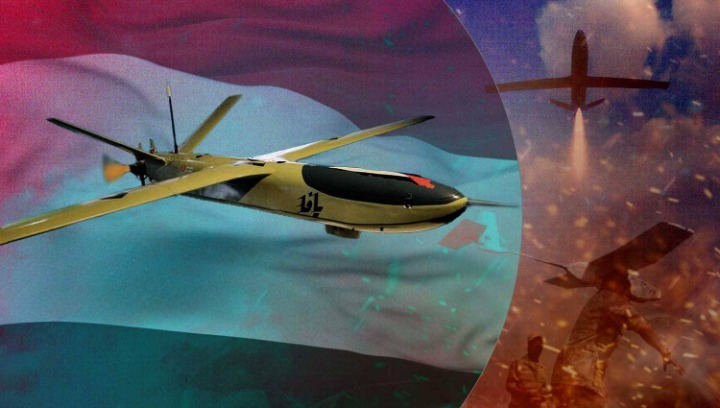
Unmanned Air Force: A Power That Built Deterrence and Terrified the Enemy in Support of Gaza
Unmanned aerial vehicles (UAVs) are no longer merely a limited military support tool. Over recent years, they have evolved into an effective strategic force that has reshaped deterrence equations and imposed Yemen’s direct presence in the battle for Palestine—reaching deep into the Zionist entity itself, in a precedent that has altered the rules of the regional conflict.
Amid a suffocating siege and continuous aggression, the armed forces succeeded in building an integrated unmanned air force system based on domestic manufacturing, mission diversity, and cumulative field experience. This enabled them to break Zionist air superiority, disrupt its defensive systems, and undermine its military and economic security.
From Foundation to Accumulation: An Upward Trajectory Despite the Siege
The first public appearance of Yemen’s unmanned air force dates back to February 26, 2017, when the armed forces launched their initial aerial operations using a Qasef-1 attack drone, alongside three reconnaissance drones—Hudhud-1, Rased, and Raqeeb—after nearly 700 days of aggression and blockade.
That announcement marked a pivotal turning point, revealing Yemen’s shift from a defensive posture to the development of qualitative offensive capabilities despite scarce resources. From that point onward, the unmanned air force embarked on a rapidly accelerating cumulative path, evolving from short-range models into a multi-role deterrence system.
An Integrated System, Not a Single Weapon
Recent military parades highlight that Yemen no longer relies on a single drone model; rather, it possesses a comprehensive aerial system comprising a diverse arsenal that meets the full spectrum of battlefield requirements—from reconnaissance and surveillance to tactical strikes and long-range strategic operations.
This system includes drones such as: Rajoum, Rased, Raqeeb, Mirsad-2, Qasef-2K, Khatif-2, Shehab, Waed-1, Waed-2, Samad-1, Samad-2, Samad-3, and others yet to be revealed. These platforms vary in range and feature high penetration capabilities and precisely effective warheads.
Informational Superiority and Precision Strikes
Reconnaissance drones such as Rased, Raqeeb, and Mirsad-2 served as the “eye before the strike,” contributing to monitoring movements, correcting coordinates, and exposing gaps in air defenses—directly enhancing operational accuracy and success rates.
Tactical drones like Qasef-2K, Khatif-2, Shehab, and Rajoum played a central role in exhausting the enemy by striking military sites and sensitive radar systems, forcing it to expend costly interceptor missiles against low-cost targets—creating a long-term war of attrition.
Numbers That Impose Themselves on the Battlefield
Military data indicate that the unmanned air force has carried out thousands of aerial operations—both reconnaissance and attack—over recent years, including more than 2,400 operations in 2019 alone. Combat effectiveness increased by an estimated 400% compared to the previous year in terms of range, accuracy, and the ability to bypass air defenses.
The “Yafa” Drone: A Moment That Broke Deterrence
At dawn on Friday, July 20, 2024, at the height of calm inside “Tel Aviv,” the armed forces carried out an unprecedented qualitative operation using a drone named “Yafa,” inaugurating the fifth phase of escalation against the Zionist entity.
The drone flew for more than nine hours, penetrated multiple layered defense systems, and struck its target in the heart of “Tel Aviv,” causing an unprecedented shock at both the security and political levels within the entity—an outcome officially acknowledged by the enemy.
The operation exposed the collapse of the illusion of Zionist air superiority and demonstrated the failure of surveillance and early-warning systems. The enemy army spokesperson admitted that “the protection system does not guarantee 100% security,” after previously boasting that “Tel Aviv is completely safe.”
Zionist Admissions: Security and Strategic Failure
Zionist leaders and officials acknowledged the scale of the failure. Opposition leader Yair Lapid stated, “Whoever loses deterrence in the north and south also loses it in the heart of Tel Aviv,” while “National Security” Minister Itamar Ben-Gvir declared that “Israel has lost security and red lines have been crossed.”
Yedioth Ahronoth described the incident as a “serious security breach,” while military analysts considered the targeting of “Tel Aviv” to be the “October 7 of Israeli air defense,” signaling the entity’s entry into a phase in which it is no longer safe from sudden aerial attacks.
From Deterrence to Depth: Samad and Waed
The Waed-1 and Waed-2 drones represent a direct deterrence message, affirming that any escalation will