
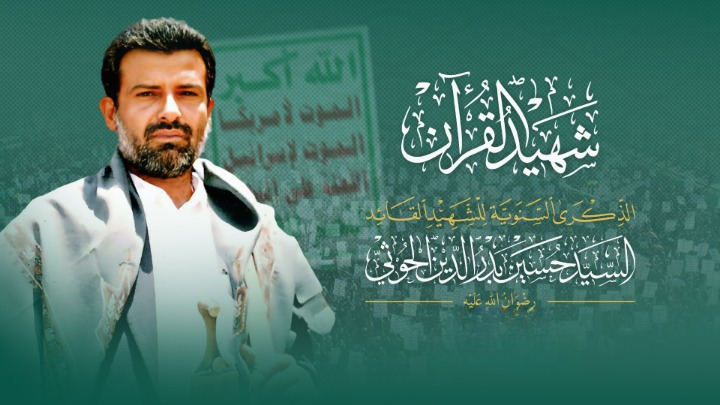
The Martyred Leader: A Project for a Nation and a Cry That Shakes the Thrones of Tyranny
The martyred leader, Sayyid Hussein Badr al-Din al-Houthi—may God be pleased with him—was not merely a scholar or a religious reformer in a turbulent era. He was an integrated project of awareness that restored the Qur’an to its leadership role in shaping positions, diagnosing reality, and anticipating the future.
Guided by the Almighty’s words: “Indeed, this Qur’an guides to that which is most upright” (Qur’an 17:9), he set forth to build a dynamic, action-oriented Qur’anic reading that transcended the limits of time and place. Events unfolded as he foresaw them, conspiracies were exposed exactly as he had warned, and his words became benchmarks by which the credibility of positions is measured—rather than fleeting sermons lost to the passage of time.
The Qur’an: The Compass of History and the Maker of the Future
In the thought of the martyred leader, the Qur’an was not merely a book of recitation and rituals, but a comprehensive life project and an all-encompassing system of guidance—one that connects faith with action, the unseen with reality, and promise with warning in this world before the Hereafter.
From this foundation emerged his profound vision of God’s laws governing nations: that dignity is not a slogan, but the fruit of practical commitment; and that humiliation is not an inevitable fate, but the result of negligence and deviation from the divine path.
With this understanding, he interpreted the verse “Corruption has appeared on land and sea” (Qur’an 30:41) as a civilizational reading, revealing that the political, economic, and moral collapses afflicting the nation are not coincidences, but worldly consequences of abandoning divine guidance—and a Qur’anic warning calling for a sincere return to God.
“Cry Out”: When a Word Became a Historical Equation
On January 17, 2001, the martyred leader launched the cry of dissociation from the enemies of God—not as a protest slogan, but as a strategic transformation in the consciousness of the nation:
God is Great… Death to America… Death to Israel… Curse upon the Jews… Victory to Islam.
That day, he declared with the confidence of a leader who sees what others do not: “Cry out, and you will find others crying out with you.” It was not the prophecy of a poet, but the insight of a leader who understood the laws of history. Today, the cry echoes from Sana’a to Baghdad, from Beirut to Gaza, and from Yemen’s squares to the arenas of the wider nation—affirming that the project of the martyred leader did not remain confined to Marran or to Yemen’s borders, but became an equation of awareness that transcends geography.
Anticipating Conspiracies: When Intentions Were Laid Bare
1. Warning of an American Invasion of Yemen
In February 2002, the martyred leader clearly warned of an American plan to invade Yemen, stressing that occupation never comes without pretexts, but is preceded by media and political preparation that manufactures “justifications” repeated to the people until aggression becomes normalized.
Today, after facts have been revealed and coastlines and islands have turned into arenas of influence, Yemenis realize that his words were not speculation, but a Qur’anic reading of the trajectory of global arrogance.
2. Exposing the Project of Control Without Direct Occupation
He warned of the most dangerous form of occupation: control over decision-making, the creation of rival local tools, and the transformation of the state into chaos. This is precisely what is witnessed today in occupied provinces, where disorder and collapse prevail—contrasted with the model of resilience and sovereignty in Sana’a and the liberated governorates that followed his path of awareness and independence.
3. Warning Against Tampering with Sacred Sites
When he spoke of a project to restrict Hajj and prevent Muslims from performing this obligation, many were astonished. Yet the years proved that global arrogance understands the significance of Hajj more than the complacent do, and that tampering with sacred sites is part of a comprehensive war on the identity of the nation.
4. Reading International Transformations
From the return of the Taliban to Afghanistan after two decades of invasion, to the exposure of false international alliances, the foresight of the martyred leader is evident in his understanding that major powers do not act according to their slogans, but according to their interests—and that whoever lacks an independent project will remain a tool in the projects of others.
Humiliation Is Not Fate—It Is a Result
In his enduring lecture “No One Has an Excuse Before God,” the martyred leader placed the nation before the court of conscience:
that surrender to the enemy is betrayal; silence before domination is submission; and abandoning the responsibility of jihad and dissociation is the shortest path to humiliati