
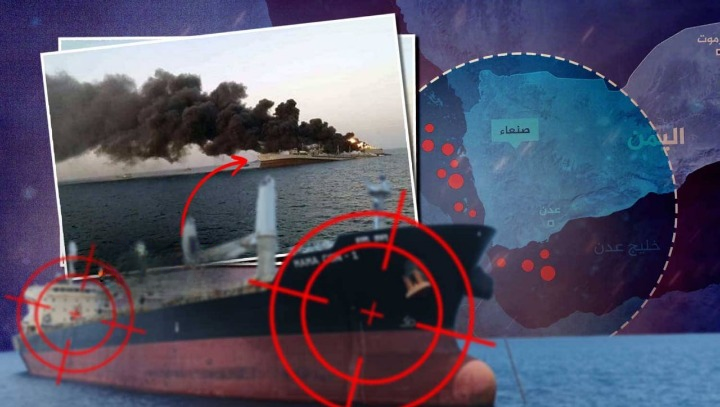
Targeting “Marlin Luanda”.. Yemeni Forces Broadcast Deterrence Messages
Before the announcement of a ceasefire, the operations conducted in support of Gaza demonstrated the Yemeni Armed Forces’ ability to impose maritime and strategic deterrence. One of the most prominent of these operations was the targeting of the British vessel Marlin Luanda, footage of which was broadcast for the first time by military media. The images confirmed that a principled national stance can be transformed into tangible deterrent power, and that Yemen is capable of influencing vital international maritime routes.
Precision in Planning and Target Control
The released footage showed real-time tracking of the British vessel using advanced radar systems, with highly precise identification of the missile launch point. A domestically manufactured “Red Sea” missile was used, developed from the “Sa‘ir” missile—medium-range and operating with dual guidance systems: thermal and radar.
The operation reflected a high level of coordination between the naval forces and the missile force, demonstrating advanced planning, field execution, and precise control of timing and angle of attack to ensure accurate target engagement. These images are not merely operational documentation; they constitute a strategic message to adversaries that maritime corridors are not open to unchecked movement, and that Yemen is capable of imposing deterrence.
Numerical Strength and Operational Diversity
The Leader announced that the Yemeni Armed Forces carried out more than 1,835 diverse operations during the period of support for Gaza, including:
Ballistic, cruise, and hypersonic missiles.
Multiple types of unmanned aerial vehicles (UAVs).
Advanced military boats.
Distribution of Operations by Location
Occupied Jaffa:
74 missiles targeting various areas:
42 hypersonic missiles of the “Palestine-2” type.
4 hypersonic “Palestine-2” missiles with multi-warhead fragmentation.
11 hypersonic missiles of another type.
17 ballistic missiles of the “Dhu al-Fiqar” type.
More than 60 UAVs, including 18 “Jaffa”-type drones.
Umm al-Rashrash (Eilat):
More than 60 ballistic and cruise missiles.
More than 120 diverse UAVs.
Targeted Vessels During Operations:
Total vessels targeted: more than 76 ships:
41 in the Red Sea.
13 in the Gulf of Aden.
5 in the Indian Ocean.
5 in the Mediterranean Sea.
7 vessels in the port of Haifa, in coordination with the Iraqi resistance, including two military-equipment ships.
These figures reflect the continuity of Yemen’s maritime and aerial deterrence capabilities and the impact of operations on international shipping routes prior to the ceasefire announcement.
Significance of Broadcasting the Footage
The footage demonstrates the Armed Forces’ ability to monitor foreign vessels and exert full control over vital maritime corridors. It also highlights enhanced deterrence through advanced operations rooms, digital maps, and precise tracking systems—sending a clear message to all foreign powers: any movement in the region will be met with a firm and calculated response.
These operations confirm that military media has become a strategic tool that reflects the strength of the Armed Forces and reinforces deterrence while safeguarding national sovereignty.
Strategic and Political Impact: Strength in Principle
The operation and its footage carry a dual impact:
Proving the ability to accurately target maritime assets and undermine the assumed security of foreign fleets in vital corridors.
Sending a clear message that Yemen controls key maritime routes and that any violation of decisions will face a firm, practical response.
Demonstrating that a national stance and sovereignty can be transformed into real deterrent power, even against major powers.
When Principle Becomes a Weapon: Dignity and Deterrence Above All
The operations were not merely military strikes measured by numbers or material results; they carried symbolic and political messages in support of Palestine prior to the ceasefire. The national stance became an effective weapon that enforces respect for sovereignty and reflects Yemen’s ability to protect its interests and vital passages.
In this context, the Leader’s declaration that “the Red Sea is a red line for Zionist ships and those heading to the entity” practically affirmed that sovereignty is not a slogan, but a reality enforced on land and sea—where any movement outside the bounds of national decision will face a firm and calculated response.
The operations, official figures, and released footage confirm that principled positions and national dignity can have a deeper and more sustainable impact than conventional force alone. National will is no longer mere rhetoric; it has become real strategic deterrence that imposes its calculations on the adversary and proves that Yemen can