
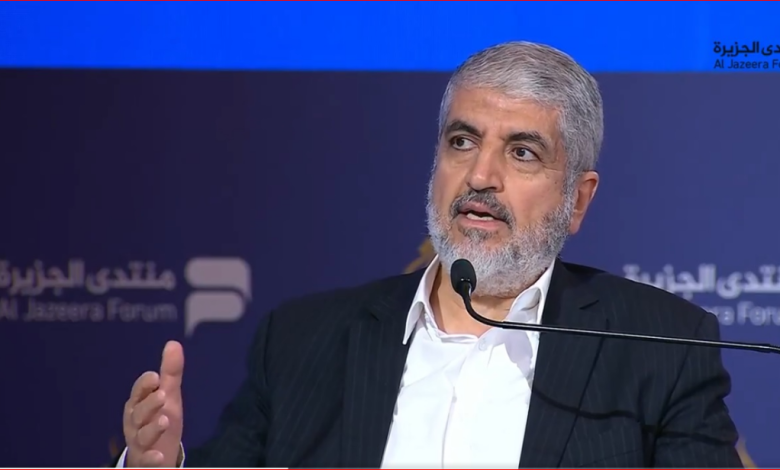
Mashaal: We Will Not Give Up Our Weapons and Will Not Accept Foreign Rule in Gaza
Khaled Mashaal, head of Hamas’s political bureau abroad, stated on Sunday that the movement will not relinquish its weapons and will not accept “foreign rule” in the Gaza Strip. This statement coincided with the start of the second phase of the US plan, which includes provisions related to disarmament and governance arrangements in the Strip.
Mashaal’s remarks came during his participation in the 17th Doha Forum, where he said, “We should not accept the criminalization of resistance, the weapons of resistance, and those who engage in resistance.”
He added, “As long as there is occupation, there will be resistance. Resistance is a right of peoples under occupation; it is part of international law, divine law, and the collective memory of nations, and they take pride in it.”
The ceasefire agreement between Hamas and the Zionist entity came into effect on October 10th, following a devastating two-year war, based on a US plan endorsed by a subsequent UN Security Council resolution.
Mashaal called on the “Peace Council” to adopt a “balanced approach” that would allow for the reconstruction of Gaza and the flow of aid to its approximately 2.2 million residents, while simultaneously warning that the movement “will not accept foreign rule” over Palestinian territory.
He said, “We adhere to our national principles and reject the logic of trusteeship, foreign intervention, and a renewed mandate.” He added, “The Palestinians govern the Palestinians. Gaza is for the people of Gaza, and Palestine is for the people of Palestine. We will not accept foreign rule.”
Mashaal indicated that the responsibility for managing the next phase rests with “the leadership of the Palestinian people in all its active forces,” and not solely with Hamas.
He reiterated the movement’s commitment to its weapons, emphasizing that the mediators understood Hamas’s position on this matter, and stressing that the real danger comes from the usurping Zionist entity, not from the Gaza Strip.
He said, “Hamas’s vision regarding weapons was understood by the mediators,” referring to Egypt, Qatar, and Turkey, which played a mediating role in the negotiations.
He added that the second phase of the agreement, announced in mid-January, includes a clause concerning the disarmament of Palestinian factions, which Hamas rejects, proposing alternatives such as “storing or freezing weapons.”
Mashaal continued: “Aside from Zionist pressure and blackmail, we can reach approaches under the umbrella of ‘guarantees.’ The danger comes from Israel, not from Gaza. Gaza needs a long time to recover.”
He pointed out that the Zionist entity is demanding disarmament before beginning the reconstruction of the Gaza Strip, despite the widespread destruction caused by the war, considering this a violation of the ceasefire agreement.
Regarding the concept of guarantees, he said: “The presence of international forces on the borders (of the Gaza Strip) to maintain peace is a guarantee. Hamas also offered a truce of 5 to 10 years, and this is a guarantee. Weapons (during the truce) will not be used or displayed, and mediators can provide a guarantee.”
Mashaal asserted that the problem does not lie with Hamas and the resistance forces in Gaza, but rather with the Zionist entity, which seeks to seize Palestinian weapons and place them in the hands of militias to create chaos.
He added, “There is a strange paradox: the Palestinian people, who defend themselves with their weapons, are brazenly and shamelessly targeted for disarmament, while the weapons of proxy militias are legitimized.”
He pointed to what he described as attempts to create internal chaos in the Gaza Strip, asserting that relying on such tactics “will not succeed” against the Palestinian people and the resistance forces.
Mashaal reiterated that resistance remains a right of peoples under Zionist occupation and is enshrined in international law and divine law.
He stated, “In the Palestinian cause, there are constants and variables. The constant is that as long as there is occupation, there will be resistance. The variables are the forms of resistance, from revolution to intifada to armed resistance and others.”
He considered “talking about disarmament” while the Zionist enemy continues its occupation to be “an attempt to make the Palestinian people victims, making them easier to eliminate and exterminate.”
Mashaal believes that one of the reasons for the cessation of the genocide in Gaza is the transformation of the Zionist enemy into a “moral, political, and economic burden,” and the shift of public outrage to the international arena.
He called upon the Arab and Islamic nations to pursue the Zionist entity politically and legally, and to work towards “deepening global engagement with the Palestinian cause.”
The Zionist enemy continues to violate the ceasefire agreement daily, resulting in the martyrdom of 576 Palestinians and the injury of 1,543 others, most of whom are children and women. This occurs alongside the prevention of the entry of agreed-upon quantities of humanitarian aid into the Gaza Strip, where approximately 2.4 million Palestinians are living in catastrophic humanitarian conditions.
Since October 7, 2023, the Zionist enemy army, with American and European support, has committed genocide in the Gaza Strip, resulting in more than 243,000 Palestinian casualties, including martyrs and wounded, the majority of whom are children and women. In addition, more than 11,000 people are missing, hundreds of thousands have been displaced, and widespread destruction has affected most areas of the Strip.