
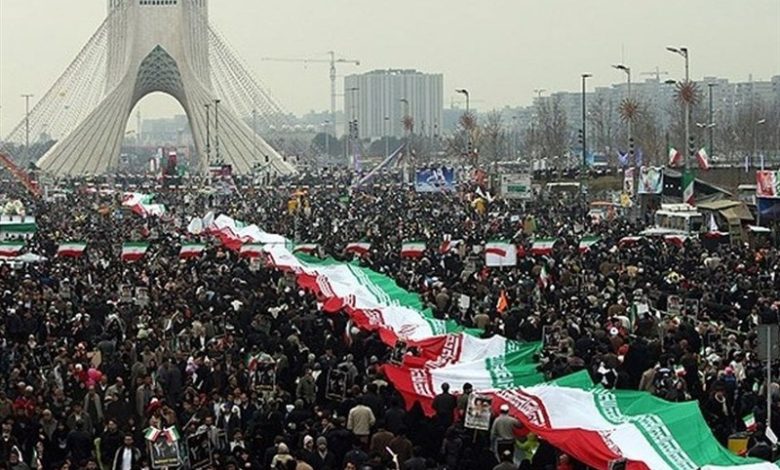
On the anniversary of the revolution, Iran fills the squares and reaffirms its sovereignty.
In a scene that transcended mere celebration, conveying a profound political and strategic message, millions of Iranians took to the streets and squares to commemorate the 47th anniversary of the victory of the Islamic Revolution. They transformed the 22nd of Bahman (February 11th) into a renewed popular referendum on the choice of independence, and a resounding message of strength against the United States, the Zionist enemy, and all instruments of pressure and siege.
Massive marches swept through Tehran and more than 1,400 cities, towns, and villages, creating a unified national tableau that affirmed the revolution’s continued presence in the people’s consciousness and demonstrated that the attempt to weaken the home front had once again been thwarted by the masses.
A scene of millions: The people at the heart of the battle.
From the early hours of the morning, crowds poured into the main streets of the capital, Tehran, and other provinces, waving Iranian flags and portraits of the revolution’s leaders, chanting slogans of independence and rejecting American hegemony and Zionist aggression. A massive, organized, and cohesive public demonstration defied the weather conditions, reaffirming that the revolutionary spirit remains vibrant and that the Iranian people are present at every pivotal moment to defend their gains and sovereign choices.
This momentum was not spontaneous or merely for show, but rather carried the hallmarks of a comprehensive mobilization, reflecting a political and popular readiness for a period characterized by escalating threats and pressures, especially in light of the indirect negotiations with the United States and the ongoing Zionist provocations.
1. Aerial footage of millions gathered to commemorate the anniversary of the victory of the Islamic Revolution
Leadership in the Field: Unity and Messages for Domestic and International Audiences
The participation of Iranian President Masoud Pezeshkian in the central march in Tehran, alongside senior leaders and officials, reflected a unified national front and reinforced the bond between the leadership and the people.
In his speech, Pezeshkian emphasized that the people had come out to defend their country and their revolution, stressing that the revolution was launched to achieve justice and independence, and that the United States and European countries had failed for decades to break Iran’s will.
The Iranian president delivered clear messages:
No yielding to pressure and no compromise on sovereignty.
Readiness to negotiate within the framework of international law without accepting unjust demands.
Internal unity is the first line of defense against conspiracies.
He also stressed that the government considers the people’s livelihood a red line, emphasizing its commitment to addressing internal challenges and offering a sincere apology for shortcomings, in a speech reflecting an understanding of the sensitivity of the current phase and the need to bolster public trust.
1. Iranian President Masoud Pezeshkian participates in the anniversary march of the Islamic Revolution in Tehran.
Negotiating from a position of strength… No compromise on defense capabilities.
Alongside the popular demonstrations, decisive political and diplomatic stances emerged.
Foreign Minister Abbas Araqchi affirmed that Iranian missiles are not and will not be subject to negotiation, emphasizing that the broad public support is the most important factor strengthening Iran’s position at the negotiating table.
Araghchi explained that Iran is working on a proposal that guarantees its right to peaceful nuclear energy without possessing nuclear weapons, and is prepared to offer verifiable guarantees, provided there is good faith. He simultaneously emphasized Iran’s distrust of the United States and its complete readiness to defend the country should the diplomatic track fail.
Deterrence Messages: Any Aggression Will Be the Beginning of Open War
At the height of the situation, statements by the Secretary of Iran’s Defense Council, Ali Shamkhani, drew clear red lines. He affirmed that any targeting of Iran, even a limited one, would be considered the beginning of war, and that Tehran would not be bound by any limits in its response.
Shamkhani stressed that the era of limited strikes is over, and that any American or Zionist adventure will open the doors to a broad confrontation, the consequences of which will be borne by the aggressors—a direct and decisive message of deterrence.
The Field Reinforces Deterrence: From Missiles to Willpower
The public turnout, which included the display of Fateh-110, Haj Qassem, and Fateh missiles, and the unveiling of the wreckage of Israeli drones shot down during recent confrontations, served as a practical affirmation that Iranian deterrence is not mere rhetoric, but a reality based on readiness and capability.
Brigadier General Ahmad Vahidi described this conscious public presence as the greatest achievement in 47 years since the revolution, and a warning message to the enemies to reconsider their calculations, emphasizing that the Iranian people are the architects of the future and the guardians of sovereignty.
1. Iran displays Fateh-110, Haj Qassem, and Fateh missiles in Azadi Square, Tehran
2. Iran unveils and displays the wreckage of Israeli drones shot down in the 12-day war in Azadi Square, Tehran
Summary of the Scene: A Continuing Revolution and an Unbreakable People
What Iran witnessed on the anniversary of its revolution’s victory was not a fleeting celebration, but a resounding political and popular declaration that:
The revolution continues.
Sovereignty is non-negotiable.
Deterrence relies on the people, not weapons.
Any attempt to sow discord within is doomed to failure.
This is Iran’s message to the world: We negotiate from a position of strength, we respond from a position of sovereignty, and we resolve matters with the will of an invincible people.