
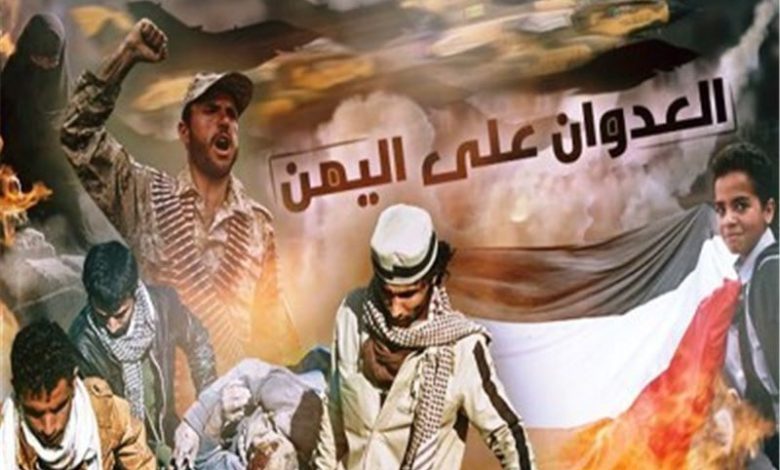
February 14th: A Bloody Day in the Record of Aggression Against Yemen
In the Yemeni memory, February 14th is not just another day. It returns each year laden with damning evidence of documented war crimes committed by the American-Saudi-Emirati aggression against civilians. This recurring scene reveals the nature of a war that has systematically targeted the Yemeni people and the foundations of their lives throughout the years of aggression.
2016: Massacres and Direct Targeting of Civilians
February 14, 2016, marked one of the bloodiest days. A sewing and embroidery workshop in the Shu’ub district of the capital, Sana’a, was targeted, resulting in the martyrdom of 11 citizens and the injury of four others. The workshop was destroyed, and the adjacent Hotel Institute and dozens of homes sustained severe damage.
In Al Mahwit Governorate, airstrikes committed another massacre in the city of Kawkaban, resulting in the martyrdom of five citizens and the injury of ten others. More than twenty homes were destroyed, and historical and archaeological landmarks were severely damaged, in a clear targeting of Yemeni cultural identity. The crimes continued in Taiz, Saada, Marib, Ibb, and Sana’a, with airstrikes targeting homes, mosques, schools, water projects, farms, and civilian infrastructure. This confirms that the targeting was not limited to military operations but encompassed all aspects of life.
2017: Expansion of Bombing and Use of Prohibited Weapons
On February 14, 2017, the aggression’s warplanes expanded the scope of their crimes, targeting the governorates of Hodeidah, Marib, Hajjah, and Taiz. A cluster bomb was also dropped on Jabal al-Doud in Jizan, in flagrant violation of international laws prohibiting this type of weapon.
2018: Women and Children in the Line of Fire
This day in 2018 witnessed a dangerous escalation, with two women and two children, one of them an infant, killed in an airstrike targeting a house in the Sarwah district of Ma’rib. Other massacres were also recorded in Taiz and Hodeidah, including the targeting of a civilian gas station in Al-Jarahi, which resulted in the deaths of two women and the destruction of the station.
2019: Intense Bombing and Targeting of Residential Areas
On February 14, 2019, warplanes launched 15 airstrikes on the Al-Qafleh district of Amran Governorate, while residential neighborhoods and farms in Hodeidah were subjected to heavy artillery shelling, in addition to widespread Saudi missile strikes on the border districts of Sa’dah.
2020: A Fierce War of Attrition
The crimes continued in 2020 with intense airstrikes on Nihm, Majzar, and Al-Ghayl, alongside heavy artillery and missile shelling of residential neighborhoods in Hodeidah, including densely populated areas, causing widespread damage to homes and property.
2021–2022: Border Fire and Aerial Reconnaissance
During these two years, Saudi border shelling emerged as one of the most prominent forms of aggression, resulting in martyrs and wounded in Saada, in addition to intensive reconnaissance raids and direct targeting of civilian institutions, most notably the Ministry of Communications in Sana’a in 2022.
2023: The Remnants of Aggression Claim Lives
On February 14, 2023, the crimes continued in another form, as a young man was killed and two others, including a child, were injured by an explosion of remnants of aggression in the city of Al-Durayhimi, confirming that the effects of war continue to kill even in the absence of airstrikes.
A Documented War of Extermination
February 14th encapsulates the full scope of the aggression: airstrikes, artillery shelling, prohibited weapons, targeting of civilians, and the systematic destruction of infrastructure.
It is a day that renews condemnation, exposes the falsehood of the aggressor states’ humanitarian claims, and proves that what has happened and is happening in Yemen is a documented war of extermination that will not be forgotten.
Send feedback