
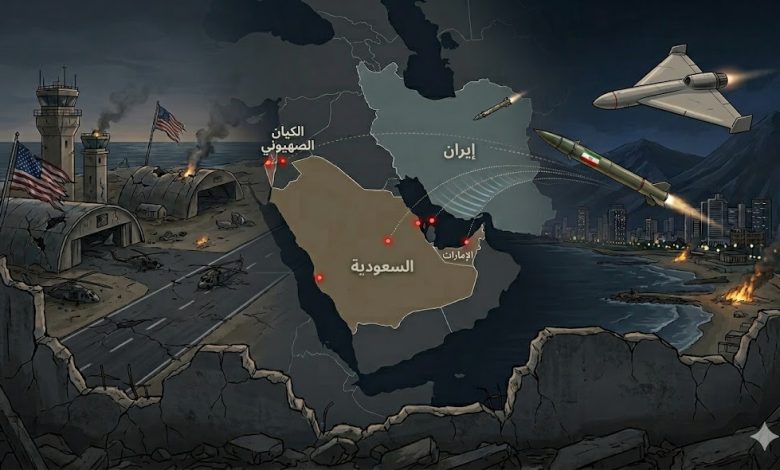
Paralyzed US bases in the Gulf after the Iranian response: The final nail in the coffin of “Greater Israel” and the “New Middle East”
The talk of the “devastating Iranian response” is no longer merely a description of a limited military operation in terms of time and scope. It is a formal declaration of the “clinical death” of the era of unilateral hegemony that the United States has imposed on the West Asia region for decades. This response, with its intense firepower, technological advancements, and strategic planning, has created an “existential breach” in the wall of American and Zionist national security, transforming the military bases that once terrorized the region into political and military “scrap” incapable of even protecting themselves. This confrontation has put a definitive end to the arrogance of power and proven that the balance of deterrence is no longer measured by the size of military budgets, but rather by the will to fight and the ability to reach strategic and sensitive targets deep within areas of colonial influence. This has led to the dismantling of the “New Middle East” that Washington engineered in its back rooms, replacing it with a reality imposed by the missiles and drones of the resistance.
The added value of this historic achievement lies in its being a precise “surgical operation” that excised the illusion of “Western technological superiority” and revealed that alliances built on the basis of “protection in exchange for subservience” are fragile alliances that collapse at the first real test. Today, we are facing a new international and regional landscape in which there is no place for Zionist expansionist projects. Iran, along with the axis of resistance, has moved from a position of “defending its existence” to one of “drawing borders” and imposing new equations that make any future aggression a reckless adventure with unpredictable consequences that could lead to the demise of entire entities. This report delves into the depths of this transformation, based on the realities on the ground and the repercussions of the political situation, to demonstrate that the situation before the Iranian response is not the same as after it, and that the features of the “new regional order” have begun to take clear shape from Tehran to Sana’a.
“Strategic Stupefaction”… America’s Bases Out of Service
The realities of the earth-shattering Iranian response have proven that the American military bases scattered throughout the Gulf region, which were designed to be “spearheads” in any regional confrontation, have become centers of incapacity and functional paralysis. Before the missiles even began exploding on their targets, the cyber infrastructure of these bases had already suffered its first blow. Tehran implemented a complete “blindout” of American radar systems, paralyzing joint operations rooms. US Central Command (CENTCOM) at Al Udeid Air Base in Qatar found itself facing blank screens, unable to track the complex trajectories of the drones and missiles. This represented the pinnacle of intelligence and technological failure at the heart of the American presence in the region.
In the UAE, Al Dhafra Air Base suffered significant damage to its vital infrastructure. The Iranian response precisely targeted the runways for F-35 fighter jets and smart munitions storage facilities. Disabling Al Dhafra was not merely a material loss; it shattered the concept of “air superiority” that Washington so proudly proclaims. Leaked footage and intelligence reports revealed that the multi-billion-dollar Patriot and THAAD air defense systems were rendered ineffective by swarms of relatively inexpensive Iranian drones. This highlights the “cost-effectiveness” equation: while an American interceptor missile costs millions of dollars, an Iranian drone costs only a few thousand. This means that the US military infrastructure is suffering from severe financial strain, making its continued presence in the region economic suicide before it is a military defeat.
In Saudi Arabia, Prince Sultan Air Base also suffered from this strategic paralysis. Long-range radars were neutralized and launch platforms disabled, effectively removing Saudi Arabia from the equation of “defending Israel.” Similarly, Ali Al Salem Air Base in Kuwait and the Fifth Fleet headquarters in Bahrain bore witness to American impotence. The Iranian response imposed an invisible “fire blockade,” forcing US naval vessels to withdraw to a considerable distance for fear of total destruction. The specific mention of these bases (Al-Udeid, Al-Dhafra, Prince Sultan, Ali Al-Salem, and the Fifth Fleet headquarters) documents the collapse of the “backbone” of the American project and proves that these bases have been transformed from a “deterrent force” into exposed and vulnerable “targets” lacking even the most basic means of self-defense.
The failure has moved from the technical to the operational level. Disabling these bases effectively means Washington has lost its ability to control international energy and shipping lanes through military force. The infrastructure that Washington invested in for half a century to serve as a bulwark against the will of the people crumbled overnight before the Iranian military ingenuity, which successfully integrated electronic warfare with kinetic strikes, leaving American forces in a state of “strategic shock.” This paralysis represents the actual beginning of a “forced” US withdrawal from the region, now that the cost of maintaining and securing these bases has exceeded the capacity of the depleted American budget.
The Normalization Alliance Cracks: Masks Fall and the Fragility of “Imported Security” is Revealed
The strong Iranian response exposed deep and structural cracks in the wall of the “American-Zionist-Saudi-Emirati” alliance. The “joint defense” hypothesis, which Washington had been promoting to the normalizing states as an alternative to national sovereignty, collapsed. Riyadh and Abu Dhabi found themselves facing a shocking reality: the United States, which failed to protect its “giant” base in Al Udeid, is even less capable of providing a security umbrella for the palaces of Riyadh or the skyscrapers of Dubai. This crack was not merely a difference in political visions, but a “functional collapse” of the protection mission. The states that had become beholden to foreign powers discovered that they had been transformed into “battlefields” without any means of defense, prompting the ruling elites in these countries to…