
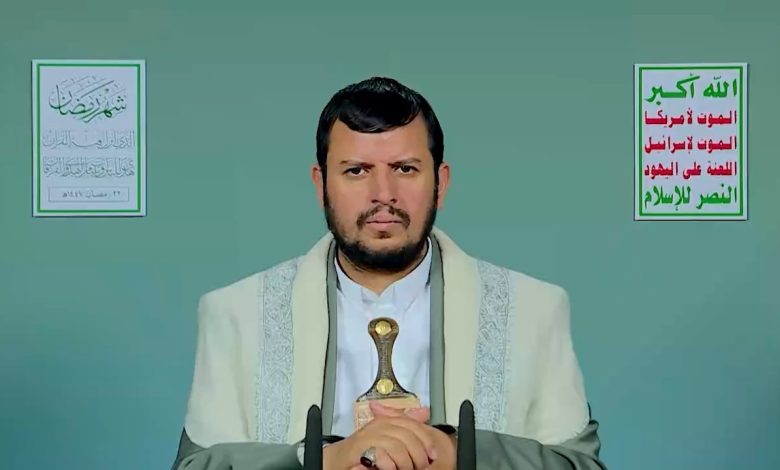
The Twenty-Second Ramadan Lecture by Sayyid Abdul-Malik Badr al-Din al-Houthi
I seek refuge in God from the accursed Satan.
In the name of God, the Most Gracious, the Most Merciful.
All praise is due to God, Lord of the Worlds. I bear witness that there is no god but God, the King, the Truth, the Manifest. And I bear witness that our master Muhammad is His servant and messenger, the Seal of the Prophets.
O Allah, send blessings upon Muhammad and the family of Muhammad, and bestow Your grace upon Muhammad and the family of Muhammad, as You sent blessings and bestowed Your grace upon Abraham and the family of Abraham. Indeed, You are Praiseworthy and Glorious. And, O Allah, be pleased with his chosen and virtuous companions, and with all Your righteous and striving servants.
O Allah, be pleased with Muhammad and the family of Muhammad, and with all Your righteous and striving servants. O Allah, guide us and accept from us, for You are the All-Hearing, the All-Knowing. And accept our repentance, for You are the Oft-Returning, the Most Merciful.
O brothers and sisters:
Peace, mercy, and blessings of Allah be upon you.
In yesterday’s lecture, we discussed, in light of the blessed verses in the story of the Prophet Moses (peace be upon him), the following blessed verses:
In Surah Ta-Ha.
In Surah An-Naml.
In Surah Al-Qasas.
In the context of the discussion in light of the Almighty’s words: {Then when he came to it, he was called, “O Moses, (11) Indeed, I am your Lord, so take off your sandals. Indeed, you are in the sacred valley of Tuwa.”} [Ta-Ha: 11-12], as well as in light of the blessed verses: {The right valley in the blessed spot.} [Al-Qasas: 30], {Blessed is He who is in the fire and those around it.} [An-Naml: 8], we spoke about the sanctity of holy places, in relation to Islamic landmarks and Islamic monuments, and the importance of this Qur’anic religious concept; because it is targeted by the enemies of Islam; Because one of their main objectives is targeting Islamic holy sites and landmarks, which they seek to obliterate:
Due to their religious significance.
Due to their emotional and spiritual impact.
Due to their value in matters of faith.
The enemies understand their importance as sacred rituals and landmarks with a religious character, to which people are emotionally connected, and with which they are linked in matters of worship, closeness to God Almighty, devotion to Him, and obedience to Him, and which strengthen the bonds of faith among them.
And for humankind, as creatures on this earth, God has ordained rituals and landmarks as an essential part of worshiping Him. For example:
Regarding the Holy Kaaba, which God has honored and which is at the forefront of sacred sites, we find, for instance, that God has linked the direction of prayer (Qibla) to it, as well as the Hajj and Umrah pilgrimages, circumambulating it, and all acts of worship performed around it. There is great merit in praying there, the reward, and the immense closeness to God through prayer, worship, supplication, good deeds, and the acceptance of prayers… and much more.
Then we find—for example—in the rest of the Islamic landmarks of Hajj, for both Hajj and Umrah: some of which are shared by both, and some that are specific to Hajj. Most of these are physical landmarks, meaning places, spots, for example: Safa, Marwa, and the Station of Abraham (Maqam Ibrahim). It is well known what the Station of Abraham (peace be upon him) is—the rock upon which his footprints are imprinted. Likewise, there are other physical landmarks that pilgrims visit as part of the Hajj rituals: standing at Arafat, spending the night at Muzdalifah, going to Mina, and so on. This is regarding Hajj—for example—and Umrah.
There are other Islamic landmarks: As we discussed the Al-Aqsa Mosque, its importance, its blessings, and its great significance among Islamic landmarks, there is also the Prophet’s Mosque (peace and blessings be upon him and his family), and his great and sacred shrine in Medina. And how numerous are the Islamic landmarks and monuments of religious importance throughout the Muslim world!
We find in the blessed verses how this concept is inherent in divine messages throughout time, and throughout the depths of history. This is evident in the story of the Prophet Abraham (peace be upon him) and Ishmael (peace be upon him), and in the story of the Prophet Moses (peace be upon him). We find it expressed as “sacred things,” such as the description of the sacred valley as blessed, and the blessed places, as we find, for example, in the expression of a blessed spot. We also find the word “veneration” in what is mentioned, for example, in Surah Al-Hajj: {And whoever venerates the symbols of Allah – indeed, it is from the piety of the hearts} [Al-Hajj: 32]. However, the word “veneration” is considered by those who accuse others of disbelief to be polytheism when applied to anything other than God. They say that using the word “veneration” for anything other than God is polytheism, a departure from the true path. The term “religion” (or “nation”) refers to those who use or act upon this expression, and as we explained, this issue is driven by Jewish engineering, a scheme and plan spearheaded by Britain, and later actively pursued by Zionist forces.
Islamic landmarks, places, and holy sites:
They hold immense importance due to their association with closeness to God and the sanctity bestowed upon them by God, as we mentioned regarding the Holy Kaaba, the Station of Abraham, Safa and Marwa, and others. This is just one example among many Islamic landmarks, not an exhaustive list.
It holds significance in fostering an emotional connection even to our past, to the past in terms of its landmarks, in terms of the journey of religion—a great journey extending across time, since the beginning of human existence with Adam, who was a prophet of God, peace be upon him. The connection made through these places is a connection to landmarks, figures, messengers, prophets, and guides from among God’s servants. The emotional impact of this is undeniable; a person is affected in their feelings, in their conscience, when they visit them.